
News
Papers, awards, talks, grants and stories from the group, newest first. Use the buttons to show one kind of news, or search by keyword.
2026
-
Paper
A ferrocene-functionalized framework that exceeds the ultimate hydrogen-storage targets
Marcus Djokic designed a covalent organic framework with ferrocene binding sites that, in multiscale simulations, stores 18 wt% and 72.6 g/L of hydrogen at room temperature and 700 bar, beyond the U.S. Department of Energy ultimate targets. npj Energy Materials; provisional patent filed.
-
Talk
Invited seminar at Central Michigan University
From next-generation AI-powered force fields to automated discovery and heavy-element chemistry: an overview of the group's newest methods.
-
Paper
How sodium reshapes layered birnessite
With Tec de Monterrey, we show from first principles how inserting sodium changes the structure and electronic states of layered potassium birnessite, a candidate electrode and catalyst. The Journal of Chemical Physics 165, 084703.
-
Grant
NSF funds our study of synthetic mimics of the oxygen-evolving complex
A collaborative NSF Chemistry award with Michael Zdilla (Temple University) will use theory and synthesis to understand how heterocubane clusters, topological mimics of the water-oxidizing center of Photosystem II, release oxygen. Award CHE-2555662, 2026 to 2029.
-
Talk
Invited talk at Los Alamos National Laboratory
Fantastic simulations and where to find them: next-generation AI-powered force fields, automated discovery and the secrets of heavy elements.
-
Milestone
Congratulations, Dr. Maldonado-Lopez and Dr. Rodriguez
Daniel Maldonado-Lopez (2D materials, ammonia production and porous materials) and Austin Rodriguez (machine-learned interatomic potentials for reactions) completed their Ph.D. degrees in Chemical Engineering and Materials Science.
-
Group
Undergraduate research at MidSURE and SROP 2026
Rohan Yarlagadda presented automated convex-hull stability screening for our SALSA discovery pipeline, and Fernando Velasquez presented quantum circuits for solving the Dirac equation in periodic systems at the Mid-Michigan Symposium for Undergraduate Research Experiences and the MSU Summer Research Opportunities Program.
-
Award
Best Oral Presentation Award for CheMLFlow
Susana Lopez-Moreno received the Best Oral Presentation Award (Silver) at the 1st Humanoid Olfactory Display International Research Conference in Busan, Korea, for CheMLFlow, our open platform for cheminformatics and materials informatics. She also received a 2026 Industrial Mathematics research grant from Pusan National University.
-
Talk
Projected Hessian Learning at CECAM and MLCM-26
Austin Rodriguez presented Projected Hessian Learning, our scalable way to train machine-learned potentials with curvature information, at the CECAM Flagship Workshop on physics-aware machine learning (New York City) and at MLCM-26 (Santa Fe).
-
Media
Fighting bacteria without antibiotics
MSU Engineering, MSUToday and WILX News 10 featured our work with Yu Lei, Mauricio Terrones and colleagues on copper single atoms anchored on two-dimensional boron nitride, which use sunlight to kill bacteria without antibiotics. Published in ACS Nano.
-
Award
A season of fellowships and awards
Congratulations to Brandon Lewis (TEAM-UP Together Undergraduate Research Fellowship, College of Natural Science Undergraduate Research Scholarship and Parker Scholarship), Daniel Maldonado-Lopez (second place, 2025–26 Fitch H. Beach Award of the College of Engineering), Ismail Buliyaminu (College of Natural Science Dissertation Completion Fellowship), Marcus Djokic (Dissertation Completion Fellowship and Graduate Office Fellowship) and Austin Rodriguez (Graduate Office Fellowship and two travel fellowships).
-
Talk
Keynote at ACS Spring 2026
Prof. Mendoza-Cortés gave a keynote in the symposium This Would Change Everything at ACS Spring 2026 in Atlanta: Angle as a reagent: programmable twistronics for obedient 2D heterostructures.
-
Paper
Polymorphism in YbCuBi maps transport and elastic properties
With Alex Zevalkink's group and colleagues at Oak Ridge National Laboratory, we use two polymorphs of YbCuBi to separate how structure controls heat and charge transport. Chemistry of Materials.
-
Paper
Projected Hessian Learning, with Los Alamos
Austin Rodriguez, with Nicholas Lubbers, Kipton Barros and colleagues at Los Alamos and NVIDIA, shows how to supervise machine-learned potentials with curvature (Hessian-vector products) at roughly the cost of training on forces. Machine Learning: Science and Technology.
-
Teaching
Quantum Computing Live Book released
Our open-access, executable textbook on quantum computing, written with undergraduate Fernando Velasquez and alumni William Comaskey and Eric Dolores-Cuenca.
2025
-
Paper
Copper single atoms on boron nitride against bacteria
With Yu Lei, Mauricio Terrones and colleagues, Daniel Maldonado-Lopez explains with density-functional theory why copper atoms anchored at defects of boron nitride make a safe, sunlight-activated antibacterial material. ACS Nano.
-
Paper
Two-dimensional metal halides, on the cover of PCCP
Yu-Hsiu Lin and Daniel Maldonado-Lopez map band gaps, magnetism and catalytic descriptors of 2D MX and MX2 metal halides. Part of the PCCP 2025 Emerging Investigators collection and featured on the front cover of issue 6 (2026).
-
Milestone
Listed in the 2025 Nobel Prize lecture in chemistry
Prof. Omar Yaghi's Nobel lecture, Metal-organic frameworks: from molecules to society, lists José Mendoza-Cortés among the group's former visiting students (slide 49). As a student in the Yaghi lab he co-authored the first three-dimensional covalent organic frameworks and a widely used review of the building units of metal-organic frameworks.
Nobel lecture (video and slides)Slides (PDF)Publication details
-
Media
On TV: wiggling atoms may lead to smaller, more efficient electronics
WILX News 10 covered our joint work with Tyler Cocker's lab on terahertz control of surface topology.
-
Paper
Alternating layers make better oxygen-evolution catalysts
With Michael Zdilla's group at Temple University, we show that stacking cobalt and nickel oxide sheets in alternating order lowers the overpotential for oxygen evolution far more than mixing the metals. ACS Catalysis.
-
Award
Royal Society of Chemistry Emerging Investigator, again
Prof. Mendoza-Cortés was named one of the PCCP 2025 Emerging Investigators; he was first recognized in the Royal Society of Chemistry's Emerging Investigators collections in 2018.
-
Milestone
Metal-organic frameworks win the 2025 Nobel Prize in Chemistry
The prize, shared by Susumu Kitagawa, Richard Robson and Omar Yaghi, recognizes the development of metal-organic frameworks. Our 2009 Chemical Society Reviews article with Michael O'Keeffe and Omar Yaghi, which catalogued the secondary building units used to design these materials, is a widely used reference in the field.
-
Talk
CM-AMO seminar at the University of Michigan
One century of quantum science and the future: next-generation quantum materials, ultrafast physics, moiré lattice design and beyond the Standard Model.
-
Paper
Grain size and quantum coherence in halide-perovskite films, on the cover
With MSU physicists and engineers, we find that the low-temperature phase coherence of charge carriers in CsSnI3 films depends on crystal structure and strain rather than grain size. Advanced Materials Interfaces, cover article.
-
Award
Another strong year of group awards
Austin Rodriguez received a Dissertation Completion Fellowship, the Software for Chemistry & Materials Poster Award and the Rising Star and Best Poster Abstract Award at the MLCM-25 conference at Los Alamos. Yu-Hsiu Lin received the College of Engineering's Outstanding Graduate Student Award in Materials Science and Engineering. Daniel Maldonado-Lopez received the ACS Bridge Program travel award and a Graduate School and College of Engineering travel grant for ACS Spring 2025.
-
Paper
Nature Photonics: terahertz fields reshape a surface, seen atom by atom
With Tyler Cocker's lab, we show that terahertz light can switch the topology of a surface and that the change can be imaged with subatomic resolution. Ph.D. students Daniel Maldonado-Lopez and Ismail Buliyaminu performed the calculations.
-
Milestone
Dr. Yu-Hsiu Lin joins TSMC
Yu-Hsiu Lin defended his Ph.D. on batteries beyond lithium and on 2D and 1D materials, and joined TSMC as an R&D engineer.
-
Group
Summer researchers present at MidSURE and PAREDS
Gabriel Martinez (NSF REU Site in semiconductor materials) presented convex-hull stability analysis for sustainable energy materials, and Brandon Lewis (Physics and Astronomy Research Experiences for Drew Scholars) presented electronic-structure discovery in carbon allotropes.
-
Paper
Does Hessian data improve machine-learning potentials? With NVIDIA
Austin Rodriguez and Justin Smith (NVIDIA) show that training on second derivatives of the energy improves the accuracy and robustness of machine-learned interatomic potentials. Journal of Chemical Theory and Computation.
-
Talk
Two talks at the BASF Student Research Forum
Daniel Maldonado-Lopez spoke on false positives in nitrogen photofixation and Marcus Djokic on screening earth-abundant semiconductors for artificial photosynthesis.
-
Talk
Group talks at the APS Global Physics Summit and ACS Spring 2025
Daniel Maldonado-Lopez presented picometer-scale imaging of a terahertz-driven topological phase transition (Anaheim) and our study of nitrogen-containing ligands in N2 photofixation (San Diego). Prof. Mendoza-Cortés gave the MSU Chemistry Colloquium, Fantastic simulations and where to find them.
-
Paper
Designing twistronics: how twisting and stacking tune 2D bilayers
Yu-Hsiu Lin and William Comaskey show how twist angle and stacking control electronic transitions in transition-metal dichalcogenide bilayers and heterostructures. Nanoscale Advances.
-
Teaching
Machine Learning and Quantum Computing Guide for Humans
Our open textbook with executable notebooks for students outside computer science, used in courses at MSU and FSU.
2024
-
Talk
Order theory meets convolutional networks at NeurIPS 2024
Susana Lopez-Moreno presented a new convolutional filter inspired by order theory at the Women in Machine Learning poster session of NeurIPS 2024 in Vancouver; the theory is in our preprint Order theory in the context of machine learning.
-
Grant
NSF funds the MSU Data Hub
A campus-wide platform to store, share and curate large research datasets (NSF OAC-2429466, PI B. O'Shea). Prof. Mendoza-Cortes is a co-investigator; together with the MSU Data Machine, it supports our machine-learning and simulation data.
-
Media
The State News profiles MSU's 'renaissance scientist'
MSU's student newspaper on how the group combines physics, chemistry, mathematics and computing, from solar ammonia to fuel-cell catalysts, with interviews of Prof. Mendoza-Cortés and two students.
-
Media
MSUToday: an ultrastable catalyst to improve fuel cells
With Bruce Koel's group at Princeton, we show how defective PtSe2 restructures during the oxygen reduction reaction into a highly stable catalyst. Published in Nature Materials; patent pending.
-
Grant
NSF supports sustainable dual-ion batteries
A collaborative NSF award with Joaquín Rodríguez-López (University of Illinois) will stabilize the cathode–electrolyte interphase of dual-ion batteries with ultrathin graphitic electrodes (CHE-2422570, 2024 to 2027).
-
Grant
New NSF REU Site in semiconductor materials and technologies
Our lab is one of the mentoring groups of the NSF Research Experiences for Undergraduates site Early Engagement in Semiconductor Materials and Technologies (DMR-2349357, directed by A. Zevalkink).
-
Paper
Beyond lithium-ion batteries
Yu-Hsiu Lin examines whether surface-modified few-layer graphene can host alkali and alkaline-earth ions, and how the number of layers and staging control capacity. Journal of Applied Physics.
-
Award
Documentary on our lab wins a Telly Award
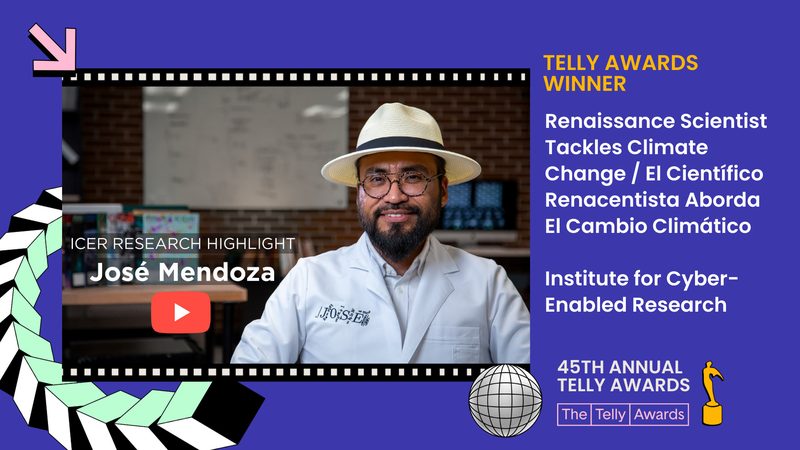
Renaissance Scientist Tackles Climate Change, a research-highlight video by Michelle David for MSU's Institute for Cyber-Enabled Research, won a Bronze Telly Award (social video, diversity, equity and inclusion) in the 45th annual Telly Awards, which received more than 13,000 entries.
-
Group
Talks and travel awards at the APS March Meeting
Marcus Djokic presented MSUCOF frameworks for room-temperature hydrogen storage and Daniel Maldonado-Lopez presented spintronic control in bilayer covalent organic frameworks in Minneapolis. Daniel received the APS Braslau Family Travel Grant and an FGSA Travel Award; Marcus received travel awards from the College of Engineering and the Graduate School.
-
Paper
MSUCOF frameworks for hydrogen delivery, on the cover of Energy & Fuels
Marcus Djokic designed covalent organic frameworks with multiple binding sites for storing and delivering hydrogen at room temperature.
-
Paper
Rare isotopes in diamond to test fundamental symmetries, on the cover of Phil. Trans. A
With Jaideep Singh, Shannon Nicley and Jonas Becker (MSU), we propose diamond color centers that host rare, pear-shaped isotopes as sensors for physics beyond the Standard Model.
2023
-
Paper
Screening earth-abundant semiconductors for artificial photosynthesis
Sean Stafford and co-workers introduce a high-throughput search that combines element substitution with first-principles calculations to find semiconductors for solar water splitting. Journal of Applied Physics.
-
Talk
Seminar at the Facility for Rare Isotope Beams
Relativistic quantum calculations for electronic structure and for separating radioactive isotopes.
-
Talk
Blue/Green Seminar speaker
Prof. Mendoza-Cortes was the speaker of the Blue/Green Seminar, the joint lecture series of the University of Michigan and MSU held since 1982.
-
Group
Four presentations at the CHEMS Annual Research Forum
Sean Stafford, Austin Rodriguez, Lucas Nascimento Santos and Yu-Hsiu Lin presented work on next-generation semiconductors, epoxide polymerization, silicon carbide nanotubes and batteries beyond lithium.
-
Talk
Invited talks at Kyoto University and the University of Tokyo
Talks on the quantum behavior of hydrogen in porous materials and on quantum and atomistic simulations for condensed-matter physics and chemistry.
-
Talk
Lecture at Dow on epoxide polymerization
About 100 Dow scientists attended a lecture on mechanistic investigations in epoxide polymerization, the topic of our recent Polymer Chemistry paper with Robert Ferrier's lab.
-
Award
Best poster at the AVS Michigan Chapter meeting
Daniel Maldonado-Lopez won the best poster presentation award for exquisite control of electronic and spintronic properties of porous frameworks; Marcus Djokic presented MSUCOF for hydrogen storage. Daniel also won first place in the Ph.D. presentations at a UNAM symposium this year.
-
Paper
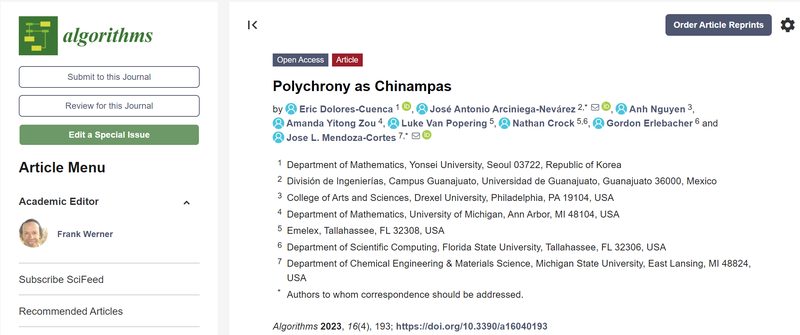
The group now has Erdős number 5
Our paper Polychrony as chinampas in Algorithms gives its authors an Erdős number of 5, so anyone who publishes with us will have an Erdős number of at most 6. Graduates of the group are also academic descendants of Marie Curie and of Ralph Fowler, Paul Dirac's doctoral advisor.
-
Award
NSF Graduate Research Fellowship for Daniel Maldonado-Lopez
Daniel received an NSF Graduate Research Fellowship. Congratulations also to Marcus Djokic and Gourhari Jana on their first papers with the group, in JACS and The Journal of Physical Chemistry A.
-
Grant
Second Scialog collaborative award
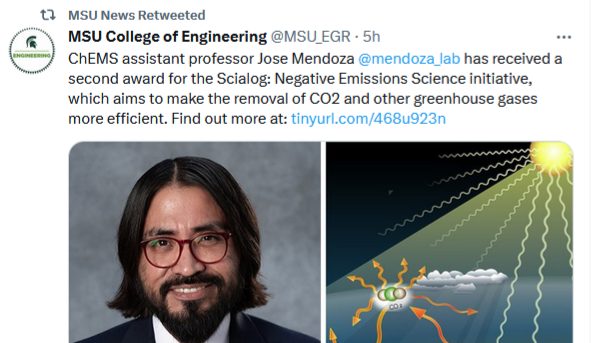
Research Corporation for Science Advancement, the Alfred P. Sloan Foundation and the ClimateWorks Foundation funded seven cross-disciplinary teams in the third year of Scialog: Negative Emissions Science. Our team with Will Bowman (UC Irvine) and Hang Ren (UT Austin) will develop a robust, scalable electrode for CO2 reduction and carbon–carbon coupling in seawater, with support from the ClimateWorks Foundation.
2022
-
Milestone
Dr. William Comaskey
William Comaskey completed his Ph.D. (FSU, co-advised from MSU) with work on spin currents in topological phases, published in Physical Review B, and joined the Mathematics faculty at the University of Nevada, Las Vegas.
-
Talk
Keynote at the CHEMS Research Forum
Quantum mechanical simulations for solid-state physics, materials and chemistry.
-
Grant
NSF funds the MSU Data Machine
A high-memory, GPU-enabled cluster for data-intensive and AI research at MSU (NSF OAC-2200792, PI B. O'Shea), with Prof. Mendoza-Cortes as a co-investigator. The machine supports our machine-learning and quantum simulations.
-
Milestone
Dr. Sean Stafford
Sean Stafford completed his Ph.D. at FSU on high-throughput screening of semiconductors and Gaussian-process potentials; he later returned as a postdoctoral researcher in our MSU group (2023–2024).
-
Talk
Invited talk at Graphene and Beyond, Penn State
Theory and simulation of 2D materials.
-
Group
Undergraduate research forum
Rachel Schenck presented transition-metal substitution in potassium-intercalated birnessites for artificial photosynthesis at MSU's University Undergraduate Research and Arts Forum.
-
Grant
Scialog collaborative award: photochemical amine production
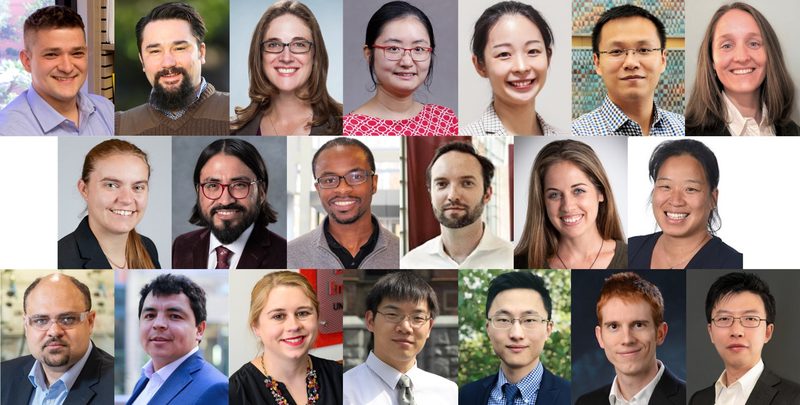
With Marta Hatzell (Georgia Tech) and Kathryn Knowles (University of Rochester), our Scialog: Negative Emissions Science team received a Sloan Foundation award for photochemical amine production from N2 and CO2, a step toward sustainable amines for direct air capture.
-
Paper
Cubanes everywhere in bioinorganic chemistry
A review led by Alec Bigness, who started this work as an undergraduate in the group, surveys cubane-type clusters across bioinorganic compounds. Coordination Chemistry Reviews.
2021
-
Paper
Turning inert materials into useful, active ones
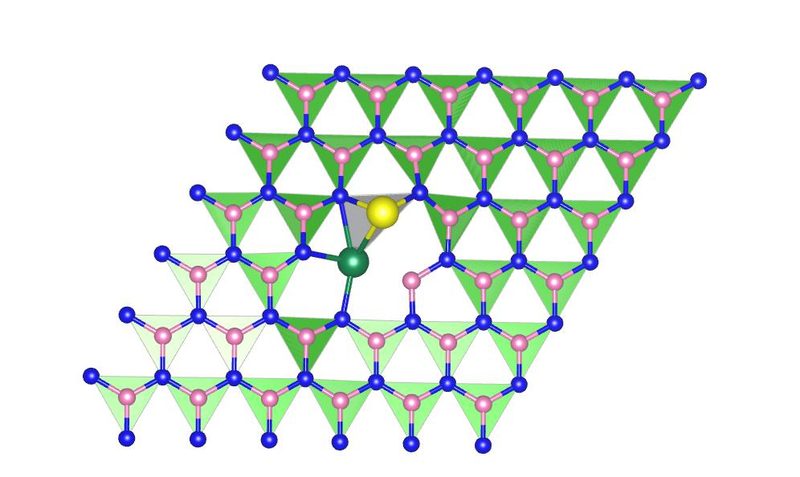
With Mauricio Terrones and Yu Lei, we show that defects make supposedly inert hexagonal boron nitride chemically active, enabling metal deposition and single-atom catalysis. Materials Today.
MSU Engineering newsPenn State release (EurekAlert!)Phys.orgScienceDailyNewswiseAZoMCeramic Tech TodayPublication details
-
Media
Penn State News: can defects turn inert materials into useful, active ones?
The press release on our joint Materials Today paper on defects that activate hexagonal boron nitride, quoting Prof. Mendoza-Cortés.
-
Paper
An organic crystal that turns heat into motion
With Jeremiah Gassensmith's group, we explain a rapidly reversible organic crystalline switch that converts heat into mechanical energy. Journal of the American Chemical Society.
-
Talk
Colloquium at Hendrix College
Science, research, and how identity intersects with life in STEM.
-
Outreach
Organizer at large, APS March Meeting 2021
Prof. Mendoza-Cortes was one of about 30 organizers at large of the largest physics meeting of the year, with about 12,000 attendees.
-
Outreach
Certified expert Wikipedia editor
After eight weeks of training sponsored by the American Physical Society, Prof. Mendoza-Cortés became a certified Wikipedia editor for science and engineering articles.
2020
-
Talk
CMSE Colloquium at MSU
Machine learning meets first-principles quantum calculations and big data.
-
Award
Scialog Fellow for Negative Emissions Science
Prof. Mendoza-Cortes was named a Fellow of Scialog: Negative Emissions Science, joining 50 early-career scientists from the U.S. and Canada working on the removal of greenhouse gases. He was named a Scialog Fellow again in 2021, 2022 and 2023.
-
Teaching
Our machine-learning course is preserved in the GitHub Arctic Code Vault
The open course Machine Learning guide for non-Computer Science majors was selected for the 2020 GitHub Archive Program, which preserves open-source software for future generations.
The courseGitHub Archive ProgramVideo: the Arctic Code Vault
-
Milestone
Joining Michigan State University
Prof. Mendoza-Cortés joined the Department of Chemical Engineering and Materials Science at MSU as one of nine new faculty members of the College of Engineering.
-
Paper
Understanding disorder in 2D materials
With Troy Van Voorhis (MIT), Ricardo Pablo-Pedro shows how carbon doping creates disorder in silicene and what it means for devices. Nano Letters.
-
Talk
Seminar tour on quantum theory and machine learning
Invited seminars at Caltech, UCLA, UC San Diego, Northwestern, the University of Washington, Pacific Northwest National Laboratory, the University of Oregon, the University of Florida, Yale and UNC Chapel Hill.
-
Outreach
Is graduate school right for me?
Talk for the National Mentoring Community and Inclusive Graduate Education Network conference of the APS, MRS and ACS in Orlando.
2019
-
Milestone
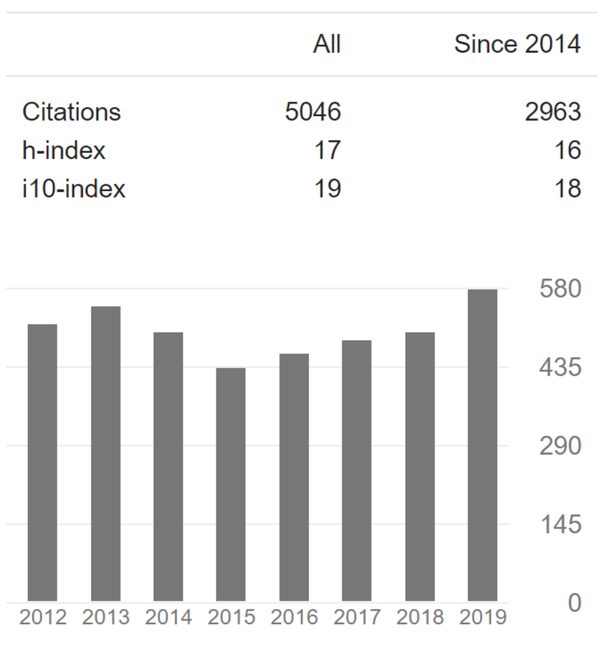
2019 in review
More than 5,000 citations, new grants, and former members doing well in academia, industry and national laboratories.
-
Talk
Chair of the Dynamic Dirac Quantum Matter workshop
Co-sponsored by the Institute for Materials Science at Los Alamos, the Nordic Institute for Theoretical Physics and the University of North Florida.
-
Media
Better batteries with Cornell
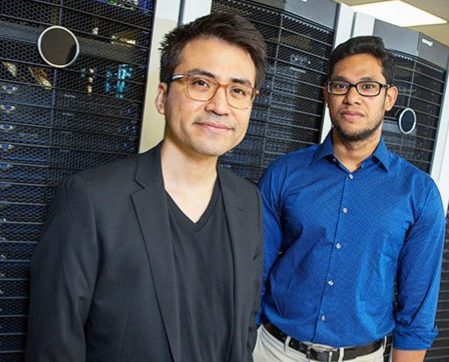
The National MagLab reports our work with Lynden Archer's group at Cornell on polymer electrolytes that stabilize high-voltage lithium batteries. Nature Communications.
-
Group
Superconductivity in intercalated bilayer graphene at the APS March Meeting
Undergraduate Kevin Lucht presented our proposal for superconductivity through magnetic exchange in transition-metal-intercalated bilayer graphene.
-
Paper
Understanding f-orbital bonding in late actinides
With Suzanne Bart, Thomas Albrecht-Schmitt, Laura Gagliardi and colleagues, we characterize tris-chelate complexes of late actinides. Journal of the American Chemical Society.
-
Award
APS Bridge fellowship for Gabriel Jurado
M.S. student Gabriel Jurado (Physics, FSU) received an APS Bridge Program fellowship.
2018
-
Teaching
New courses on machine learning and quantum computing
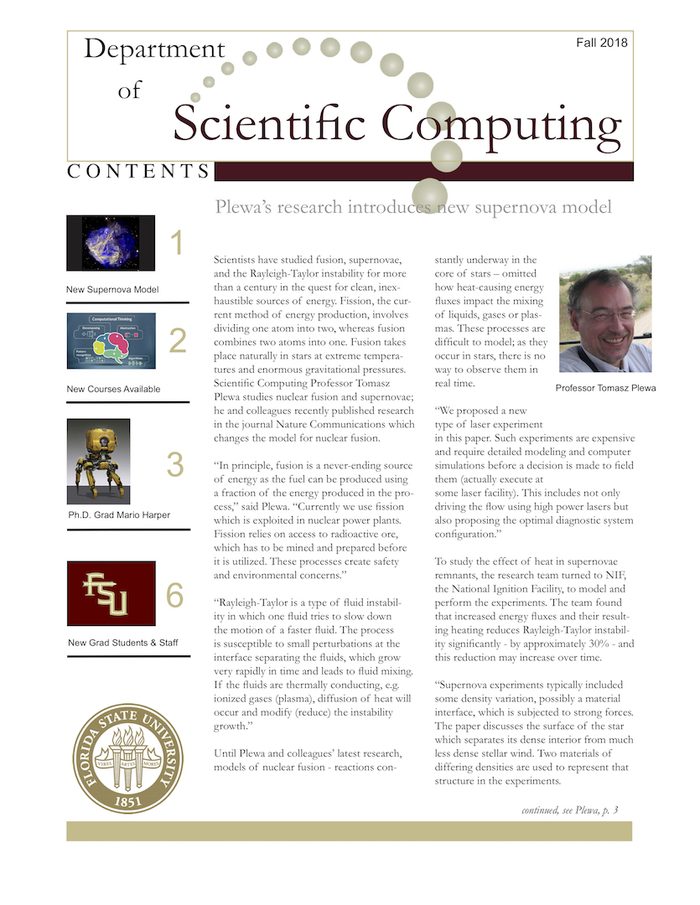
Prof. Mendoza-Cortés created FSU's first courses combining machine learning and quantum computing for students in science and engineering.
-
Group
Honoring Paul Dirac in Tallahassee
On the 34th anniversary of Paul Dirac's death, the group invited physics graduate students to join its visit to his grave in Tallahassee, to wash the headstone and plant a flower. Dirac spent his last years at Florida State University; his doctoral advisor, Ralph Fowler, is part of the group's academic lineage.
-
Award
Royal Society of Chemistry Emerging Investigator 2018
Our Chemical Communications paper with Fernando Uribe-Romo and James Harper (UCF) on moving side chains in covalent organic frameworks was selected for the 2018 Emerging Investigators collection.
-
Outreach
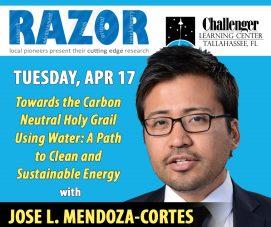
Inaugural RAZOR lecture at the Challenger Learning Center
Towards the carbon-neutral holy grail: using water as a path to clean and sustainable energy, the first lecture of a public series in Tallahassee.
-
Grant
FSU GAP award to bring computational design to market
Our lab was one of four selected for FSU's GAP awards, which help move research from the lab to the market, to build a database that predicts materials with desirable properties.
-
Award
Carl Storm Fellowship
Prof. Mendoza-Cortés received a Carl Storm Fellowship from the Gordon Research Conferences.
2017
-
Talk
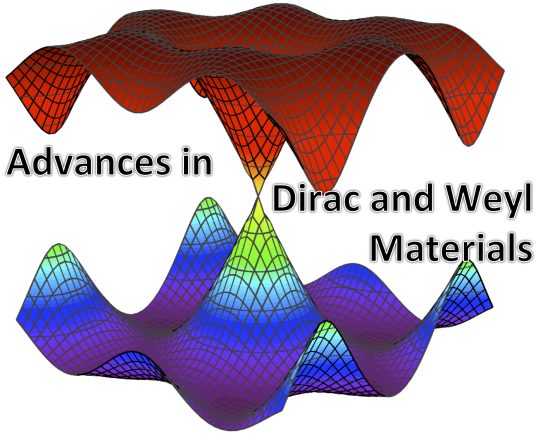
Invited talk and chair, Advances in Dirac and Weyl Materials
A workshop funded in part by the Institute for Materials Science at Los Alamos, the Nordic Institute for Theoretical Physics and the University of North Florida.
-
Outreach
Public talk at FSU Libraries: a path to clean and sustainable energy
Towards the carbon-neutral holy grail using water, a public lecture on artificial photosynthesis.
-
Outreach
Summer research for undergraduates in light–matter science
The group mentors students in the NSF REU Site Sunshine Institute for the Interaction of Light with Matter at FSU.
-
Media
MRS Bulletin: cost-effective materials design for hydrogen storage
MRS Bulletin Energy Focus highlighted our design principles for storing and delivering hydrogen at room temperature in frameworks that chelate abundant transition metals.
2016
-
Grant
GPU donation from NVIDIA
NVIDIA donated GPUs to adapt our codes to GPU architectures; one of our alumni now designs GPUs at NVIDIA.

-
Talk
Invited seminar at Soochow University, China
Density Functional Theory and its Applications to Clean and Sustainable Energy: Towards the Carbon Neutral Holy Grail, at the College of Nano Science and Technology.
-
Grant
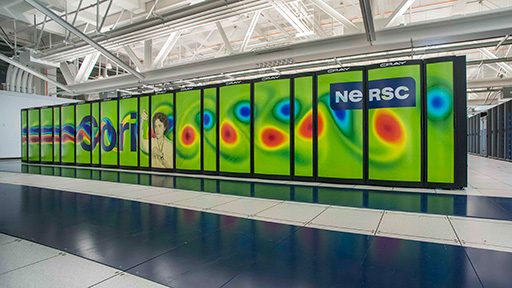
Supercomputing time at NERSC
We received an allocation at the National Energy Research Scientific Computing Center, the main computing facility of the DOE Office of Science.
-
Talk
Invited talk at El Colegio de México
Lecture on computational methods for clean and sustainable energy.
-
Media
FSU News radio segment on our artificial photosynthesis work
A radio report on our discovery that a layered manganese oxide captures sunlight and drives the splitting of water into oxygen and hydrogen.
-
Media
FSU video: high-tech photosynthesis
Florida State University's video on our prediction that birnessite, a layered manganese oxide, can capture sunlight to split water.
-
Media
Forbes: one step closer to efficient artificial photosynthesis
Forbes discussed our prediction that single-layer manganese oxide (birnessite) is a promising material for capturing sunlight and splitting water.
-
Award
CRC Assistant Professor Award
Prof. Mendoza-Cortés received FSU's Council on Research and Creativity award for assistant professors.
2015
-
Media
CNBC: high-tech photosynthesis
CNBC reported our finding of a synthetic material that, like plants, uses sunlight to produce oxygen.
-
Media
Featured by the U.S. Department of Energy
The DOE Office of Science highlighted our birnessite work in its university research news and on social media.
-
Paper
Book chapter on the oxygen-evolving complex
The oxygen-evolving complex of Photosystem II: insights from computation and synthetic models, in Metalloproteins: Theory, Calculations, and Experiments (CRC Press).
-
Paper
Predicting how an energetic molecule packs in a crystal
With William Goddard's group at Caltech, we predict the crystal packing of di-tetrazine-tetroxide (DTTO). Journal of Computational Chemistry.
-
Paper
Watching the first step of CO2 reduction
With Heinz Frei, Martin Head-Gordon and Jonas Peters, we combine density-functional theory and in-situ infrared spectroscopy to characterize the visible-light activation of CO2 by a cobalt complex. The Journal of Physical Chemistry C.
-
Milestone
Joining the National High Magnetic Field Laboratory
Prof. Mendoza-Cortés joined the Condensed Matter Science group of the National MagLab.
-
Milestone
The lab opens at Florida State University
Prof. Mendoza-Cortés started as Assistant Professor at the FAMU–FSU College of Engineering, with affiliations in Scientific Computing and Materials Science at Florida State University.
2014
-
Talk
Online talk for CIIDIR Oaxaca (IPN)
Quantum mechanical simulations and their applications to clean energy.
-
Talk
Five talks at ACS San Francisco
Including Electronic structure contributions to physical properties and reactivity in transition-metal chemistry.
-
Talk
Theory and Computation Colloquium at UCLA
Generation, transformation and storage of chemical energy.
2013
-
Outreach
Speaker at the Adelante Young Men conference
A talk on careers in science and engineering for thousands of Latino K–12 students in Southern California.
-
Paper
Selected for the Models of Metalloenzymes virtual issue
Our JACS paper on oxygen-atom transfer in cuboidal Mn3MOn complexes was selected by the editors of Inorganic Chemistry and JACS for their virtual issue on models of metalloenzymes.
-
Outreach
Mentoring Caltech SURF students
Co-mentoring four students in Caltech's Summer Undergraduate Research Fellowships program, six undergraduates and four graduate students in total.
-
Talk
Invited talk at the University of Maryland
Production and storage of renewable clean energy from first principles, for the Materials Science and Mechanical Engineering departments.
2012
-
Talk
Roberto Rocca fellows conference
Trapping and storing gases in nanoporous organic and metal-organic materials.
-
Milestone
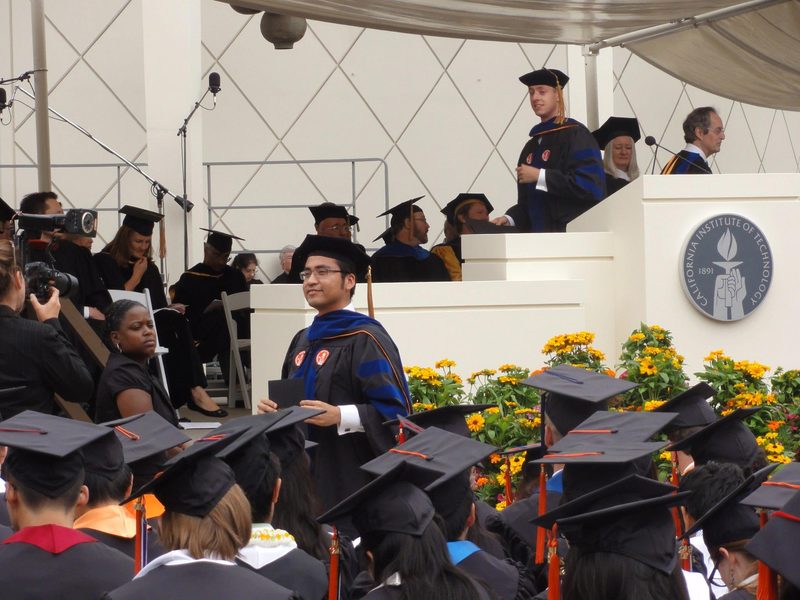
Ph.D. from Caltech
José Mendoza-Cortés received his Ph.D. from Caltech with the thesis Design of molecules and materials for applications in clean energy, catalysis and molecular machines through quantum mechanics, molecular dynamics and Monte Carlo simulations, advised by William A. Goddard III.
2011
-
Paper
Hydrogen in alkali-metalated frameworks
Eleven frameworks reach the DOE 2010 gravimetric target for hydrogen storage at room temperature, and two exceed the 2015 target. The Journal of Physical Chemistry A.
-
Paper
Covalent organic frameworks for methane storage
Two frameworks are predicted to exceed the DOE target for deliverable methane at 35 bar. The Journal of Physical Chemistry A.
2010
-
Paper
Methane uptake in covalent organic frameworks: theory and experiment
A first-principles force field explains measured methane uptake in COFs. The Journal of Physical Chemistry A.
-
Outreach
Mentoring Caltech SURF students
Co-mentoring two students in Caltech's Summer Undergraduate Research Fellowships program.
-
Award
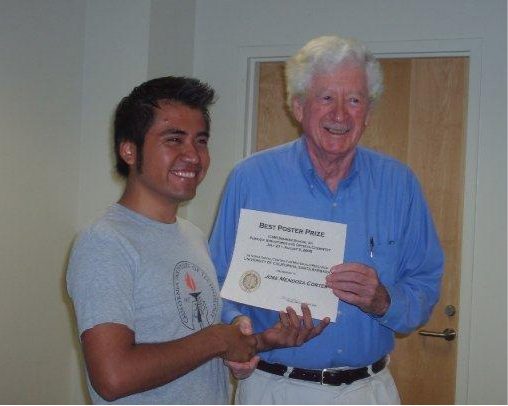
Best poster at the UCSB–ICMR workshop
Best poster at the International Center for Materials Research workshop Periodic structures and crystal chemistry.
-
Paper
Our review of MOF building units among the most accessed of 2009
The critical review of transition-metal carboxylate clusters as secondary building units of metal-organic frameworks was one of the ten most accessed Chemical Society Reviews articles of 2009.
2009
-
Award
Roberto Rocca Fellowship
A Ph.D. fellowship awarded to 15 students per year worldwide, from countries such as Argentina, Brazil, Colombia, Indonesia, Mexico, Romania and Venezuela.
2008
-
Award
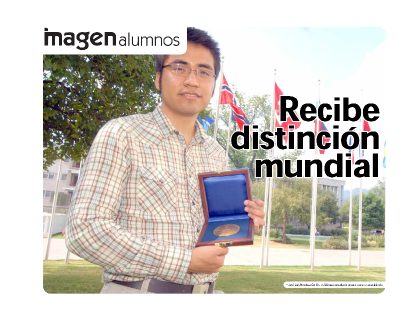
AAAS Newcomb Cleveland Prize
The first three-dimensional covalent organic frameworks received the Newcomb Cleveland Prize, the oldest award of the American Association for the Advancement of Science, for the best paper published in Science.
AAAS: 2007 prize recipientsAbout the prizeAAAS annual report (PDF)Publication details
2007
-
Media
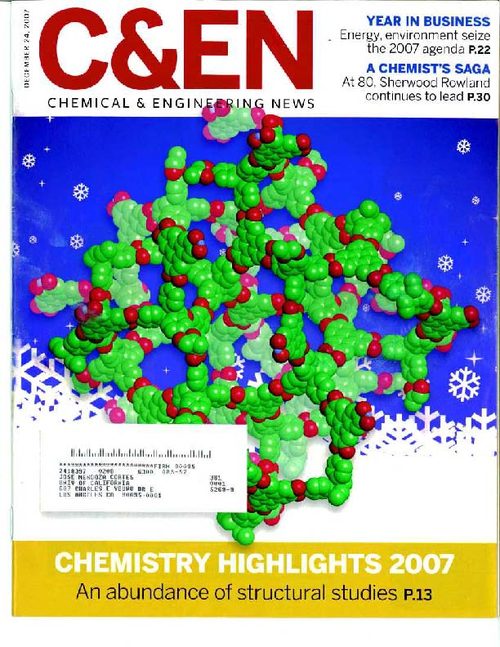
COF-105 on the cover of C&EN
Our compound COF-105 illustrated the Chemical & Engineering News 2007 chemistry highlights.
-
Paper
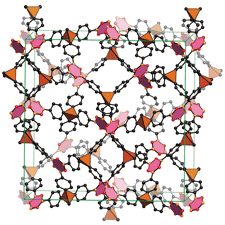
Three-dimensional covalent organic frameworks in Science
The first 3D COFs, built entirely from strong covalent bonds, have very high surface areas and one of them, COF-108, is among the lowest-density crystals known. The work was also featured in C&EN (R. Dagani, Porous crystalline organic frameworks, May 28, 2007).
-
Talk
Two presentations at the ACS National Meeting in Chicago
On covalent organic frameworks and on frameworks as adsorbents for H2, CO2 and CH4.
2005
-
Paper
First research paper
A one-step, high-yield synthesis of a shape-persistent molecular triangle by precipitation-driven alkyne metathesis, with Jeffrey Moore's group at the University of Illinois. The Journal of Organic Chemistry.
No news items match. Clear the search or choose "All".