
The lab
The Mendoza Lab is also known as the AI QUANTUM Lab (AI and QUantum Hub for Advanced Next-generation Technologies and Ultimate Materials). It is a computational lab: our instruments are algorithms and computers, and our experiments are designed together with the experimental groups we collaborate with.
How we work
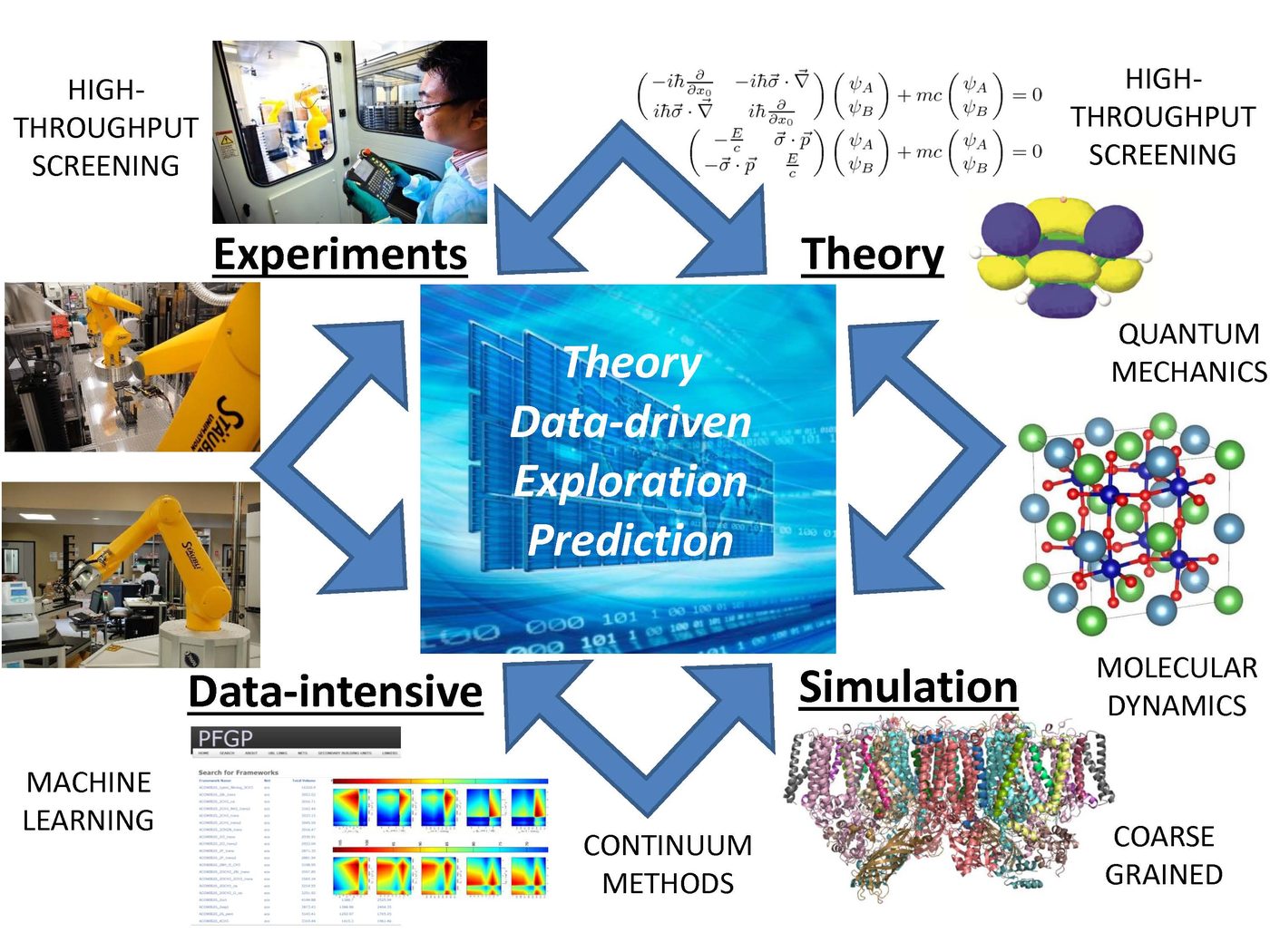
We call our style renaissance science: each project starts from a question and borrows whatever physics, chemistry, mathematics, computer science or engineering it needs. Students learn quantum mechanics, simulation, machine learning and scientific programming side by side, publish with experimental partners, and release their code and data.
New members get an onboarding plan, a mentor in the group and access to our wiki of manuals and tutorials. The group meets weekly, and every student presents regularly at group meetings, MSU research forums and national conferences.
Computing
Our calculations run on the high-performance computing center of MSU's Institute for Cyber-Enabled Research (ICER), including the GPU-enabled, high-memory MSU Data Machine and the MSU Data Hub for large datasets, two NSF-funded resources that Prof. Mendoza-Cortés helped bring to MSU (see Funding). We also use national supercomputing facilities and GPU workstations in the group.
Software includes periodic and molecular quantum-chemistry codes (for example CRYSTAL, which we drive with our MACE engine), machine-learning frameworks such as PyTorch, and the codes we develop.
Where we are
The lab belongs to the Department of Chemical Engineering and Materials Science in the College of Engineering at Michigan State University in East Lansing, with an affiliation in the Department of Physics and Astronomy. On the same campus are ICER, the Facility for Rare Isotope Beams and many of our experimental collaborators. See Contact for directions and Why MSU for what the university and the region offer. More photos of the campus are in the slideshow above, and photos of the group over the years are on the Members page.
Places

