
Research
We develop theory and computational methods, from quantum and relativistic quantum mechanics to machine learning and AI, and apply them to quantum and 2D materials, quantum computing and quantum sensing, catalysis, energy storage and conversion, porous materials, polymers and molecular machines, crystal-structure prediction, clean energy, bio-inspired research and health, and nuclear-waste separation and recovery, together with experimental partners who make and test new materials.
Our approach is deliberately renaissance: we combine physics, chemistry, mathematics, computer science and engineering regardless of where the traditional boundaries lie. Each section below explains the questions we ask, the methods we use and the publications that support it; the In depth panels describe individual projects in more detail.
Research themes
Expertise at a glance
Materials and molecules
graphene and twisted bilayers, transition-metal dichalcogenides, hexagonal boron nitride, black phosphorus and silicene, 2D metal halides, Weyl semimetals and topological surfaces, quantum spin Hall materials, halide perovskites, covalent organic frameworks (COFs), metal–organic frameworks (MOFs), layered manganese, cobalt and nickel oxides, metal phosphides and sulfides, single-atom catalysts, antiperovskite and polymer electrolytes, rotaxanes and molecular machines, molecular switches and actuators, polymerization mechanisms, polymer electrolytes, hydrogel networks, energetic molecular crystals, polymorphs and phase transitions, macrocycles and dynamic covalent chemistry, actinide and heavy-element complexes, cubane clusters in enzymes, diamond color centers.
Energy, environment and devices
lithium-, sodium- and potassium-ion batteries, dual-ion and zinc–air batteries, hydrogen storage, methane storage, artificial photosynthesis and solar fuels, fuel cells and oxygen reduction, hydrogen and oxygen evolution, CO2 reduction and negative emissions, green ammonia, nuclear-waste separation, twistronics, superconductivity and Dirac materials, spintronics, terahertz control of quantum materials, antibacterial materials, quantum sensing beyond the Standard Model.
Methods and theory
machine-learned interatomic potentials, Hessian-informed training, reaction datasets with transition states, cheminformatics pipelines and AI agents, density functional theory, coupled-cluster and MP2 benchmarks, four-component relativistic methods, spin–orbit coupling, ab initio and classical molecular dynamics, first-principles and classical force fields, grand canonical Monte Carlo, adsorption theory, high-throughput screening and evolutionary search, crystal-structure prediction, quantum algorithms, order theory, tropical algebra and category theory for AI, combinatorics and number theory.
Then, now and next
- 2005 to 2014
Foundations: frameworks and clean energy
As a student and postdoc at UIUC, UCLA, Caltech, the Joint Center for Artificial Photosynthesis and UC Berkeley, José Mendoza-Cortés co-authored the first three-dimensional covalent organic frameworks, catalogued the building units of metal-organic frameworks, designed frameworks for hydrogen and methane storage, and modeled the oxygen-evolving complex and CO2 activation.
- 2015 to 2020
Florida State University and the National MagLab
The independent group began at the FAMU–FSU College of Engineering and the National High Magnetic Field Laboratory. It extended first-principles design to 2D materials and Dirac-cone engineering, batteries and catalysts, and launched courses on machine learning and quantum computing.
- 2020 to today
Michigan State University
At MSU the group joins machine learning with quantum simulation (curvature-trained potentials with Los Alamos and NVIDIA), studies twisted and ultrafast 2D materials with MSU physicists, designs hydrogen-storage frameworks and beyond-lithium batteries, and works on heavy elements and rare isotopes with the community of the Facility for Rare Isotope Beams (FRIB).
- Next
AI-driven discovery from electrons to devices
Reactive force fields that know the curvature of the energy landscape, automated discovery pipelines, quantum algorithms, and the chemistry of heavy elements.
Where we are heading
- Reaction force fields with second derivatives. Machine-learned potentials that describe bond breaking and transition states accurately, trained with curvature information at the cost of force training.
- Programmable twistronics. Treating the twist angle between 2D layers as a design variable to place electronic transitions where devices need them.
- Digital twins for ultrafast materials. Simulations that run alongside terahertz and scanning-probe experiments to interpret, and eventually steer, atomic motion.
- Heavy elements and rare isotopes. Relativistic quantum chemistry for actinide separation, nuclear-waste chemistry and isotope-based quantum sensors.
- Heavy elements for personalized medicine. An emerging direction: using relativistic quantum chemistry to match a specific heavy element and ligand to a specific cancer, for metal-based chemotherapy and targeted radiopharmaceuticals.
- Quantum algorithms for materials. Quantum circuits for the Dirac equation in periodic systems and other problems that are hard for classical computers.
- Water oxidation and sustainable batteries. Synthetic heterocubane mimics of Photosystem II (NSF CHE-2555662, 2026 to 2029) and dual-ion batteries with ultrathin graphitic electrodes (NSF CHE-2422570, 2024 to 2027).
Machine learning and AI
Machine learning lets us simulate chemistry with near-quantum accuracy at a small fraction of the cost. We train interatomic potentials on energies, forces and second derivatives (Hessians) of the potential-energy surface. With collaborators at NVIDIA and Los Alamos National Laboratory we showed that curvature information makes these potentials more accurate away from equilibrium, more stable in molecular dynamics and more data-efficient, and our Projected Hessian Learning keeps that accuracy while training more than 24 times faster per epoch than full-Hessian training. We share the tools: the OpenREACT-CHON-EFH reaction dataset, CheMLFlow for reproducible and auditable machine-learning studies run by scientists or AI agents, and our open e-book for students outside computer science, the Machine Learning and Quantum Computing Guide for Humans (2025). Machine-learned potentials are the newest generation of the force fields we have built since 2008; the earlier ones are described under Interatomic potentials (force fields) and atomistic simulation.
What we study
- Interatomic potentials trained on energies, forces and Hessians
- Projected Hessian Learning: curvature supervision with Hessian–vector products
- Open reaction datasets with transition states and Hessians (OpenREACT-CHON-EFH)
- Cheminformatics and materials informatics: reproducible, auditable ML workflows and AI agents (CheMLFlow)
- Quick classification experiments to choose molecular descriptors
- Open e-book: Machine Learning and Quantum Computing Guide for Humans (2025)
Approaches
- Neural-network potentials (ANI and HIP-NN)
- Automatic differentiation for forces and Hessian–vector products
- Gaussian-process regression
- Nested cross-validation and scaffold splits
- AI coding agents inside audited workflows
- GPU computing (NVIDIA hardware grants in 2016 and 2018; the MSU Data Machine)
Selected publications
- Projected Hessian Learning: Fast Curvature Supervision for Accurate Machine-Learning Interatomic PotentialsMachine Learning: Science and Technology 2026
- Does Hessian Data Improve the Performance of Machine Learning Potentials?Journal of Chemical Theory and Computation 2025
- CheMLFlow: An Open-Source Platform for Cheminformatics and Materials Informatics ApplicationsarXiv preprint 2026
- Machine Learning and Quantum Computing Guide for HumansOpen-access e-book 2025
- Obtaining transferable chemical insight from solving machine-learning classification problems: Thermodynamical properties prediction, atomic composition as good as Coulomb matrixarXiv preprint 2022
- Order Theory in the Context of Machine LearningarXiv preprint 2024
All 8 publications on machine learning and ai
In depth: 6 topics described in detail
An open machine-learning guide for non-specialists
Students in chemistry, physics, engineering, medicine and the arts increasingly need machine learning, but few of them take computer-science courses. For them we maintain Machine Learning for Humans, an open online guide whose notebooks were first written in 2018 for the machine-learning seminar at Florida State University. It is listed among our publications as the e-book Machine Learning and Quantum Computing Guide for Humans (2025). Short explanations are paired with executable Jupyter notebooks, and the only prerequisite is basic Python.
- Methods. Data preprocessing, decision trees, k-nearest neighbours, support-vector machines, self-organizing maps, genetic algorithms, naive Bayes, non-negative tensor factorization, Monte Carlo and Markov-chain methods and uncertainty quantification, followed by neural networks: convolutional and recurrent networks, generative adversarial networks, DeepDream and style transfer.
- Tools. Tutorials for scikit-learn, Keras, PyTorch and TensorFlow.
- Applications. Examples are grouped by field, from art and image manipulation to chemistry, engineering, medicine and physics, and include potential-energy surfaces and reaction networks.
The guide's quantum-computing chapter is described under Quantum computing. We use the guide in our courses at FSU and MSU.
Classification experiments as a guide to molecular descriptors
Choosing a molecular representation and a training set-up for a property-prediction model is often a matter of trial and error. With L. Alday-Toledo and co-workers, we proposed running quick classification experiments first, to gauge how hard a prediction task is and which descriptors carry the information it needs (arXiv:2212.01420, 2022).
- Set-up. For the 133,885 small organic molecules of the QM9 database, the enthalpy, Gibbs free energy, zero-point vibrational energy and heat capacity were each divided into five to seven classes of similar size, and neural networks with three hidden layers were trained to assign molecules to these classes.
- Descriptors. The sorted Coulomb matrix (435 numbers per molecule), its eigenvalues, a five-number atomic-composition vector that simply counts the atoms of each element, and combinations of these were compared, using the Adam and AdaBelief optimizers.
- Finding. With AdaBelief, atomic composition alone classified enthalpy and Gibbs free energy with more than 99% accuracy, about as well as the much larger Coulomb matrix. It was less accurate for zero-point energy and much less for heat capacity, where structural descriptors helped.
Such classifiers can quickly filter a database for molecules in a desired property range before costly electronic-structure calculations are run on them.
Do Hessians improve machine-learning potentials?
Machine-learning interatomic potentials are usually trained on energies and forces, and models trained mostly on stable geometries can fail elsewhere on the potential-energy surface. With J. S. Smith of NVIDIA, A. Rodriguez in our group tested whether adding Hessians, the second derivatives that describe the curvature of that surface, helps (J. Chem. Theory Comput. 21, 6698 (2025)). ANI-type neural-network potentials were trained on energies alone, on energies and forces, or on energies, forces and Hessians, using our OpenREACT-CHON-EFH dataset of small C, H, N, O molecules along reactions.
- Accuracy. Hessian-trained models gave lower energy errors for distorted geometries and along reaction paths, captured the curvature at transition states and reproduced most DFT vibrational frequencies.
- Simulations. They kept molecular dynamics stable above 500 K for most test molecules, and nudged-elastic-band calculations with them converged to a reaction barrier close to the DFT value, whereas models trained without Hessians did not converge.
- Cost. Hessians are expensive to compute, and training took about 25 times longer per epoch; in return, less training data was needed.
The study concluded that potentials for reaction simulations should include curvature information, a cost we later reduced with Projected Hessian Learning.
OpenREACT-CHON-EFH: a reaction dataset with energies, forces and Hessians
To train and test curvature-aware potentials we released OpenREACT-CHON-EFH (Open REaction Dataset of Atomic ConfiguraTions comprising C, H, O, N with Energies, Forces, and Hessians) on Figshare in 2025 under a CC BY 4.0 licence (doi:10.6084/m9.figshare.29189858). It accompanies our study of Hessian training and builds on the reactions collected by Grambow, Pattanaik and Green (2020). Every geometry carries an energy, atomic forces and a full Hessian computed at the ωB97X-D/6-31G(d) level of density-functional theory.
- RTP. 35,087 optimized reactants, transition states and products from 11,961 elementary reactions: the core set for training and evaluation.
- IRC. 34,248 geometries along 600 intrinsic-reaction-coordinate paths, held out to test how well a model extrapolates along complete reaction pathways.
- NMS. 62,527 off-equilibrium geometries made by displacing path geometries along vibrational normal modes, to test robustness.
The dataset supports benchmarking of potentials that learn second derivatives and is also used in our Projected Hessian Learning work.
Projected Hessian Learning
Training on full Hessians makes machine-learning potentials more accurate, but a Hessian grows with the square of the number of atoms, so computing and storing it limits practical use. With S. Matin, N. Lubbers and K. Barros at Los Alamos National Laboratory and J. S. Smith at NVIDIA, we developed Projected Hessian Learning (PHL), which supervises curvature using only Hessian–vector products along random probe directions, at a cost close to that of force training (Mach. Learn.: Sci. Technol. 7, 055037 (2026)).
- Benchmark. Reactants, products, transition states, reaction paths and normal-mode-sampled geometries from OpenREACT-CHON-EFH. Training on energies and forces, on Hessian–vector products with one-hot or dense Gaussian probes, and on full Hessians was compared.
- Result. When the probe vectors are redrawn for every minibatch, both projected schemes match full-Hessian training in energy, force and Hessian accuracy, with epochs more than 24 times faster on the small molecules studied. With one fixed probe per molecule, dense Gaussian probes beat single-column probes, especially far from equilibrium.
- Code. A reference implementation for ANI models is at github.com/Austinrg14/PHL; Hessian and Hessian–vector-product training for HIP-NN models is available in the hippynn library.
The authors propose PHL as a scalable replacement for explicit Hessian supervision in larger molecular systems.
CheMLFlow: reproducible machine-learning workflows for chemistry and materials
Machine-learning studies in chemistry often force researchers to assemble a whole pipeline, from data acquisition to the final report, even when they contribute to only one step. With B. Smith, N. Abdulrahiman and colleagues, we developed CheMLFlow, an open-source platform of modular components and ready-to-run reference pipelines for cheminformatics and materials informatics (arXiv:2608.04942, 2026; code at github.com/nijamudheen/CheMLFlow).
- Reproducible and auditable. Each run is defined by one version-controllable YAML or JSON file. Data splits are deterministic and saved, every step writes its outputs to the run directory, and runs record configuration and git hashes, so results, including failed runs, can be audited.
- Models. From random forests, support-vector machines, XGBoost and CatBoost to neural networks, Chemprop graph networks and the CheMeleon foundation model, with a design-of-experiments engine for large model and hyperparameter screens.
- Agent layer. Short, versioned “skills” let coding agents install the software, write configurations, launch runs and summarize results, while interpretation and final decisions stay with the researcher.
- Benchmarks. Quantum-mechanical (QM9), physicochemical and bioactivity (ChEMBL) prediction tasks reach performance comparable to published results, and a time-series example shows that the platform extends beyond molecular data.
2D materials
Atomically thin materials can be stacked, twisted, intercalated and engineered with defects to obtain properties that no bulk crystal has. We map how twisting and stacking change electronic transitions in transition-metal dichalcogenide bilayers and heterostructures, build databases of two-dimensional metal halides with tunable band gaps, magnetism and catalytic descriptors, and explain with experimental partners how defects activate inert hexagonal boron nitride, how arsenic changes black-phosphorus transistors and how surface modifiers let graphene host sodium and potassium. Our 2023 multi-group review in ACS Nano surveys theory, synthesis, properties and applications of 2D materials.
What we study
- Twistronics: electronic transitions controlled by twisting and stacking TMDC bilayers
- Two-dimensional MX and MX2 metal halides
- Defects that activate inert hexagonal boron nitride for single-atom catalysis
- Doped black phosphorus and silicene for electronics
- Surface-modified few-layer graphene for battery electrodes
- Interatomic potentials for large deformations and fracture
Approaches
- Periodic hybrid DFT and spin-polarized calculations
- Builders for twisted bilayers and heterostructures
- Phonons, Raman and lattice dynamics
- Joint studies with synthesis, scanning-probe, transport and Raman experiments
Selected publications
- How Can We Engineer Electronic Transitions Through Twisting and Stacking in TMDC Bilayers and Heterostructures? A First-Principles ApproachNanoscale Advances 2025
- A first-principles theoretical study on two-dimensional MX and MX2 metal halides: bandgap engineering, magnetism, and catalytic descriptorsPhysical Chemistry Chemical Physics 2026
- Recent Advances in 2D Material Theory,Synthesis, Properties, and ApplicationsACS Nano 2023
- Low temperature activation of inert hexagonal boron nitride for metal deposition and single atom catalysisMaterials Today 2021
- Raman and electrical transport properties of few-layered arsenic-doped black phosphorusNanoscale 2019
All 25 publications on 2d materials
In depth: 7 topics described in detail
Recent advances in 2D materials: a multi-group review
Research on two-dimensional (2D) materials now spans theory, synthesis, characterization, devices and quantum physics. In 2023 a team of 48 authors from many groups, with J. A. Robinson (Penn State) as corresponding author and Y.-H. Lin, D. Maldonado-Lopez and J. L. Mendoza-Cortés among the contributors, surveyed recent progress across the field (ACS Nano 2023). The review covers:
- Theory and modelling. Modelling of defects and intercalants in 2D materials.
- Machine learning. Data-driven methods for synthesis and sensing.
- New materials. Growth of MXenes and of magnetic and low-symmetry 2D crystals.
- Optics and phonons. Optical and phonon properties of atomically thin layers.
- Devices. Mixed-dimensional heterostructures for logic and memory.
- Quantum transport. Transport in twisted homojunctions.
The review closes with perspectives on future directions for the field.
Twistronics: engineering band gaps by twisting and stacking TMDC bilayers
Twistronics, the control of electronic properties through the twist angle between stacked two-dimensional layers, took off after superconductivity was found in magic-angle bilayer graphene in 2018. Semiconducting transition-metal dichalcogenides (TMDCs) add further knobs: the choice of metal and chalcogen, and the stacking of two different materials. In 2025 we reported a first-principles survey of bilayers built from six MX2 compounds (M = Mo, W; X = S, Se, Te), using range-separated hybrid density functional theory on 30 homo- and heterobilayer combinations with different stackings and twist angles (Nanoscale Advances 2025).
- Twist angle. Twisted bilayers form moiré patterns. At critical angles (17.9°, 42.1°, 77.9° and 102.1° for WS2 and WSe2) the patterns are symmetric and the band gap becomes tunable. Under low strain, MoS2, WS2 and WSe2 bilayers switch between direct and indirect gaps at specific angles, and MoS2 can switch between semiconducting and metallic states.
- Stacking. Stacking and composition set the stability and the size of the gap; for example, the MoTe2/WSe2 heterostructure with a 60° shift keeps a direct band gap.
- Band flatness. The twist angle also tunes how flat the electronic bands are.
Combining heterostructure chemistry with controlled twist angles gives a toolkit for setting the size and character (direct or indirect) of band gaps in 2D semiconductors.
Silicene nanoclusters with low reorganization energies
Good charge-transport materials change shape very little when they gain or lose an electron; in other words, they have a small internal reorganization energy (λ). In a 2018 study led by R. Pablo-Pedro with T. Van Voorhis, J. Kong and M. S. Dresselhaus (MIT) and S. Fomine (UNAM), with J. L. Mendoza-Cortés as co-author, density functional theory calculations predicted small reorganization energies for rectangular, hydrogen-passivated nanoclusters of silicene (H-SiNCs), the silicon analogue of graphene (Physical Review Applied 2018).
- Low reorganization energies. For several clusters both the electron and the hole reorganization energies are below 0.1 eV, with the lowest values between about 0.05 and 0.07 eV. These are comparable to pentacene for holes (0.097 eV) and fullerene for electrons (0.06 eV), two benchmark organic semiconductors.
- n-type character. All clusters studied have large electron affinities and strongly stabilized anions, which points to n-type behaviour.
- Design handle. Changing the cluster size along the zigzag and armchair directions tunes these properties.
Size-selected H-SiNCs are therefore proposed as n-type materials for silicon-compatible electronics and spintronics.
Activating "inert" hexagonal boron nitride
Hexagonal boron nitride (hBN) is usually considered chemically inert because of its wide band gap and strong covalent bonds, which limits its use in catalysis and energy conversion. In 2021, in work co-led by M. Terrones (Penn State) and our group, cryomilling (mechanical milling in liquid nitrogen) was shown to turn hBN into a reactive support for single metal atoms (Materials Today 2021).
- Defects by cryomilling. Milling creates vacancies, with or without oxygen, giving defective BN (d-BN). Photoluminescence reveals mid-gap states and electron spin resonance detects localized radicals; density functional theory links both to the vacancies and their spin densities.
- Spontaneous metal loading. The radicals and the resulting shift of the Fermi level let d-BN reduce metal cations without an added reducing agent, anchoring single atoms (for example platinum) as well as mono- and bimetallic clusters.
- Catalysis. The anchored single atoms and nanostructures improve catalysis of the hydrogen-evolution reaction; the authors also point to uses in sensing and quantum information.
The same defective-BN platform was later used to anchor copper single atoms that inactivate E. coli within 30 minutes under sunlight (ACS Nano 2025).
Arsenic-alloyed black phosphorus transistors
Black phosphorus is a layered semiconductor whose band gap and carrier mobility depend on the number of layers, which makes it attractive for optoelectronics and thin-film transistors. In 2019, in a collaboration led by the experimental groups of N. R. Pradhan and L. Balicas, with theory from H. Terrones and our group, few-layer black phosphorus with a quarter of its atoms replaced by arsenic (b-AsP, x = 0.25) was characterized (Nanoscale 2019).
- Raman spectroscopy. Density functional theory (DFT) explains the measured spectra: each Raman mode of black phosphorus splits into three, from P–P, P–As and As–As bonds.
- Transistors. Few-layer b-AsP field-effect transistors show an on/off current ratio of about 103 at room temperature (about 105 at 4 K) and an intrinsic field-effect mobility approaching 300 cm2 V−1 s−1 at 300 K, rising to about 600 cm2 V−1 s−1 at 100 K.
- Insulator–metal transition. At high gate voltages the resistivity decreases on cooling and saturates below about 100 K, a gate-induced insulator-to-metal transition.
- Anisotropy and doping. Transport is strongly anisotropic between the armchair and zigzag directions, as in pristine black phosphorus, and hybrid DFT places the Fermi level close to the top of the valence band, explaining the hole conduction.
With its tunable band gap and anisotropy, b-AsP is a candidate for optoelectronic applications.
Carbon-doped silicene: disorder, correlation and magnetism
Silicene, the silicon analogue of graphene, is compatible with silicon electronics but has no natural band gap. In 2020, with T. Van Voorhis (MIT), we used first-principles calculations on finite clusters and periodic sheets to understand how substituting carbon atoms into silicene changes its properties through lattice disorder and local electron correlation (Nano Letters 2020).
- Tunable band gap. Where the carbon atoms sit changes the electronic properties dramatically; the band gap is set by the amount of lattice disorder and by electron correlation.
- Mott–Anderson transition. Changing the dopant positions drives a Mott–Anderson transition, a change from extended to localized electronic states caused jointly by electron–electron repulsion and disorder.
- Magnetism. The doped sheets remain ferromagnetic even when disordered.
Carbon doping therefore offers a way to engineer the band gap, magnetism and correlation effects of silicene for silicon-based nanoelectronics such as field-effect transistors.
Two-dimensional metal halides
Metal halides with MX and MX2 formulas can be thinned from bulk crystals into two-dimensional sheets, but how this changes their electronic behaviour was poorly understood. In 2026 we built a database of 60 such compounds (X = F, Cl, Br, I) and computed their properties in bulk and slab form with the hybrid functional HSE06-D3 (Phys. Chem. Chem. Phys. 2026).
- Band gaps. Most compounds are semiconductors, with band gaps from 0 to 9 eV that depend on composition and on dimensionality.
- Indirect-to-direct switching. Nine compounds, including CdCl2, CuI and VI2, change from an indirect to a direct band gap when thinned, which could benefit energy-conversion applications.
- Magnetism. Many monolayers are magnetic; for example, CrI2 and NiCl2 change from antiferromagnetic in the bulk to ferromagnetic as monolayers, whereas MnCl2 and FeCl2 stay antiferromagnetic within the layer.
- Catalytic descriptors. Comparing band-edge positions with the water redox levels singles out CrI2 and NiI2 monolayers as candidates for photocatalytic water splitting.
The database is intended as a resource for choosing low-dimensional halides for electronic, optoelectronic, catalytic and spintronic uses.
Fundamental physics and quantum sensing
Some isotopes made at rare-isotope facilities such as MSU's Facility for Rare Isotope Beams (FRIB) have pear-shaped nuclei that amplify signs of time-reversal violation. With colleagues in physics we proposed trapping such isotopes in diamond, where they form color centers that can be read out with light, and we computed the electronic structure of protactinium-229 defects and of lanthanide stand-ins. The idea links nuclear physics, quantum sensing and materials theory, and experiments to make these defects are under way.
What we study
- Rare-isotope color centers in diamond
- Electric dipole moments and symmetry tests beyond the Standard Model
- Heavy-element defects in wide-gap crystals
Approaches
- Relativistic and spin-polarized DFT for defects
- Defect levels and optical transitions
Selected publications
- Rare isotope-containing diamond colour centres for fundamental symmetry testsPhilosophical Transactions of the Royal Society A 2024
Publications on fundamental physics
In depth: one project described in detail
Rare isotopes in diamond for tests of fundamental symmetries
A permanent electric dipole moment of a nucleus would violate time-reversal symmetry and point to physics beyond the Standard Model. In “pear-shaped” nuclei such as protactinium-229, octupole deformation enhances the nuclear Schiff moment and hence the expected signal, but such isotopes can be produced only in tiny amounts, for example at MSU's Facility for Rare Isotope Beams. I. M. Morris, K. Klink, J. T. Singh, J. L. Mendoza-Cortés, S. S. Nicley and J. N. Becker proposed embedding them in synthetic diamond, where they would form colour centres that can be probed repeatedly (Phil. Trans. R. Soc. A 382, 20230169 (2024)).
- Why diamond. A defect in diamond can combine isolated, molecule-like electronic states with efficient capture of scarce atoms, repeated measurements on even a single atom and narrow optical linewidths.
- Calculations. Density-functional calculations (PBE+U geometries, HSE06 electronic structure) indicate that the most stable protactinium defect is the ion accompanied by two carbon vacancies, with defect states inside the diamond band gap.
- Non-radioactive proxy. A praseodymium defect with a similar electronic structure is also stable and could be used to prepare experiments without radioactive material.
The article appeared in the Theo Murphy meeting issue “Diamond for quantum applications”, where it was featured on the cover, and outlines a toolbox, inspired by quantum information processing, for studying rare isotopes.
Catalysis
Catalysts decide how fast and how selectively chemistry happens. We identify active sites and reaction pathways with first-principles calculations, usually together with the groups that make and test the catalysts: restructured PtSe2 for oxygen reduction, layered cobalt and nickel oxides whose layer-by-layer arrangement lowers the oxygen-evolution overpotential, doped phosphides and dichalcogenide heterostructures for hydrogen evolution, graphene that is impermeable yet electronically transparent to a buried metal, copper single atoms on boron nitride, photoredox catalysis in titanium frameworks, and aluminum and Vandenberg catalysts for epoxide polymerization.
What we study
- Electrocatalysis: oxygen reduction, oxygen evolution and hydrogen evolution
- Single-atom catalysts on defective 2D supports
- Graphene heterostructures as electronically transparent electrodes
- Photoredox catalysis in metal–organic frameworks
- Mechanisms of molecular and polymerization catalysts
Approaches
- Free-energy diagrams and the computational hydrogen electrode
- Transition-state searches
- Ab initio molecular dynamics at interfaces
- Theory–experiment co-design
Selected publications
- Reaction-driven restructuring of defective PtSe2 into ultrastable catalyst for the oxygen reduction reactionNature Materials 2024
- Enhanced Activity in Layered Metal-Oxide-Based Oxygen Evolution Catalysts by Layer-by-Layer Modulation of Metal-Ion IdentityACS Catalysis 2025
- Enhanced Antibacterial Efficacy of Copper Single-Atom Catalysts on a Two-Dimensional Boron Nitride PlatformACS Nano 2025
- Synergistic Steric and Electronic Effects on the Photoredox Catalysis by a Multivariate Library of Titania Metal--Organic FrameworksJournal of the American Chemical Society 2023
- Modulating Electrocatalysis on Graphene Heterostructures: Physically Impermeable Yet Electronically Transparent ElectrodesACS Nano 2018
All 19 publications on catalysis
In depth: 4 topics described in detail
Tuning photoredox catalysis in titanium metal–organic frameworks
Metal–organic frameworks (MOFs) that drive light-powered redox reactions are attractive photocatalysts because their pore size and electronic structure can be tuned by changing their building blocks. In a 2023 collaboration led by F. J. Uribe-Romo (University of Central Florida) with several groups, including ours, a library of eleven isoreticular titanium MOFs with the formula Ti6O9(linker)3 was used to separate these two effects (J. Am. Chem. Soc. 2023).
- Structure. The linkers are linear oligo(p-arylene) dicarboxylates of different lengths, some carrying electron-donating amine groups. Powder X-ray diffraction and total scattering show parallel one-dimensional titanium-oxo "nanowires" connected by the linkers in a rod-packed hexagonal net.
- Steric versus electronic effects. Longer linkers enlarge the pores, while donor groups change the HOMO–LUMO gap. In the photocatalytic oxidation of benzyl alcohol, substrate uptake correlates with the reaction rate, and both longer linkers and more donor groups increase activity.
- Performance. The best frameworks react almost 20 times faster than the benchmark MOF MIL-125(Ti).
The results show that pore size and electronic structure must be considered together when designing MOF photocatalysts.
Platinum-free catalysts for hydrogen evolution
Platinum is the benchmark catalyst for the hydrogen-evolution reaction (HER) in water electrolysis, but it is scarce and expensive. In two collaborations, synthesis and electrochemistry were combined with our density functional theory (DFT) calculations to explain the activity of cheaper catalysts.
- Alloyed dichalcogenides on graphene (2017). With M. Terrones (Penn State), R. Lv and co-workers, centimetre-scale films alternating graphene with WxMo1−xS2 alloy layers were made by wet chemistry and annealing at only 300 °C. The best composition, W0.4Mo0.6S2, reaches 10 mA cm−2 at 96 mV with a Tafel slope of 38.7 mV dec−1, is at least twice as efficient as WS2 or MoS2 and keeps its activity over 1000 cycles. DFT shows that alloying activates the otherwise inert basal plane, with the lowest hydrogen-adsorption barrier at x ≈ 0.4 (ACS Nano 2017).
- Sulfur-doped molybdenum phosphide (2019). With Y. Yang (University of Central Florida), a self-organized, binder-free S-doped MoP nanoporous layer was made by anodization followed by two-step chemical vapour deposition. It needs an overpotential of 86 mV to reach 10 mA cm−2 in acid (Tafel slope 34 mV dec−1) and is also active in basic and neutral electrolytes. DFT indicates that H2 forms through the Volmer–Heyrovsky route and that sulfur doping makes this easier than on MoS2 (ACS Catalysis 2019).
How a cobalt complex selectively reduces CO2 to CO
Electrochemical reduction of carbon dioxide to carbon monoxide is a step toward recycling carbon, but molecular catalysts often waste electrons by reducing protons to hydrogen. The cobalt tetraaza complex [CoIIN4H]2+ makes CO with 45% Faradaic efficiency (CO:H2 = 3:2). In 2018, with M. Head-Gordon and A. T. Bell (UC Berkeley), we used density functional theory to identify its most likely mechanism (Phys. Chem. Chem. Phys. 2018), building on our earlier infrared and computational study of CO2 activation by the same complex (J. Phys. Chem. C 2015).
- Selectivity. Comparing the catalyst's affinity for the species present (acetonitrile, water, CO2 and bicarbonate) explains why CO2 reduction wins over proton reduction: after a two-electron reduction, formation of [CoIN4H]+–CO2− is strongly favoured.
- Catalytic cycle. Protonation gives [CoIN4H]+–CO2H, which reacts with a second CO2 molecule to give [CoIIN4H]2+–CO and bicarbonate; CO2 acts as a Lewis acid that assists C–O bond cleavage.
- No formic acid. High activation barriers block the formic acid pathway, consistent with the observed products, and the calculated reduction potentials and turnover frequency agree with published experiments.
- Testable prediction. The rate of CO formation should increase linearly with the CO2 partial pressure.
Graphene electrodes that are impermeable yet electronically transparent
Graphene blocks molecules yet is only one atom thick, which raises the question of whether a metal buried beneath it can still influence reactions on its outer surface. In 2018, with J. Rodríguez-López's group (University of Illinois Urbana-Champaign), we built graphene heterostructures that combine a buried underlayer with a molecular-catalyst adlayer and used them to tune the oxygen-reduction reaction (ORR) (ACS Nano 2018).
- Approach. Systematic voltammetry and imaging of patterned electrodes probed how each modification changes the ORR mechanism and overpotential.
- Adlayers. Porphyrin catalyst adlayers showed higher activity for the two-electron pathway than the bare graphene basal plane.
- Underlayers. The buried layer lowered the ORR activation potential in the order Pt > Au > SiOx, even though it is sealed off from the solution.
- Mechanism and stability. Calculations attribute the enhancement to metal d-electrons permeating through the graphene. The electrodes tolerated cyanide poisoning and long-term cycling, showing that graphene can protect noble metals while still allowing electrochemical interaction.
The results inform the design of two-dimensional and core–shell electrocatalysts.
Energy storage
Storing energy needs materials that take up ions or molecules reversibly, quickly and safely. We work on two families: batteries and hydrogen (and methane) storage, most often together with experimental groups. Fuel cells, which turn stored hydrogen back into electricity, are described under Energy conversion.
Batteries
With electrochemists we study how lithium, sodium and potassium intercalate into surface-modified few-layer graphene, how sodium reshapes layered manganese oxides, whether electrodes for alkaline-earth ions are possible, and how polymer and helical-polymer electrolytes conduct lithium and survive high voltages. With NSF support (2024 to 2027) we work on stabilizing the cathode–electrolyte interphase on ultrathin graphitic electrodes in dual-ion batteries.
- Lithium-, sodium- and potassium-ion intercalation in graphene electrodes
- Sodium insertion in layered manganese oxides
- Alkaline-earth (Be, Mg, Ca) electrodes
- Dual-ion batteries
- Solid and polymer electrolytes, including antiperovskites
- Zinc–air batteries
Selected publications
- Beyond lithium-ion batteries: Are effective electrodes possible for alkaline and other alkali elements? Exploring ion intercalation in surface-modified few-layer graphene and examining layer quantity and stagesJournal of Applied Physics 2024
- How Does Intercalation Reshape Layered Structures? A First-Principles Study of Sodium Insertion in Layered Potassium BirnessiteThe Journal of Chemical Physics 2026
- Helical Covalent Polymers with Unidirectional Ion Channels as Single Lithium-Ion Conducting ElectrolytesCCS Chemistry 2021
- Stabilizing polymer electrolytes in high-voltage lithium batteriesNature Communications 2019
- Impact of Surface Modification on the Lithium, Sodium, and Potassium Intercalation Efficiency and Capacity of Few-Layer Graphene ElectrodesACS Applied Materials & Interfaces 2020
Hydrogen and methane storage
Storing hydrogen at room temperature needs binding sites strong enough to hold H2 but weak enough to release it. We design covalent organic frameworks with metalated, chelating, multi-binding and ferrocene sites and treat the quantum nature of the H2 interaction; our 2026 design MSUCOF-4-FeCp is predicted to store 18.0 wt% and 72.6 g/L at room temperature and 700 bar, beyond the U.S. Department of Energy's ultimate targets. Our first work in this area (2008 to 2012) designed a framework predicted to store 1.5 times the Department of Energy's 2015 volumetric hydrogen target at 298 K and covalent organic frameworks that exceed its methane target.
- Ferrocene- and metallocene-functionalized frameworks
- Multi-binding sites united in COFs (MSUCOF)
- Chelation of abundant transition metals
- Quantum nature of H2 binding
- Methane storage in COFs
Selected publications
- Ferrocene-functionalized covalent organic framework exceeding the ultimate hydrogen storage targets: a first-principles multiscale computational studynpj Energy Materials 2026
- MultiBinding Sites United in Covalent-Organic Frameworks (MSUCOF) for H2 Storage and Delivery at Room TemperatureEnergy & Fuels 2024
- Design Principles for High H2 Storage Using Chelation of Abundant Transition Metals in Covalent Organic Frameworks for 0–700 bar at 298 KJournal of the American Chemical Society 2016
- Quantum Nature in the Interaction of Molecular Hydrogen with Porous Materials: Implications for Practical Hydrogen StorageThe Journal of Physical Chemistry C 2020
- A Covalent Organic Framework that Exceeds the DOE 2015 Volumetric Target for H2 Uptake at 298 KThe Journal of Physical Chemistry Letters 2012
Approaches
- DFT of intercalation, interfaces and electrolytes
- Grand canonical Monte Carlo with first-principles force fields
- Quantum treatment of H2 binding
- Collaboration with electrochemistry labs
All 20 publications on energy storage
In depth: 10 topics described in detail
Batteries
Stabilizing ether electrolytes in high-voltage lithium batteries
Ether-based liquid and polymer electrolytes are promising for high-energy batteries with lithium or sodium metal anodes, but they fail at both electrodes: at the low potential of the anode they undergo uncontrolled anionic polymerization, and at the cathode they oxidize at the working potentials of the most attractive cathode chemistries. In 2019, a joint experimental and computational study with L. A. Archer's group at Cornell University addressed both problems (Nature Communications 2019).
- Anode side. A cationic chain-transfer agent, tris(hexafluoroisopropyl) phosphate, stops the runaway polymer growth that degrades the electrolyte at the lithium anode.
- Cathode side. Cathode–electrolyte interphases made from preformed anionic polymers, or from oligomers derived from the additive lithium bis(oxalato)borate (LiBOB), protect the ether. Our density functional theory calculations examined how these oligomers form, how stable they are and how they oxidize.
- Outcome. The strategies raise the oxidative stability of ether electrolytes by about 0.3 V, beyond conventionally accepted limits. Lithium-metal cells with nickel–manganese–cobalt oxide (NCM) cathodes and LiBOB retained more than 80% of their capacity for at least 200 cycles between 3 and 4.2 V.
Potassium and sodium in few-layer graphene electrodes
Graphite, the standard lithium-ion anode, works poorly for more abundant alkali metals: potassium tends to plate on its surface instead of intercalating, and sodium barely intercalates at all. With the electrochemistry group of J. Rodríguez-López (University of Illinois Urbana-Champaign), we use ultrathin few-layer graphene as a model electrode and combine electrochemistry and spectroscopy with density functional theory (DFT).
- Fast potassium (2018). Conditioning the electrode in a Li+ electrolyte forms a solid-electrolyte interphase (SEI) through which K+ intercalates efficiently, with distinct staging peaks at scan rates up to 100 mV s−1, charge–discharge at up to about 360C (a full discharge in 10 s) and stable cycling for 1000 cycles at 10C (J. Am. Chem. Soc. 2018).
- Two ions at once (2021). Li+ intercalation follows the Nernst equation (54–58 mV per decade). In mixed Li+/K+ electrolytes the slope falls to about 30 mV per decade once lithium is abundant, a signature of co-intercalation; to our knowledge this was the first study of two alkali ions intercalating together. DFT shows that separate Li-only and K-only domains are always stable, whereas mixed layers are stable only when lithium is dilute (Chemical Science 2021).
- Reversible sodium (2022). As our calculations had predicted, fluorinating the graphene surface allows Na+ to intercalate, reaching about NaC14–18 compared with NaC186 reported for graphite, but only when a Li-based SEI is formed first (J. Electrochem. Soc. 2022).
Designing surface-modified graphene for beyond-lithium batteries
Sodium, potassium, magnesium and calcium are more abundant than lithium, but graphite cannot store most of them efficiently. Our calculations ask whether modifying only the outer surface of few-layer graphene can change the energetics of ion insertion in the layers below.
- Surface modifiers (2020). First-principles calculations compared doping the top layer with heteroatoms and covering the electrode with a single-side fluorinated graphene or a Janus hydrofluorographene monolayer. With a suitable modifier, Li+, Na+ and K+ intercalation all become thermodynamically favourable, making reversible sodium storage with a large capacity possible; charge transfer between the modifier and the graphene explains the effect (ACS Appl. Mater. Interfaces 2020).
- Six ions, three stages (2024). Hybrid DFT on four- and five-layer graphene topped with a half-fluorinated graphene layer followed Li, Na, K, Be, Mg and Ca from stage 3 to stage 1. For all six ions the most favourable site lies directly beneath the modifier; the modifier reverses the unfavourable intercalation of Na, Be, Mg and Ca in pristine graphene, and four layers bind the ions more strongly than five (J. Appl. Phys. 2024).
The 2020 predictions motivated the sodium experiments described above.
Solid electrolytes for lithium batteries
Solid electrolytes could replace the flammable liquids in lithium batteries, but few combine high room-temperature conductivity with stability over a wide voltage range.
- Helical covalent polymers (2021). In work led by W. Zhang's group (University of Colorado Boulder), single-crystal X-ray diffraction showed that an anionic covalent polymer folds into densely packed double helices whose bundles form one-directional, negatively charged channels for lithium ions. Without added lithium salt it conducts 1.2 × 10⁻³ S cm−1 at room temperature, with a lithium transference number of 0.84, an activation energy of 0.14 eV and a stability window of 0.2–5 V; a nonflammable ionic liquid acts as a solvating medium that raises the conductivity more than 1000-fold. With this ionic liquid, an all-solid-state cell with a high-voltage NMC811 cathode cycled reversibly (CCS Chemistry 2021).
- Antiperovskites under strain (2026 preprint). Lithium chalcohalide antiperovskites are candidate solid electrolytes. Our calculations of their energetics and lattice dynamics show that placing the smaller anion inside the octahedron favours stability: Li3OCl, Li3OBr, Li3OI, Li3FTe and Li3FPo are stable cubic phases, Li3FS and Li3FSe become dynamically stable under compression, and a few percent strain tunes the band gap within the electrochemical stability window (arXiv 2026).
Air electrodes for rechargeable zinc–air batteries
Rechargeable zinc–air batteries need low-cost air electrodes that catalyse both the oxygen-reduction reaction (ORR) during discharge and the oxygen-evolution reaction (OER) during charging, without platinum-group metals. Arrays of nitrogen-doped carbon nanotubes (NCNTs) are good ORR catalysts, but their hydrophobic surface and base-growth mode limit their performance in practical cells. In 2018, with Y. Yang's group (University of Central Florida), we reported an "apically dominant" design (Adv. Energy Mater. 2018).
- Design. CoNi nanoparticles are encapsulated in the tips (apical domain) of NCNTs grown on nickel foam (CoNi@NCNT/NF).
- Performance. The electrode is more active for both ORR and OER than conventional base-grown NCNT arrays. As the air electrode of a zinc–air coin cell it gave a peak power density of 127 mW cm−2, an energy density of 845 Wh kgZn−1 and rechargeable operation for more than 90 h, outperforming platinum-group-metal catalysts.
- Mechanism. Density functional theory attributes the ORR activity mainly to synergy between the nanotubes and active sites near the embedded CoNi particles.
Sodium insertion in layered birnessite
Layered manganese oxides such as birnessite can host ions between their sheets, but how intercalation reshapes their structure and electronic properties is not well understood. In 2026, with M. Videa and J. L. Cholula-Díaz, we followed the insertion of Na+ into potassium birnessite up to saturation using hybrid density functional theory (J. Chem. Phys. 2026).
- What was computed. Formation energies, simulated Raman spectra and X-ray diffraction patterns, diffusion barriers for Na+ and K+, binding energies and spin-polarized densities of states.
- Structural changes. Intercalation changes the oxidation states of manganese, distorts the lattice and alters its symmetry; Na+ ions become more loosely bound as the layers approach saturation.
- Electronic and magnetic changes. Intercalation tunes the band gap and the magnetism, and some intercalated structures behave as bipolar magnetic semiconductors, of interest for spintronics.
The results connect ion uptake in a layered oxide to measurable structural signatures and to its electronic and magnetic behaviour.
Hydrogen and methane storage
Where it began: designing frameworks for methane and hydrogen, 2008 to 2012
With first-principles force fields in hand (see Interatomic potentials (force fields) and atomistic simulation), we designed new frameworks on the computer before anyone made them. For methane-fuelled vehicles, simulations of gas delivery and molecular-dynamics tests of stability gave 14 new covalent organic frameworks, two of which exceed the Department of Energy target at 35 bar (J. Phys. Chem. A 2011). For hydrogen, which binds too weakly to most materials at room temperature, we added metals.
- Metalated linkers. Quantum calculations on 48 metal-containing versions of five common COF linkers led to COF-301-PdCl2, predicted to store 60 g of hydrogen per liter at 298 K and 100 bar, 1.5 times the Department of Energy 2015 target (J. Phys. Chem. Lett. 2012).
- Alkali doping. Lithium, sodium and potassium doping of simple, low-cost frameworks brought eleven compounds to the 2010 Department of Energy weight target at room temperature (J. Phys. Chem. A 2012).
- Thesis. These designs are the core of the Ph.D. thesis (Caltech 2012); the projects above continue them with chelating, multi-binding and ferrocene sites.
Quantum-level design rules for hydrogen-storage materials
Storing hydrogen by physisorption in porous solids is attractive because uptake and release are fast and reversible, but H2 usually binds too weakly for practical storage at room temperature; an adsorption enthalpy of roughly 7–15 kJ mol−1 is considered ideal for charging and discharging at ambient temperature. In 2020 we used dispersion-corrected density functional theory (B3LYP-D3) to map how H2 binds to 240 model complexes that mimic the metal sites of metal–organic and covalent organic frameworks (J. Phys. Chem. C 2020).
- Chemical space. Eleven transition metals (Sc, Ti, V, Cr, Mn, Fe, Co, Ni, Cu, Pd and Pt) chelated by five organic linkers, in different oxidation states, spin states and coordination geometries, from square-planar and tetrahedral to octahedral.
- Key findings. Dispersion and electrostatics dominate the interaction. Many sites bind H2 with at least 10 kJ mol−1, a key requirement for practical storage, and the average binding of the metal complexes is close to the ideal range; Pt(II) complexes bind most strongly.
- Design implications. The results give quantitative guidance for choosing metals and linkers so that framework pores present many sites with suitable binding strength.
This work underpins our framework designs for room-temperature hydrogen storage described below.
Metal-chelating covalent organic frameworks for room-temperature hydrogen storage
Most porous materials store less than 10 g L−1 of hydrogen at room temperature because they bind H2 too weakly. Our strategy is to add linkers that chelate (bind) transition metals to lightweight covalent organic frameworks (COFs), so that the pores offer stronger binding sites.
- Design principles (2016). Quantum-mechanical calculations on five linkers, each chelated with 11 transition metals, showed that abundant first-row metals (Sc to Cu) bind H2 as strongly as precious metals, or more strongly. We then built 30 new COFs and simulated their uptake from 0 to 700 bar at 298 K with quantum-derived force fields and grand canonical Monte Carlo. Co-, Ni- and Fe-based frameworks gave the highest uptake and delivery, up to about 40 g L−1 at 700 bar (J. Am. Chem. Soc. 2016; highlighted in MRS Bulletin).
- Multi-binding-site COFs (2024). The MSUCOF family combines three linkers with seven metals (Co, Cu, Fe, Mn, Ni, Pd and Pt) in 24 designs. In simulations at 298 K and up to 700 bar, Co-, Ni-, Mn-, Fe-, Pd- and Pt-based MSUCOFs reach the U.S. Department of Energy (DOE) 2025 targets, and the cheaper first-row metals often outperform palladium and platinum (Energy & Fuels 2024, front cover).
These capacities are computational predictions for the materials alone, whereas the DOE targets (5.5 wt% and 40 g L−1 for 2025; 6.5 wt% and 50 g L−1 ultimately) apply to complete storage systems, including the tank.
A ferrocene-functionalized framework beyond the ultimate hydrogen-storage targets
Extending the multi-binding-site strategy, in 2026 we designed MSUCOF-4-FeCp by attaching ferrocene groups (an iron atom sandwiched between two cyclopentadienyl rings) to the covalent organic framework IRCOF-102, and evaluated it with first-principles multiscale simulations (npj Energy Materials 2026).
- Binding sites. The ferrocene units provide multiple binding sites with binding energies of 15–20 kJ mol−1, strong enough for high capacity yet weak enough to deliver the hydrogen under practical conditions.
- Capacity. At 298 K and 700 bar the framework is predicted to store 18.0 wt% and 72.6 g L−1 of hydrogen, above the DOE ultimate targets of 6.5 wt% and 50 g L−1 (which apply to complete storage systems).
- Cost. Ferrocene offers a lower-cost alternative to incorporating precious metals in COFs.
The design builds directly on the metal-chelating frameworks described above, replacing chelated metals with ferrocene groups as the source of binding sites.
Energy conversion
A clean-energy economy depends on converting energy efficiently from one form into another: sunlight into chemical fuels, chemical energy into electricity, heat into motion. We design and explain the materials that do it, with experimental partners who build and test them.
Solar fuels and artificial photosynthesis
Our SALSA workflow proposes more than 30,000 new compositions and narrows them to dozens of earth-abundant semiconductors that could split water with sunlight. We tune the band gap of layered manganese oxides by inserting ions between their sheets, show that alternating cobalt and nickel oxide layers lowers the oxygen-evolution overpotential by roughly 200 to 400 mV, and, with NSF support from 2026 to 2029, study synthetic heterocubane mimics of the oxygen-evolving complex of Photosystem II.
- Earth-abundant semiconductors for water splitting (SALSA)
- Layered manganese, cobalt and nickel oxides for oxygen evolution
- Mimics of the oxygen-evolving complex
Selected publications
- Transforming Materials Discovery for Artificial Photosynthesis: High-Throughput Screening of Earth-Abundant SemiconductorsJournal of Applied Physics 2023
- Enhanced Activity in Layered Metal-Oxide-Based Oxygen Evolution Catalysts by Layer-by-Layer Modulation of Metal-Ion IdentityACS Catalysis 2025
- Birnessite: A Layered Manganese Oxide To Capture Sunlight for Water-Splitting CatalysisThe Journal of Physical Chemistry C 2015
- The oxygen-evolving complex of Photosystem II: insights from computation and synthetic modelsMetalloproteins: Theory, Calculations, and Experiments (CRC Press) 2015
Fuel cells
With Bruce Koel's group at Princeton we showed that electrochemical cycling restructures defective PtSe2 into an oxygen-reduction catalyst that, after 42,000 cycles, has 2.6 times the mass activity of commercial Pt/C and keeps working to 126,000 cycles; hybrid DFT traces the gain to platinum nanoparticles working with apical sites (Nature Materials, 2024). Earlier we helped explain why cobalt–nickel particles at the tips of nitrogen-doped carbon nanotubes make good oxygen catalysts for zinc–air batteries.
- Ultrastable PtSe2 oxygen-reduction catalysts
- Platinum-free oxygen-reduction and evolution catalysts
Selected publications
- Reaction-driven restructuring of defective PtSe2 into ultrastable catalyst for the oxygen reduction reactionNature Materials 2024
- Reaction-driven restructuring of defective PtSe2 into ultrastable catalyst for the oxygen reduction reactionU.S. provisional patent application 2025
- Apically Dominant Mechanism for Improving Catalytic Activities of N-Doped Carbon Nanotube Arrays in Rechargeable Zinc-Air BatteryAdvanced Energy Materials 2018
Hydrogen production
Water electrolysis needs hydrogen-evolution catalysts made from abundant elements. With experimental partners we explained why sulfur-doped molybdenum phosphide works in acidic, neutral and basic electrolytes and why tungsten–molybdenum disulfide alloys on graphene outperform the pure sulfides.
- S-doped MoP for pH-universal hydrogen evolution
- WxMo1−xS2/graphene heterostructures
Selected publications
- S-Doped MoP Nanoporous Layer Toward High-Efficiency Hydrogen Evolution in pH-Universal ElectrolyteACS Catalysis 2019
- Low-temperature Synthesis of Heterostructures of Transition Metal Dichalcogenide Alloys (WxMo1−xS2) and Graphene with Superior Catalytic Performance for Hydrogen EvolutionACS Nano 2017
Heat and motion
Some materials convert heat directly into motion or carry it in unusual ways. We helped explain an organic crystal that contracts almost instantly when heated above 45 °C and re-expands on cooling, and how corrugation of the honeycomb layers in YbCuBi controls its elastic and thermal-transport properties.
- Organic crystalline switches that convert heat into mechanical work
- Thermal transport in layered Zintl compounds
Selected publications
- Rapidly Reversible Organic Crystalline Switch for Conversion of Heat into Mechanical EnergyJournal of the American Chemical Society 2021
- Leveraging Polymorphism in YbCuBi to Map Transport and Elastic PropertiesChemistry of Materials 2026
Approaches
- Hybrid DFT for band gaps and band edges
- Free-energy diagrams for electrochemical steps
- High-throughput screening (SALSA)
- Theory–experiment co-design
All 9 publications on energy conversion
In depth: 3 topics described in detail
Layered metal oxides for solar and electrochemical water oxidation
Splitting water into hydrogen and oxygen requires efficient, earth-abundant catalysts for the demanding oxygen-evolution half-reaction. Layered manganese, cobalt and nickel oxides are natural candidates; birnessite, a layered manganese oxide found in nature, resembles the manganese cluster that oxidizes water in Photosystem II.
- Tuning birnessite to capture sunlight (2015). First-principles calculations on birnessite with 13 different intercalated cations, from Li+ to Y3+, showed how Jahn–Teller distortions and the ordering of Mn3+ centres tune the band gap, from 2.63 to about 2.20 eV (indirect gap) and from 3.09 to about 2.50 eV (direct gap). Band alignment points to Sr, Ca, B and Al birnessites as candidates for water splitting, and separating a single oxide layer turns the gap from indirect to direct (J. Phys. Chem. C 2015).
- Ordering metal ions layer by layer (2025). With M. J. Zdilla's group (Temple University), few-layer potassium cobalt and nickel oxides with uniform, randomly mixed and alternating CoO2/NiO2 layers were compared. The alternating stack performs best, lowering the oxygen-evolution overpotential by about 200–400 mV, and our calculations relate the gain to the density of states and orbital localization of the layer-segregated material (ACS Catalysis 2025).
Both studies show that which ions sit in or between the layers, and how they are arranged, matters as much as the overall composition.
An ultrastable platinum diselenide catalyst for fuel cells
The oxygen-reduction reaction (ORR) at the cathode limits the efficiency and cost of hydrogen fuel cells, which rely on platinum catalysts. Platinum dichalcogenides had been overlooked as ORR catalysts because they are semiconducting and their stacked layers expose little surface. In October 2024, with B. E. Koel's group at Princeton University, we showed that electrochemical cycling restructures defective platinum diselenide (PtSe2) into an ultrastable ORR catalyst (Nature Materials 2024).
- Restructuring. Defective PtSe2 was cycled electrochemically in an oxygen-saturated electrolyte; the restructured surface carries platinum nanoparticles and apical active sites.
- Activity and durability. After 42,000 cycles the catalyst showed 1.3 times the specific activity and 2.6 times the mass activity of a commercial Pt/C catalyst, and after 126,000 cycles it still outperformed Pt/C with minimal decay.
- Mechanism. Hybrid density functional theory attributes the performance to synergy between the platinum nanoparticles and the apical active sites on the PtSe2 surface.
The study shows that defect engineering combined with reaction-driven restructuring can turn a semiconducting layered material into a durable electrocatalyst.
An organic crystal that converts heat into mechanical work
Solids that abruptly expand or contract at a phase transition could serve as actuators, but in organic crystals this behaviour is rare: few such crystals are reversible, most degrade after about a dozen cycles, and others take minutes or hours to reset. In 2021, with J. J. Gassensmith's group, we reported a fully reversible organic crystalline switch that works near ambient temperature (J. Am. Chem. Soc. 2021).
- Actuation. When heated above 45 °C the crystals contract almost instantly to 90% of their length, and they return to their original length when cooled below 35 °C.
- Durability. The crystals actuate for more than 200 cycles and remain stable at room temperature for years.
- Application. The fast, predictable motion was used to build a thermal fuse that switches a circuit on and off in real time.
The work shows that an organic crystal can convert heat into mechanical work repeatedly and predictably near room temperature.
Porous materials
Porous materials have pores the size of molecules, where gases and ions can be stored, separated or converted. Many of those we study are built by reticular chemistry, which links molecular building blocks into crystals, and we have worked on it since the first three-dimensional covalent organic frameworks were made in 2007. Our catalogue of the secondary building units of metal–organic frameworks became a standard reference for designing these materials, which were recognized by the 2025 Nobel Prize in Chemistry. Today we design frameworks that store hydrogen at room temperature, predict how intercalated metals turn frameworks into semiconductors and magnets, follow how side chains move inside them, and describe gas uptake with a restricted multilayer theory of adsorption.
What we study
- Design of three-dimensional covalent organic frameworks
- Secondary building units and nets of metal–organic frameworks
- Frameworks for hydrogen storage at room temperature
- Semiconducting and magnetic frameworks by metal intercalation
- Moving (amphidynamic) side chains in frameworks
- Restricted multilayer theory of gas adsorption
Approaches
- Periodic DFT
- Grand canonical Monte Carlo
- Topology and net analysis
- Solid-state NMR and diffraction with partners
Selected publications
- Ferrocene-functionalized covalent organic framework exceeding the ultimate hydrogen storage targets: a first-principles multiscale computational studynpj Energy Materials 2026
- Exquisite Control of Electronic and Spintronic Properties on Highly Porous Covalent Organic Frameworks (COFs): Transition Metal Intercalation in BilayersPhysica Scripta 2023
- Secondary building units, nets and bonding in the chemistry of metal-organic frameworksChemical Society Reviews 2009
- Designed synthesis of 3D covalent organic frameworksScience 2007
- General Theory of Absorption in Porous Materials: The Restricted Multilayer TheoryACS Applied Materials & Interfaces 2018
All 18 publications on porous materials
In depth: 3 topics described in detail
Semiconductors with crystalline porosity
Covalent organic frameworks (COFs) are crystalline, permanently porous solids built from light elements joined by strong covalent bonds, but they are usually electrical insulators, which limits their use in electronics. Using first-principles calculations, we showed that placing transition-metal atoms between the layers of boroxine- and triazine-linked COFs can turn them into porous semiconductors with tunable electronic structure.
- Iron (2017). Seven new frameworks with iron atoms between the organic layers were designed with dispersion-corrected hybrid DFT. The parent framework has a band gap of about 2.6 eV; most iron-intercalated structures are semiconductors with gaps of about 1.1–2.0 eV, and the gap depends on which rings the iron atoms sit over (J. Phys. Chem. C 121, 21160 (2017)).
- First-row transition metals (2019). Thirty-one materials, COF-TM-x, incorporate each metal from scandium to zinc. The choice and concentration of the metal tune the band gap and density of states, with the metal's d electrons playing the main role (Phys. Chem. Chem. Phys. 21, 8785 (2019)).
- Bilayers (2023). In 63 metal-intercalated COF bilayers, the concentration and position of the metals strongly changed electronic, magnetic and spintronic properties, giving candidate water-splitting catalysts, visible-light semiconductors, half-metals and bipolar magnetic semiconductors (Phys. Scr. 98, 105926 (2023)).
Because the porous framework is preserved, such materials could combine high surface area with tailored electronic properties in nanoporous electronic devices.
Restricted multilayer theory of gas adsorption
The classic models of gas uptake in porous solids make opposite assumptions: the Langmuir model allows a single adsorbed layer, and the Brunauer–Emmett–Teller (BET) model an unlimited number. Neither fits crystalline adsorbents such as metal–organic frameworks (MOFs), whose pores can hold only a few layers. We derived a restricted multilayer theory in which the pore geometry limits the number of layers (ACS Appl. Mater. Interfaces 10, 13244 (2018)).
- Key idea. The maximum number of adsorbed layers, nmax, follows from the geometry of the framework. The isotherm reduces to the Langmuir model for nmax = 1 and to BET for nmax → ∞.
- Inputs and validation. Only geometric properties of the framework, such as pore size, pore volume and surface area, and the interaction energy between gas and framework are needed. The theory was validated against hydrogen-uptake data for seven MOF materials.
- Design rules. It yields the optimal binding strength for hydrogen storage and a universal formula for the linker length, and hence pore size, that maximizes hydrogen delivery.
Although tested for hydrogen in MOFs, the theory is expected to apply to other light gases and other crystalline porous materials.
Building units and nets of metal–organic frameworks
Metal–organic frameworks are built by linking metal-containing clusters with organic molecules, and the shape of these clusters, called secondary building units (SBUs), decides which networks can form. With Omar Yaghi's and Michael O'Keeffe's groups, we described the geometry, connectivity and composition of 131 metal carboxylate SBUs collected from the Cambridge Structural Database, and listed the frameworks in which each one appears (Chem. Soc. Rev. 2009).
- Compendium. Drawings, connectivity and composition of 279 such units were compiled for the review (2008; also listed under Code and data).
- Use. The catalogue became a reference for designing new frameworks: a chemist chooses the building unit whose shape gives the desired network, then the organic linker that connects it.
Quantum materials
Quantum materials owe their properties to topology, strong correlation or spin. With Tyler Cocker's group at MSU we showed that terahertz pulses focused at the tip of a scanning tunneling microscope shear the top atomic layer of the Weyl-semimetal candidate WTe2 and reversibly suppress its topological surface states, a motion we identified with hybrid density-functional calculations (Nature Photonics, 2025). We also recreate and tune Dirac cones in intercalated bilayer graphene, propose a path to superconductivity through magnetic exchange, show why spin currents matter in the quantum spin Hall phase, and predict magnetic and spintronic 2D and porous materials.
What we study
- Terahertz control of surface topology (with the Cocker lab)
- Dirac-cone engineering in intercalated bilayer graphene
- Superconductivity through magnetic exchange
- Spin currents and electron correlation in the quantum spin Hall phase
- Magnetic and spintronic 2D and porous materials
- Quantum coherence of charge carriers in halide-perovskite films
Approaches
- Hybrid DFT with spin–orbit coupling
- Spin-current density-functional theory
- Phonons and charge-density analysis for scanning-probe experiments
- Joint studies with terahertz STM and magnetotransport
Selected publications
- Terahertz field control of surface topology probed with subatomic resolutionNature Photonics 2025
- Designing a path towards superconductivity through magnetic exchange in transition-metal intercalated bilayer graphenearXiv preprint 2019
- Dirac cone in two dimensional bilayer graphene by intercalation with V, Nb, and Ta transition metalsThe Journal of Chemical Physics 2018
- Role of spin currents on electron-electron interaction in the quantum spin Hall phasePhysical Review B 2022
- Impact of Grain Size on Low-Temperature Carrier Phase Coherence Length in Polycrystalline Halide Perovskite FilmsAdvanced Materials Interfaces 2025
All 9 publications on quantum materials
In depth: 5 topics described in detail
Toward magnetically mediated superconductivity in metal-intercalated bilayer graphene
Graphite becomes superconducting when alkali or alkaline-earth metals such as calcium are intercalated between its layers. In a 2019 preprint with J. T. Haraldsen (University of North Florida) and A. V. Balatsky (Nordita), we asked whether transition metals could play a similar role in bilayer graphene (arXiv 2019). Using spin-polarized density functional theory, we placed each first-row transition metal, from scandium to zinc, in a stable honeycomb arrangement between two graphene sheets and calculated the electronic structure, the induced magnetic moments and the exchange coupling between the metal atoms.
- Electronic structure. The carbon p-bands become degenerate and hybridize with the metal d-bands, forming an electron pocket below the Fermi level at the Γ point. We compare this to the carbon p-band behaviour that underlies superconductivity in intercalated graphite.
- Magnetism. Comparing ferromagnetic and antiferromagnetic arrangements shows that only V and Ni favour ferromagnetic order, that Sc, Ti, Cr, Mn, Fe and Co favour antiferromagnetic order, and that Cu and Zn carry no magnetic moment; Cr, Mn and Co have the largest exchange interactions.
- Outlook. Spin coupling of the hybridized bands could provide bosonic modes while preserving graphene's linear dispersion. Superconductivity is proposed as a possibility for experiments to test, not demonstrated.
The work outlines a design route toward tunable magneto-electric Dirac materials based on transition-metal intercalation.
Terahertz control of surface topology
Using light to switch topological states could give local control over the electronic properties of quantum materials. In 2025, the terahertz scanning-tunnelling-microscopy group of T. L. Cocker and our group, both at MSU, reported a light-driven topological phase transition at the surface of tungsten ditelluride (WTe2), a layered material that is a likely Weyl semimetal (Nature Photonics 2025).
- Method. Terahertz pulses are concentrated at the apex of an atomically sharp tip. The enhanced field couples resonantly to an interlayer shear mode through a ferroelectric dipole at the interface and drives the surface into a metastable structure in which the top atomic layer has shifted.
- Subatomic imaging. Differential imaging, interpreted with our hybrid density functional theory calculations, resolved a shift of 7 ± 3 pm in the top atomic plane.
- Electronic consequences. Tunnelling spectroscopy links the changes to the electron and hole pockets of the band structure, and the data suggest a reversible, light-induced annihilation of the topologically protected Fermi-arc surface states in that single layer.
The experiment shows that a topological surface state can be switched locally by moving a single atomic layer, and that the change can be read out with subatomic precision.
Spintronic properties of metal-intercalated COF bilayers
Two-dimensional covalent organic frameworks (COFs) are porous, crystalline layered materials whose structure is easy to tune, but weak π-electron delocalization limits their use in electronics. In 2023 we used hybrid density functional theory to study a COF built from benzene, boroxine (B3O3) and triazine (C3N3) rings, reduced to just two crystalline layers, with first-row transition metals inserted between them (Physica Scripta 2023).
- Structures. We compared a pristine bilayer, a trilayer and 63 bilayers with metal atoms at different concentrations and positions.
- Key findings. The concentration and position of the metals change the electronic, magnetic and spintronic properties drastically. Depending on the configuration, the bilayers are direct semiconductors with gaps in the visible range, half-metals, half-semiconductors or bipolar magnetic semiconductors. In the last three classes the electronic states at the band edges are spin-polarized, a property that spintronic devices such as spin filters exploit.
- Catalysis. Some structures are proposed as candidate water-splitting catalysts.
The study extends our earlier work on metal intercalation in COFs (Phys. Chem. Chem. Phys. 2019) and suggests that bilayer COFs could serve as tunable platforms for organic spintronics.
Switching and moving the Dirac cone of bilayer graphene
Monolayer graphene owes its fast, massless electrons to the Dirac cone, where its valence and conduction bands meet linearly. Bilayer graphene lacks this cone and behaves as a semiconductor whose band gap can be tuned by doping or an applied voltage. In two 2018 studies we used dispersion-corrected density functional theory to ask whether metal atoms intercalated between the sheets could restore or reshape the cone.
- Recreating the cone with V, Nb and Ta. One vanadium atom at the centre of the honeycomb (BLG-1V) produces a Dirac cone at the K point. Adding more vanadium destroys it, and an antiferromagnetic arrangement of two vanadium atoms opens a small band gap (about 0.1 eV), while niobium and tantalum give metals whose Dirac point lies 1.0–1.4 eV above the Fermi level. Symmetry, spin and metal concentration are the controlling parameters (J. Chem. Phys. 2018).
- Moving the cone with Sc to Zn. A second study designed 20 materials, bilayer and bulk (graphite-like) versions of graphene intercalated with each first-row transition metal. In both forms, the position of the Dirac point depends on which metal is inserted (J. Phys. Chem. C 2018).
- Mechanism. In both studies the states near the Fermi level come from carbon 2pz orbitals mixing with metal 3dyz orbitals, so out-of-plane metal atoms control graphene's in-plane electrons.
The V, Nb and Ta compounds had not yet been made, but are predicted to be stable; the studies suggest intercalation as a chemical dial for carbon electronics.
Spin currents in the quantum spin Hall phase
Quantum spin Hall insulators, the two-dimensional topological insulators, are hard to model with standard density-functional theory (DFT), whose electron–electron potential depends on the spin density but not on the spin currents that spin–orbit coupling sets up. In spin-current DFT (SCDFT) it does. With J. K. Desmarais and A. Erba, we applied SCDFT, in a developmental version of the CRYSTAL program, to a bismuth (001) bilayer that changes from an ordinary to a topological insulator under tensile strain (Phys. Rev. B 106, L201109 (2022)).
- Band inversion. Tensile strains of 5 to 20% were applied; the transition, driven by an s+pz ↔ px+ipy band inversion, sets in at about 15%.
- Dirac cone. At the onset of the transition, a Dirac cone appears at the Γ point of the valence band only when spin currents are included, and the spin–orbit gap at Γ is larger in SCDFT (0.40 eV) than in DFT (0.28 eV). A first-order k·p model rationalizes the valence-band structure.
- Takeaway. Including spin currents improves the computed electronic structure even qualitatively, which matters for materials whose properties are governed by spin–orbit coupling.
Interatomic potentials (force fields) and atomistic simulation
A force field turns quantum mechanics into a fast model of how atoms push and pull on one another, so that simulations can follow many atoms for long times. We have built and tested force fields since 2008: first-principles van der Waals force fields fitted to MP2 calculations, which reproduced measured methane uptake in covalent organic frameworks within 2% and guided the design of new frameworks for methane and hydrogen storage; interatomic potentials for the stretching and fracture of 2D materials, fitted with a multi-objective genetic algorithm in a study led by Horacio Espinosa's group; and, today, machine-learned potentials trained on energies, forces and Hessians, described under Machine learning and AI. We use these models in grand canonical Monte Carlo and molecular dynamics, and turn to first-principles molecular dynamics where no force field is good enough, as for the thermal stability of a rotaxane.
What we study
- First-principles van der Waals force fields for gases in porous frameworks
- Grand canonical Monte Carlo of gas uptake and delivery
- Interatomic potentials for large deformations and fracture of 2D materials
- Machine-learned potentials trained on energies, forces and Hessians
- First-principles molecular dynamics of molecular machines
Approaches
- Force fields fitted to MP2 and DFT
- Grand canonical Monte Carlo
- Classical and first-principles molecular dynamics
- Multi-objective genetic algorithms for parameter fitting
- Machine-learned interatomic potentials
Selected publications
- Projected Hessian Learning: Fast Curvature Supervision for Accurate Machine-Learning Interatomic PotentialsMachine Learning: Science and Technology 2026
- Multi-objective parametrization of interatomic potentials for large deformation pathways and fracture of two-dimensional materialsnpj Computational Materials 2021
- Thermodynamics, Kinetics, and Optical Properties of Rotaxane: A First-Principles Molecular Dynamics StudyThe Journal of Physical Chemistry A 2023
- Adsorption Mechanism and Uptake of Methane in Covalent Organic Frameworks: Theory and ExperimentThe Journal of Physical Chemistry A 2010
- Design of Covalent Organic Frameworks for Methane StorageThe Journal of Physical Chemistry A 2011
- Recent advances on simulation and theory of hydrogen storage in metal-organic frameworks and covalent organic frameworksChemical Society Reviews 2009
All 8 publications on interatomic potentials
In depth: 4 topics described in detail
First-principles force fields for gases in porous materials
To predict how much gas a porous crystal can hold, a simulation needs an accurate description of the weak dispersion forces between the gas molecules and the framework. With William A. Goddard III at Caltech we computed these interactions with second-order Møller–Plesset perturbation theory (MP2) and other first-principles methods, turned them into van der Waals force fields for methane and hydrogen in covalent and metal–organic frameworks, and used the force fields in grand canonical Monte Carlo simulations of gas uptake.
- Methane in COFs. Simulations with an MP2-based force field matched measured methane uptake in covalent organic frameworks within 2%, revealed multilayer adsorption coexisting with pore filling, and identified COF-1 as exceeding the U.S. Department of Energy volumetric target (J. Phys. Chem. A 2010). The approach began as an undergraduate thesis (2008).
- Hydrogen. A new first-principles van der Waals force field for hydrogen, validated against experiments, guided the design of frameworks that reach the Department of Energy's 2015 energy-density target (Ph.D. thesis, 2012). These designs are described under Energy storage.
- Review. How quantum calculations, Monte Carlo and molecular dynamics are used to study and improve hydrogen storage in frameworks (Chem. Soc. Rev. 2009).
Interatomic potentials for large deformations of 2D materials
Simulations of how two-dimensional crystals stretch and break depend on interatomic potentials, which are hard to parameterize far from equilibrium. X. Zhang, H. D. Espinosa (Northwestern University) and co-workers, including our group, developed a fitting framework modelled on machine-learning practice (npj Comput. Mater. 7, 113 (2021)).
- Method. A multi-objective genetic algorithm (NSGA-III) fits the parameters to many density-functional targets at once: equilibrium properties such as cohesive energy, elastic constants and surface energies, and non-equilibrium ones such as bond-dissociation curves, vacancy formation energies, uniaxial stress–strain curves and a phase-transition pathway. Properties are split into training and screening sets, and correlation and principal-component analyses identify redundant targets and guide each new iteration.
- MoSe2 case study. Buckingham, Stillinger–Weber, Tersoff and modified REBO potentials were re-parameterized for monolayer MoSe2. The Tersoff form, the most flexible of the four, performed best, and adding acoustic phonon modes as targets improved its phonon properties. All fitted potentials still wrongly predicted the 1T phase to be the most stable.
The authors expect the framework to help parameterize potentials for many other 2D and bulk materials.
Rotaxanes, hydrogels and metal–organic complex arrays
The Ph.D. thesis (Caltech, 2012) argued that each problem needs a method matched to its length scale, and applied quantum mechanics, first-principles force fields, molecular dynamics and Monte Carlo simulations to very different systems.
- Metal–organic complex arrays. Their structures were predicted and characterized with quantum mechanics and force-field molecular mechanics, borrowing methods used to model enzymes.
- Hydrogels. Transition-state theory gave the rates of the reactions that build polymer hydrogel networks, which pointed to good concentrations for polymerization and supplied parameters for coarse-grained force fields, in which beads stand for groups of atoms so that simulations reach much longer times.
- Rotaxanes. Free energies from quantum mechanics explained the template-directed synthesis of rotaxane dumbbells of the Stoddart type, including the role of the counter-anion. We returned to rotaxanes in 2023 with first-principles molecular dynamics, described under Molecular machines.
From force fields to machine-learned potentials
Machine learning offers a way to keep the accuracy of quantum mechanics at the cost of a force field. At Florida State University, undergraduates worked in 2018 on a force-field generator for molecules and materials (project description, PDF), and from 2019 to 2023 the U.S. Army Research Office supported our work on machine-learning techniques for force fields (see Funding). Today we train machine-learned interatomic potentials on energies, forces and second derivatives (Hessians) with collaborators at NVIDIA and Los Alamos National Laboratory.
- Curvature helps. Potentials trained with Hessians predict structures away from equilibrium, reaction paths, transition states and vibrational spectra better, and need less training data, although training with Hessians costs more (J. Chem. Theory Comput. 2025).
- Faster curvature training. Projected Hessian Learning supervises curvature with Hessian–vector products and matches full-Hessian accuracy while training more than 24 times faster per epoch (Mach. Learn.: Sci. Technol. 2026).
Both projects are described in detail under Machine learning and AI; reaction force fields that know the curvature of the energy landscape are one of the directions on which we are heading.
High-throughput discovery and automation
Instead of studying one material at a time, we let algorithms propose and test thousands. SALSA, released as open code in 2026, combines data-driven element substitution, redox-stability screening, evolutionary structure search and hybrid density-functional theory to find earth-abundant semiconductors for solar water splitting; undergraduates in our NSF REU site add automated convex-hull stability checks. Related pipelines screen ligands for separating actinides, map 60 two-dimensional metal halides, and CheMLFlow and MACE automate machine-learning studies and large periodic quantum-chemistry calculations.
What we study
- Earth-abundant semiconductors for artificial photosynthesis (SALSA)
- Automated convex-hull stability screening
- Databases of 2D materials from first principles
- Screening of chelating agents for actinide separation
- Automated periodic quantum chemistry on HPC (MACE)
Approaches
- Data-driven substitution and evolutionary search
- Workflow engines with provenance tracking
- Databases for data mining
- Materials-genome workflows, begun at FSU (2016 to 2019)
Selected publications
- Transforming Materials Discovery for Artificial Photosynthesis: High-Throughput Screening of Earth-Abundant SemiconductorsJournal of Applied Physics 2023
- CheMLFlow: An Open-Source Platform for Cheminformatics and Materials Informatics ApplicationsarXiv preprint 2026
- Can Strain or Anion Interchange Make an Unstable Structure Stable? Energetics, Lattice Dynamics and Strain-Tunable Band Gaps of Lithium Chalcohalide Antiperovskites (Li3BA) and their Anion Interchange Variants (Li3AB)arXiv preprint 2026
- Using a High-Throughput Screening Algorithm and relativistic Density Functional Theory to Find Chelating Agents for Separation of Radioactive WastearXiv preprint 2018
All 4 publications on materials discovery
In depth: one project described in detail
High-throughput search for semiconductors for artificial photosynthesis
Artificial photosynthesis, using sunlight to make fuels by splitting water, needs semiconductors that absorb visible light, drive hydrogen or oxygen evolution and survive in water, ideally made of earth-abundant elements. To look for them we built SALSA (Substitution, Approximation, evoLutionary Search and Ab initio calculations), a high-throughput workflow (J. Appl. Phys. 134, 235706 (2023)).
- Composition generation. An ionic translation model trained on the Inorganic Crystal Structure Database proposes more than 30,000 undiscovered semiconductor compositions, ternary and quaternary hybrids of known binary compounds.
- Redox stability. Candidates are kept only if their estimated reduction and oxidation potentials let them survive hydrogen- or oxygen-evolution conditions in water: a reduction potential below 0 V and an oxidation potential above 1.23 V against the normal hydrogen electrode, within a tolerance.
- Structures and band gaps. Crystal structures of the remaining candidates are predicted with the evolutionary code USPEX, and their band gaps are recalculated with the HSE06 hybrid functional.
The workflow identified dozens of promising candidates; the five that passed every step, such as PbCuSeCl and Ag4Cl2S, all contain two kinds of anion. The SALSA code is archived on Zenodo (doi:10.5281/zenodo.23045693). The search began at Florida State University, where undergraduates worked in 2018 on materials for capturing sunlight (project description, PDF).
Mathematics of AI
Some of our questions are mathematical. We use order theory (partially ordered sets), tropical (max-plus) algebra, operads and combinatorics to understand what neural networks compute and to build new network layers from these structures, such as parameter-free poset filters for convolutional networks. The same tools have produced results in pure mathematics: a graph theory of time-locked neural firing (polychrony) and a poset version of Ramanujan's results on Eulerian numbers and zeta values. A 2023 paper in Algorithms gave the group an Erdős number of 5.
What we study
- Polychrony and chinampas: graph theory of time-locked neural firing
- Order theory and posets in machine learning, including poset filters
- Integer-valued and tropical neural networks
- Ramanujan-type results on Eulerian numbers and zeta values
Approaches
- Combinatorics, posets and operads
- Tropical (max-plus) algebra
- Category theory
- Computational experiments with neural networks
Selected publications
- Polychrony as ChinampasAlgorithms 2023
- Order Theory in the Context of Machine LearningarXiv preprint 2024
- A poset version of Ramanujan results on Eulerian numbers and zeta valuesarXiv preprint 2022
All 3 publications on mathematics of ai
In depth: 3 topics described in detail
Posets, Eulerian numbers and zeta values
Partially ordered sets (posets) connect combinatorics and number theory with our work on the mathematical foundations of machine learning. In a 2022 preprint, E. Dolores-Cuenca and J. L. Mendoza-Cortés used them to revisit results of Srinivasa Ramanujan (arXiv:2205.05208).
- Operads and order polytopes. Finite posets form an operad, an algebraic structure that describes how operations compose, and the paper studies this operad and its algebras. The order polytope of each poset is then used to study combinatorial properties of values of the Riemann zeta function, ζ(k).
- Zeta-value identities. Reading the factor kn in one of Ramanujan's zeta-value identities as the order polynomial of a set of n unrelated points, the authors generalize the identity to other posets.
- Eulerian numbers. Some of Ramanujan's results on Eulerian numbers are re-proved by viewing his series as carrying the algebraic structure of disjoint unions of points.
- Linear independence. The conjecture that 1, ζ(2), ζ(3), … are linearly independent over the rationals is recast as an equivalent statement about maps built from posets; the conjecture itself remains open.
Polychrony and chinampas
Polychronization, introduced by E. M. Izhikevich in computational neuroscience, describes networks whose nodes fire in precisely timed patterns. With J. A. Arciniega-Nevárez and colleagues, we turned this idea into a graph-theoretic framework (Algorithms 16, 193 (2023)).
- Model. A node fires either when it is stimulated externally or when two signals reach it at the same time: each signal has unit strength and the firing threshold is two. Groups of nodes that fire in such time-locked patterns are called polychrony groups.
- Cascades and profit. A cascade is a polychrony group in which more nodes are activated by other nodes than by external stimuli; the difference is its profit.
- Chinampas. The activation diagram of a cascade is called a chinampa, after the farm plots of pre-Hispanic Mexico. Chinampas of profit zero and one are counted exactly, and counting one family of chinampas turns out to be equivalent to computing Stanley's order polynomials of associated posets.
- Algorithms. One algorithm reconstructs a cascade from its externally stimulated nodes, and another predicts whether a given node will fire at a given time; both scale as O(n) in the best case and O(n2) in the worst.
The framework links timing-based models of neural computation with combinatorics.
Order theory in machine learning
Neural networks with integer weights and ReLU-type activations correspond to tropical rational functions, whose geometry is captured by polytopes. In a 2024 preprint (revised in 2025), E. Dolores-Cuenca, A. Guzmán-Sáenz, S. Kim, S. López-Moreno and J. L. Mendoza-Cortés studied the networks whose associated polytope is the order polytope of a partially ordered set, or poset (arXiv:2412.06097).
- Poset filters. Posets with four elements give network modules that act like 2×2 convolutional filters with fixed weights. They can be added to any network, for example as a pooling layer, without extra trainable parameters.
- Training behaviour. Like maxout units, poset pooling updates the network weights more precisely during backpropagation than average, max or mixed pooling. In tests on CIFAR-10, CIFAR-100, Fashion-MNIST and an ImageNet subset, it improved accuracy in some networks (on CIFAR-10, from 76.8% with max pooling to 78.9% in a quaternion network) and was on par in others.
- Algebraic structure. Poset networks and tropical polynomials form algebras over the operad of posets, and composing networks corresponds to generalized Minkowski sums and convex envelopes of their Newton polytopes.
Order theory may thus offer interpretable, geometry-aware building blocks for deep learning. Code: Poset-filters.
Quantum computing
Quantum computers may one day simulate molecules and materials that are too hard for classical machines. We write quantum algorithms for physics and chemistry, including quantum circuits for the Dirac equation in periodic systems developed with undergraduate researchers, and we teach the field with open, executable books: the Quantum Computing Live Book (2026, archived on Zenodo) and the quantum-computing chapters of our Machine Learning and Quantum Computing Guide for Humans.
What we study
- Quantum circuits for the Dirac equation in periodic systems
- Quantum algorithms for chemistry and materials on simulators and cloud hardware
- Open, executable textbooks for students outside computer science
Approaches
- Quantum SDKs on simulators and cloud hardware
- GPU-accelerated circuit simulation
- Variational and annealing algorithms
Selected publications
- Quantum Computing Live BookOpen-access e-book 2026
- Machine Learning and Quantum Computing Guide for HumansOpen-access e-book 2025
All 2 publications on quantum computing
In depth: 2 topics described in detail
Quantum computing for non-specialists
Our open guide Machine Learning for Humans, listed among our publications as the e-book Machine Learning and Quantum Computing Guide for Humans, includes a chapter of quantum-computing notebooks. It grew out of the courses on machine learning and quantum computing that Prof. Mendoza-Cortés began teaching at Florida State University in 2018 and, like the rest of the guide, assumes only basic Python.
- Foundations. Qubits, Pauli matrices, superposition and the Bloch sphere, and the physical systems used to make qubits, from spins and cold atoms to trapped ions and photons.
- Gate-based computing. Notebooks use Qiskit and the IBM Q Experience to build small circuits and run them on simulators and on IBM hardware; worked examples include Grover's search and a quantum half-adder.
- Quantum annealing. A D-Wave notebook introduces annealing-based quantum computing and quantum-assisted machine learning.
Because the circuits run on simulators or through IBM's cloud service, the notebooks can be used in classes without access to quantum hardware. The Quantum Computing Live Book (2026) builds on these courses with a full two-semester sequence.
Quantum Computing Live Book
The Quantum Computing Live Book (2026) is our open, executable textbook on quantum computing, written by F. Velasquez (an MSU undergraduate), W. Comaskey and E. Dolores-Cuenca (former group members) and J. L. Mendoza-Cortés. It is archived on Zenodo under a CC BY 4.0 licence (doi:10.5281/zenodo.21825989). Its approach is to read the theory, then run it: each topic comes with code, Jupyter notebooks, animations and exercises, and the book is updated continuously rather than fixed as a static text.
- Semester 1: foundations and algorithms. Postulates and Dirac notation, single qubits and the Bloch sphere, entanglement and teleportation, circuits and universality, software stacks, density operators and noise, qubit hardware, the quantum Fourier transform, phase estimation and Shor's algorithm, Grover search, Hamiltonian simulation with the Jordan–Wigner mapping, and variational methods for molecules and materials.
- Semester 2: information, error correction and materials. Quantum error correction from stabilizer codes to a first look at the surface code, entanglement and entropy, quantum Shannon theory, quantum key distribution, error mitigation, and end-to-end workflows for materials problems.
- Hands-on. Notebooks run on simulators and real hardware, including Qiskit with IBM Quantum and D-Wave annealers; cheat sheets and extra notebooks accompany the chapters.
The book grew out of our courses on machine learning and quantum computing.
Quantum mechanics
Everything we do rests on solving the Schrödinger equation as accurately as the question requires. We use density-functional theory with hybrid functionals and dispersion and spin–orbit corrections, wavefunction methods such as MP2 and coupled cluster, and first-principles molecular dynamics, for molecules and periodic solids alike. Examples include the mechanism by which a cobalt catalyst reduces CO2 selectively to CO, the quantum nature of hydrogen binding in porous materials, spin currents in the quantum spin Hall phase, reorganization energies of silicene nanoclusters, and the quantum-chemical data, energies, forces and Hessians, on which our machine-learned potentials are trained. Heavy elements, where relativity matters, have their own section below.
What we study
- Reaction mechanisms and excited states of molecular catalysts
- Quantum nature of H2 binding in porous materials
- Electron correlation, disorder and magnetism in low-dimensional materials
- Reorganization energies and charge transport in nanoclusters
- Reference quantum-chemical data for machine learning
Approaches
- Hybrid DFT with dispersion corrections, molecular and periodic
- Spin–orbit coupling and spin-current DFT
- MP2 and coupled-cluster benchmarks
- First-principles molecular dynamics
- Phonons and lattice dynamics
Selected publications
- Role of spin currents on electron-electron interaction in the quantum spin Hall phasePhysical Review B 2022
- Quantum Nature in the Interaction of Molecular Hydrogen with Porous Materials: Implications for Practical Hydrogen StorageThe Journal of Physical Chemistry C 2020
- Reaction Mechanism of the Selective Reduction of CO2 to CO by a Tetraaza [Co(II)N4H]2+ Complex in the Presence of ProtonsPhysical Chemistry Chemical Physics 2018
- Exploring Low Internal Reorganization Energies for Silicene NanoclustersPhysical Review Applied 2018
- Does Hessian Data Improve the Performance of Machine Learning Potentials?Journal of Chemical Theory and Computation 2025
Bio-inspired and health
Nature's catalysts inspire ours. We surveyed cubane-type clusters across bioinorganic chemistry, modeled oxygen-atom transfer in cuboidal manganese complexes that mimic the oxygen-evolving complex of Photosystem II, and, with NSF support from 2026 to 2029, study synthetic heterocubane mimics of it. With experimental partners we explained why copper single atoms on boron nitride kill bacteria under sunlight while staying safe for human cells, and helped build a microfluidic bioreactor that follows glucose consumption by liver cells.
What we study
- Cubane motifs in bioinorganic chemistry
- Artificial enzymes: mimics of the oxygen-evolving complex
- Antibacterial copper single-atom catalysts that spare human cells
- Microfluidic monitoring of liver-cell metabolism
Approaches
- DFT of metal clusters
- Theory–experiment collaborations
Selected publications
- Enhanced Antibacterial Efficacy of Copper Single-Atom Catalysts on a Two-Dimensional Boron Nitride PlatformACS Nano 2025
- Ubiquity of cubanes in bioinorganic relevant compoundsCoordination Chemistry Reviews 2022
- Oxygen atom transfer and oxidative water incorporation in cuboidal Mn3MOn complexes based on synthetic, isotopic labeling, and computational studiesJournal of the American Chemical Society 2013
- Online Measurement of Glucose Consumption from HepG2 Cells Using an Integrated Bioreactor and Enzymatic AssayAnalytical Chemistry 2019
All 5 publications on bio-inspired and health
In depth: 3 topics described in detail
Cubane clusters in enzymes and synthetic chemistry
Cube-shaped clusters of metal and oxygen or sulfur atoms, called cubanes or heterocubanes, sit at the active sites of key enzymes: the Mn4CaO5 oxygen-evolving complex that splits water in photosynthesis, the iron–molybdenum cofactor of nitrogenase that fixes nitrogen, and the Fe4S4 clusters of aconitase in the citric acid cycle and of many electron-transfer proteins. In a review with the group of M. J. Zdilla, we connected these natural clusters with the large body of synthetic cubane chemistry (Coord. Chem. Rev. 450, 214168 (2022)).
- Synthetic cubanes. The review surveys synthetic cubanes by coordination environment and cluster geometry, across different core metals and bridging ligands.
- Linking the two fields. It compares these synthetic systems with their natural counterparts, relating structure and coordination environment to function in reactions such as water oxidation, nitrogen fixation and single-electron transfer.
By bringing biological and synthetic examples together, the review presents heterocubanes as a unifying scaffold for understanding, and eventually imitating, some of nature's most demanding redox reactions. The theme continues in our work on synthetic heterocubane mimics of Photosystem II.
Models of the oxygen-evolving complex
Plants split water with a cluster of four manganese atoms, a calcium atom and five oxygen atoms in Photosystem II. Synthetic clusters that resemble it, structurally and electronically, help explain how the natural catalyst forms the oxygen–oxygen bond and suggest new catalysts for oxygen evolution. With the groups of Theodor Agapie and William A. Goddard III at Caltech, we combined synthesis, isotopic labeling and quantum-mechanical calculations on cube-shaped manganese–oxygen complexes that transfer oxygen atoms or take up oxygen from water. Oxygen transfer turned out to be controlled by how easily the surrounding ligands detach, and labeling showed oxygen atoms migrating within the cluster, supporting recent proposals for the mechanism of the natural catalyst (J. Am. Chem. Soc. 2013).
- Oxidation potentials. The Ph.D. thesis computed the oxidation potentials of tetranuclear CaMn3O4 and Mn4O4 clusters and proposed new molecules that resemble the oxygen-evolving complex (Caltech 2012).
- Review. A book chapter with the same groups reviewed what quantum calculations and synthetic model clusters reveal about the structure of the complex and how it forms the oxygen–oxygen bond (CRC Press 2015).
- Today. With NSF support from 2026 to 2029 we study synthetic heterocubane mimics of the complex (see the cubane topic above).
Real-time monitoring of glucose use by liver cells
Liver cells help keep blood glucose in balance in response to hormones such as insulin, but how the changing timing of insulin release affects liver metabolism is not well understood. A. G. Adams, M. G. Roper and co-workers, including our group, built a modular microfluidic system that follows glucose consumption by human liver-derived HepG2 cells in real time (Anal. Chem. 91, 5184 (2019)).
- Bioreactor. A microfluidic bioreactor holds about 106 HepG2 cells, which can be cultured in it for up to 10 days.
- Assay. For measurements, the bioreactor outflow is mixed with the reagents of an enzymatic glucose assay and split into droplets whose fluorescence reports the glucose concentration, over 0–12 mM and with a time resolution of about 96 s.
- Result. The system detected rapid, insulin-induced changes in glucose consumption.
The same format could be extended to other liver metabolites, such as lactate, pyruvate or ketone bodies, to relate the dynamics of pancreatic hormones to liver metabolism, a question relevant to diabetes research.
Crystal structure prediction and polymorphism
How atoms and molecules pack in a crystal decides its density and stability, and how it moves, carries heat or responds to temperature. We predicted the crystal packing of the energetic material di-tetrazine-tetroxide (DTTO), whose two most stable isomers would form crystals among the densest energetic materials. With experimental partners we explained an organic crystal that contracts almost instantly when heated, frameworks whose side chains move inside a rigid lattice, and how a change from flat to corrugated layers in YbCuBi controls its elastic and thermal properties. In a 2026 preprint we show that swapping the two anions or applying strain can stabilize lithium antiperovskites, candidate solid electrolytes for lithium batteries.
What we study
- Crystal-structure prediction for energetic materials
- Polymorphs and structural phase transitions
- Organic crystals that convert heat into motion
- Crystals with moving parts: amphidynamic frameworks
- Stabilizing crystal structures with strain and anion exchange
Approaches
- Monte Carlo packing searches with force fields, refined with DFT
- Phonons and lattice dynamics
- Strain and stability analysis
- Joint studies with neutron scattering, diffraction and solid-state NMR
Selected publications
- Leveraging Polymorphism in YbCuBi to Map Transport and Elastic PropertiesChemistry of Materials 2026
- Can Strain or Anion Interchange Make an Unstable Structure Stable? Energetics, Lattice Dynamics and Strain-Tunable Band Gaps of Lithium Chalcohalide Antiperovskites (Li3BA) and their Anion Interchange Variants (Li3AB)arXiv preprint 2026
- Rapidly Reversible Organic Crystalline Switch for Conversion of Heat into Mechanical EnergyJournal of the American Chemical Society 2021
- Framework vs. side-chain amphidynamic behaviour in oligo-(ethylene oxide) functionalised covalent-organic frameworksChemical Communications 2018
- Prediction of the crystal packing of di-tetrazine-tetroxide (DTTO) energetic materialJournal of Computational Chemistry 2015
All 5 publications on crystals and polymorphism
In depth: 4 topics described in detail
Predicting how an energetic material packs
The power of an energetic material grows with its density, and density depends on how the molecules pack in the crystal. Earlier calculations had suggested that di-tetrazine-tetroxide (DTTO), a molecule not yet synthesized, could be unusually dense and release a great deal of energy. With William A. Goddard III's group at Caltech we predicted how it would crystallize (J. Comput. Chem. 2015).
- Isomers. Density functional theory compared 20 possible isomers of DTTO and singled out the two most stable.
- Packing search. For each of the two, Monte Carlo sampling with the Universal and Dreiding force fields searched the ten space groups most common for organic crystals, and the best packings were then optimized with DFT.
- Result. One isomer is predicted to crystallize in space group P212121 with a density of 1.96 g/cm3, the other in Pbca with 1.98 g/cm3, among the highest of current energetic materials (RDX: 1.81 g/cm3; CL-20: 2.01 g/cm3). Across the predicted polymorphs, stability increases with density while the planarity of the molecules decreases.
Moving parts in rigid crystals: amphidynamic covalent organic frameworks
Amphidynamic crystals combine a rigid, ordered lattice with parts that move rapidly, a combination that is hard to design because flexible groups usually disrupt crystallization. In a 2018 collaboration with the groups of F. J. Uribe-Romo and J. K. Harper (University of Central Florida), covalent organic frameworks (COFs) were decorated with oligo(ethylene oxide) side chains of different lengths (Chem. Commun. 2018).
- Preserved crystallinity. Because the frameworks are open, the side chains do not interfere with crystallization, and the materials adopt the predicted crystal structure.
- Measuring motion. By varying the side-chain length and using solid-state 13C NMR relaxation, the team distinguished the dynamics of the framework from those of the side chains.
- Atomistic picture. Our calculations helped explain the motion of the individual atoms.
The work shows that complex, designed internal motion can be built into crystalline organic frameworks.
Polymorphism in YbCuBi: how the shape of a layer controls heat and elasticity
Zintl compounds with honeycomb layers, such as YbCuBi, tolerate vacancies and conduct heat poorly, properties that matter for thermoelectric materials, but how their structure controls heat transport was unclear. Below about 410 K, YbCuBi changes from flat to corrugated copper–bismuth layers, so the same compound offers two structures to compare. With the groups of Alexandra Zevalkink (MSU) and Raphaël Hermann (Oak Ridge National Laboratory), inelastic neutron scattering, resonant ultrasound spectroscopy and thermal-conductivity measurements were combined with our first-principles calculations (Chem. Mater. 2026).
The study ties the corrugation of the honeycomb layers directly to the elastic and thermal-transport properties, a guide for designing other Zintl materials with tailored thermal behavior.
Can strain stabilize an unstable crystal? Lithium antiperovskites
Lithium chalcohalide antiperovskites, Li3BA with a chalcogen B and a halogen A, are candidate solid electrolytes for lithium batteries, but some of the cubic structures are unstable. With MSU physicist Phillip Duxbury, we computed the energetics, lattice dynamics and electronic structure of these compounds and of their anion-interchanged variants, Li3AB (arXiv 2026).
- The smaller anion goes inside. Placing the smaller anion inside the octahedron favors stability; Li3FTe, Li3FPo, Li3OCl, Li3OBr and Li3OI are both energetically and dynamically stable.
- Strain. Li3FS and Li3FSe are energetically stable but dynamically unstable at equilibrium; compressing them in all three directions makes them stable.
- Band gaps. Interchanging the anions changes the band gap substantially, and a few percent of strain tunes it within the electrochemical stability window that matters for solid-state batteries.
Clean energy and the environment
Some clean-energy problems are about what we take out of, or keep out of, the environment. From 2020 to 2024 we were part of Scialog: Negative Emissions Science, with collaborative projects on electrodes that reduce CO2 in seawater and on a sustainable route to amines for direct air capture, and we co-wrote a perspective on designer catalysts for negative emissions. We explained how a cobalt catalyst activated by visible light reduces CO2 to CO, why it favors CO2 over protons and why it makes no formic acid, showed that nitrogen-containing surface ligands produce false positives in photocatalytic nitrogen fixation, and worked out how earth-abundant aluminum catalysts make polyethers.
What we study
- Catalysts for negative-emissions science and CO2 reduction
- Amines for direct air capture
- Green ammonia: photocatalytic nitrogen fixation without false positives
- Sustainable aluminum catalysts for polyethers
Approaches
- DFT reaction mechanisms and excited states
- Hybrid DFT of surfaces and ligands
- Collaboration with synthesis and photocatalysis labs
Selected publications
- Multi-dimensional designer catalysts for negative emissions science (NES): bridging the gap between synthesis, simulations, and analysisiScience 2022
- Nitrogen-Containing Surface Ligands Lead to False Positives for Photofixation of N2 on Metal Oxide Nanocrystals: An Experimental and Theoretical StudyAdvanced Functional Materials 2024
- Reaction Mechanism of the Selective Reduction of CO2 to CO by a Tetraaza [Co(II)N4H]2+ Complex in the Presence of ProtonsPhysical Chemistry Chemical Physics 2018
- Visible Light Sensitized CO2 Activation by the Tetraaza [CoIIN4H(MeCN)]2+ Complex Investigated by FT-IR Spectroscopy and DFT CalculationsThe Journal of Physical Chemistry C 2015
- Unveiling the mechanisms of epoxide polymerization with N–Al adduct catalysts: a comprehensive experimental and theoretical investigationPolymer Chemistry 2023
All 5 publications on clean energy
In depth: 2 topics described in detail
False positives in photocatalytic nitrogen fixation
Light-driven conversion of nitrogen gas into ammonia (photocatalytic nitrogen fixation) is widely studied on metal-oxide nanoparticles, but many synthesis recipes use nitrogen-containing ligands such as oleylamine. In 2024, with the groups of K. E. Knowles and M. C. Hatzell, we showed that such ligands can masquerade as catalytic activity (Adv. Funct. Mater. 2024).
- The artefact. Spinel ferrite nanocrystals (CoFe2O4, NiFe2O4 and ZnFe2O4) made with oleylamine produced 1–2 ppm of ammonia within 4 h, mostly before illumination, and the contamination survived standard washing. Such contamination can exceed genuine photocatalytic activity by more than two orders of magnitude.
- Controls. Comparing nitrogen-free nanocrystals under N2 and argon, only NiFe2O4 gave a small, statistically significant light-induced signal.
- Theory. Hybrid density functional theory places the conduction-band edges of CoFe2O4 and ZnFe2O4 surfaces below the level needed to reduce N2, ruling them out, whereas one spin channel of NiFe2O4 lies close to it, consistent with its small signal.
- Recommendations. Use nitrogen-free syntheses, report synthesis and washing steps in full, and run catalyst-free, dark and argon controls; the same caution applies to related reactions such as photocatalytic urea synthesis.
Catalysts for negative-emissions science
Negative-emissions technologies, which remove CO2 from the atmosphere, are considered critical for limiting global warming, and electrocatalytic or photocatalytic CO2 reduction is expected to play an important role in them. Their wider use requires efficient, selective catalysts, yet rational design is difficult: the reactions are complex, many structural variables affect behaviour at heterogeneous interfaces, and the range of candidate materials is vast.
In a 2022 perspective written with C. M. Hill (University of Wyoming), J. M. Velázquez (University of California, Davis) and L. Whittaker-Brooks (University of Utah), we examined the disconnect between the catalytic systems that can be made and probed experimentally and those that can be modelled with appropriate rigour (iScience 2022). The article discusses how materials design and synthesis, characterization and theory can be brought together to close this gap and speed up the rational design of catalysts for CO2 conversion and other applications of negative-emissions science.
Polymers
Polymers are long chains of repeating units, and how they are made decides what they can do. With the groups of N. A. Lynd and R. C. Ferrier Jr., we resolved how the Vandenberg catalyst and nitrogen–aluminum adducts control the ring-opening polymerization of epoxides into polyethers, catalysis with an abundant and inexpensive metal (see also Catalysis). In a joint study with L. A. Archer's group at Cornell, our calculations helped show how to keep ether electrolytes from polymerizing uncontrollably at the lithium anode and from oxidizing at high-voltage cathodes, and we contributed to work led by W. Zhang's group on a crystalline helical polymer that conducts only lithium ions (see Energy storage). Earlier, the 2012 Ph.D. thesis computed the rates of the reactions that build polymer hydrogel networks.
What we study
- Mechanisms of epoxide polymerization with aluminum catalysts
- Polymer electrolytes for lithium batteries: stability at high voltage and single-ion conduction
- Kinetics of hydrogel network formation
Approaches
- DFT reaction pathways and transition states
- Transition-state theory for reaction rates
- Joint studies with polymer-synthesis and battery groups
Selected publications
- Unveiling the mechanisms of epoxide polymerization with N–Al adduct catalysts: a comprehensive experimental and theoretical investigationPolymer Chemistry 2023
- Demystifying the Mechanism of Regio- and Isoselective Epoxide Polymerization Using the Vandenberg CatalystMacromolecules 2018
- Stabilizing polymer electrolytes in high-voltage lithium batteriesNature Communications 2019
- Helical Covalent Polymers with Unidirectional Ion Channels as Single Lithium-Ion Conducting ElectrolytesCCS Chemistry 2021
All 4 publications on polymers
In depth: one project described in detail
Aluminium catalysts for epoxide polymerization
Ring-opening polymerization of epoxides gives polyethers used in adhesives, elastomers and biomedical devices. Aluminium catalysts are attractive because aluminium is abundant and inexpensive, but how they control the reaction was unclear. With the groups of N. A. Lynd and R. C. Ferrier Jr., we have combined experiments with density functional theory (DFT) to establish their mechanisms.
- The Vandenberg catalyst (2018). This classical aluminium catalyst makes isotactic (stereoregular) polyethers, but the origin of its selectivity was unclear. The most likely pathway starts from a rigid bis(μ-oxo)dialuminium (BOD) resting state and passes through a mono(μ-oxo)dialuminium (MOD) transition state. Because the BOD binds both the last and the second-to-last oxygen atoms of the growing chain, inserting an epoxide of the opposite configuration loses a favourable Al–O interaction, an energy difference of about 2 kcal mol−1 that explains the isoselectivity. Spectroscopy and kinetics on model BOD and MOD complexes support this picture, a synthetic BOD analogue gave isotactically enriched poly(allyl glycidyl ether), and in situ 1H NMR gave an activation enthalpy of 21 kcal mol−1 (Macromolecules 2018).
- Nitrogen–aluminium adducts (2023). Combining experiments and DFT, we determined the complete mechanism by which N–Al adduct catalysts polymerize functional epoxides, establishing these adducts as a customizable platform for controlled epoxide polymerization (Polymer Chemistry 2023).
These mechanisms guide the design of aluminium-based catalysts for polyethers with controlled structure.
Molecular machines
Molecular machines are molecules and crystals whose parts move in a controlled way, the basis of molecular switches, motors and actuators. We simulated the thermodynamics, kinetics and optical response of a rotaxane, a ring threaded onto a dumbbell-shaped axle, with first-principles molecular dynamics. With experimental partners we helped explain how side chains move inside rigid covalent organic frameworks, and with J. J. Gassensmith's group we reported an organic crystal that contracts almost instantly when heated and recovers when cooled, turning heat into mechanical work (see Crystal structure prediction and polymorphism and Energy conversion). The 2012 Ph.D. thesis explained the template-directed synthesis of rotaxanes, and a 2011 lecture traced how topology links rotaxanes, crystal engineering and topological insulators.
What we study
- Thermodynamics, kinetics and optical response of rotaxanes
- Moving side chains in rigid frameworks (amphidynamic crystals)
- Organic crystals that turn heat into motion
- Template-directed synthesis of rotaxanes
Approaches
- First-principles molecular dynamics
- Noncovalent-interaction analysis
- Linear and nonlinear optical response
- Joint studies with solid-state NMR and crystallography groups
Selected publications
- Thermodynamics, Kinetics, and Optical Properties of Rotaxane: A First-Principles Molecular Dynamics StudyThe Journal of Physical Chemistry A 2023
- Rapidly Reversible Organic Crystalline Switch for Conversion of Heat into Mechanical EnergyJournal of the American Chemical Society 2021
- Framework vs. side-chain amphidynamic behaviour in oligo-(ethylene oxide) functionalised covalent-organic frameworksChemical Communications 2018
- Topology in the solid-state sciences: rotaxanes, crystal engineering, topological insulatorsLecture, Caltech 2011
All 3 publications on molecular machines
In depth: one project described in detail
Thermal stability and optical response of a rotaxane
Rotaxanes are mechanically interlocked molecules, a ring threaded onto a dumbbell-shaped axle, and are building blocks for molecular machines. In 2023 we combined force-field simulations with ab initio molecular dynamics (atom-centred density matrix propagation) to study a prototypical rotaxane, 2R-D-2PF6 (J. Phys. Chem. A 2023).
- Simulations. Trajectories of 1.2 ps were run at 300, 500, 700, 900, 2000 and 2500 K, and a thermal fluctuation index computed along each trajectory was used to assess stability at room temperature and above.
- Non-covalent interactions. Reduced-density-gradient analyses and Hirshfeld surfaces map the non-covalent contacts that hold the ring and axle together.
- Optical response. We computed the dipole moment, static and frequency-dependent polarizabilities and first and second hyperpolarizabilities; the linear and nonlinear optical responses are promising for nonlinear-optical materials. Time-dependent density functional theory predicts a broad ultraviolet–visible absorption band.
The broad absorption suggests that such molecules could also be used to harvest solar energy.
Relativistic quantum mechanics
In heavy elements, inner electrons move fast enough that relativity changes chemistry. We use four-component Dirac Hamiltonians and scalar-relativistic approximations such as ZORA to explain how the 5f orbitals of plutonium, americium, berkelium and californium take part in bonding, how relativistic effects shape NMR shielding in cadmium, platinum and mercury compounds, and how a heavy atom such as protactinium behaves as a defect in diamond. Comparing four-component and scalar methods on the same molecules, with up to 421 electrons, tells us when the cheaper approximations are good enough.
What we study
- f-orbital bonding in late actinides (Pu, Am, Bk, Cf)
- Four-component versus ZORA calculations: when scalar relativity is enough
- Relativistic NMR shielding in Cd, Pt and Hg compounds
- Heavy-element defects in diamond
Approaches
- Four-component Dirac–Hartree–Fock and Dirac–Kohn–Sham
- Scalar and spin–orbit ZORA
- Lévy-Leblond (non-relativistic) reference calculations
- Relativistic linear response for NMR
Selected publications
- Relativistic Quantum Calculations to Understand the Contribution of f-type Atomic Orbitals and Chemical Bonding of Actinides with Organic LigandsPhysical Chemistry Chemical Physics 2023
- Synthesis and Characterization of Tris-chelate Complexes for Understanding f-Orbital Bonding in Later ActinidesJournal of the American Chemical Society 2019
- NMR Magnetic Shielding in Transition Metal Compounds Containing Cadmium, Platinum, and MercuryMagnetochemistry 2023
- Rare isotope-containing diamond colour centres for fundamental symmetry testsPhilosophical Transactions of the Royal Society A 2024
- Using a High-Throughput Screening Algorithm and relativistic Density Functional Theory to Find Chelating Agents for Separation of Radioactive WastearXiv preprint 2018
All 5 publications on relativistic quantum mechanics
In depth: 2 topics described in detail
f-Orbital bonding in the later actinides
How much the 5f orbitals of the later actinides take part in chemical bonding is debated, partly because few well-defined molecular examples exist. S. S. Galley, S. C. Bart and co-workers, in a collaboration that included our group, prepared a family of isostructural complexes M(DOPOq)3, in which DOPOq is a redox-active dioxophenoxazine ligand, for the lanthanides Ce, Nd, Sm and Gd and the actinides Am, Bk and Cf (J. Am. Chem. Soc. 141, 2356 (2019)). The authors describe it as the first nonaqueous isostructural series that includes the later actinides.
- Experiments. All complexes were characterized by X-ray crystallography and electronic absorption spectroscopy, and the lanthanide members also by 1H NMR spectroscopy and SQUID magnetometry.
- Bonding. Multireference CASSCF calculations show that the metal–ligand bonding is largely ionic, in contrast with earlier studies that assigned a small covalent contribution to berkelium and californium.
- Method check. CASSCF analyses of the experimental structures and of structures optimized with relativistic unrestricted DFT (UDFT-ZORA) gave the same bonding picture.
UDFT-ZORA geometries combined with CASSCF therefore offer a practical first route to the structures and electronic properties of f-elements that are hard to synthesize or characterize.
Relativistic effects on NMR shielding in heavy-metal compounds
Interpreting nuclear magnetic resonance (NMR) spectra of molecules that contain heavy atoms requires relativistic theory, because relativistic effects make large contributions to the shielding constants (σ). A. D. Zapata-Escobar, A. F. Maldonado and G. A. Aucar (Universidad Nacional del Nordeste and CONICET, Argentina), together with our group, analysed these effects in platinum, cadmium and mercury compounds (Magnetochemistry 9, 165 (2023)).
- Method. LRESC-Loc, a recently introduced form of the linear response with elimination of small components (LRESC) method, expresses each relativistic correction in localized molecular orbitals, that is, in terms of core shells, lone pairs and bonds. This separates corrections that depend on the ligands from those set by the metal's core.
- Systems. PtX42− and PtX62− (X = F, Cl, Br, I), and XCl2Te2Y2H6 (X = Cd, Hg; Y = N, P).
- Platinum. In the four-coordinate halides the one-body spin–orbit term is the main relativistic mechanism, although mass-velocity and Darwin terms also matter; in the six-coordinate halides the mass-velocity and Darwin terms outweigh it.
- Cadmium and mercury. Replacing nitrogen by phosphorus leaves the ligand-dependent corrections of similar size, except the one-body spin–orbit term, which changes sign; the orbital analysis traces this to the metal–tellurium bond orbitals.
Nuclear-waste separation and recovery
Radioactive waste from Cold War-era weapons production still contaminates sixteen sites in the United States, and cleaning it up requires separating actinides from complex mixtures. Designing ligands that bind one actinide selectively needs bonding models that include relativity. We combine a high-throughput screening algorithm that assembles candidate host molecules with relativistic density-functional theory to design chelating agents for thorium, protactinium and uranium, and we test the theory on isostructural americium, berkelium and californium complexes made by our experimental partners.
What we study
- High-throughput screening of chelating agents for actinide separation
- Relativistic DFT for ligand stability and selectivity
- Benchmarks against experiments on late-actinide complexes
Approaches
- Host-design screening with molecular mechanics
- Scalar-relativistic and four-component calculations
- Partnership with actinide chemists
Selected publications
- Using a High-Throughput Screening Algorithm and relativistic Density Functional Theory to Find Chelating Agents for Separation of Radioactive WastearXiv preprint 2018
- Relativistic Quantum Calculations to Understand the Contribution of f-type Atomic Orbitals and Chemical Bonding of Actinides with Organic LigandsPhysical Chemistry Chemical Physics 2023
- Synthesis and Characterization of Tris-chelate Complexes for Understanding f-Orbital Bonding in Later ActinidesJournal of the American Chemical Society 2019
All 3 publications on nuclear-waste separation and recovery
In depth: 2 topics described in detail
Four-component relativistic calculations on actinide complexes
Dealing with spent nuclear fuel and legacy waste requires knowing how actinides bind to organic ligands, but for these heavy elements relativistic effects must be included, and the most rigorous methods are costly. With the group of G. A. Aucar, we compared relativistic methods for an isostructural series of plutonium, americium, berkelium and californium complexes, each with three ligands of the redox-active molecule DOPO (2,4,6,8-tetra-tert-butyl-1-oxo-1H-phenoxazin-9-olate) (Phys. Chem. Chem. Phys. 25, 5592 (2023)).
- Methods. All-electron, four-component Dirac–Hartree–Fock calculations with the DIRAC program, on molecules of up to 67 atoms and 421 electrons (6,131 basis functions), were compared with scalar and spin–orbit ZORA calculations using Hartree–Fock and hybrid density-functional theory in ADF.
- Structures. Where crystal structures were available for comparison (Pu, Am and Bk), the four-component geometries agreed most closely with experiment, while ZORA-DFT gave a reasonable first estimate at much lower cost.
- Bonding. Relativistic effects control how the 5f orbitals take part in metal–ligand bonding; for americium, spin–orbit coupling was the largest relativistic contribution to the computed bond energy.
The results support lower-cost ZORA-DFT as a first approximation for actinide complexes that are hard to study experimentally, with four-component methods reserved for refinement.
Designing chelating agents to separate actinides
Radioactive waste from Cold War-era nuclear-weapons production still contaminates sixteen sites in the United States, and cleaning it up requires separating actinides from complex mixtures. In a 2018 preprint led by A. Gannon, we combined a high-throughput structure search with relativistic density-functional theory (DFT) to design chelating ligands, molecules that grip a metal ion at several points, for thorium(IV), protactinium(IV) and uranium(IV) (arXiv:1806.09733).
- Screening. The HostDesigner program joined two catecholamide ligands with linkers drawn from a library of 8,266 candidates and ranked the resulting structures with molecular mechanics. The twelve best structures for each actinide were then optimized with relativistic DFT (the ZORA approximation, with a dispersion-corrected B3LYP functional).
- Secondary coordination sphere. The central hypothesis was that tuning interactions beyond the atoms bound to the metal can improve selectivity. Covalent linkers joining the two ligands made the complexes more stable than non-covalent ligand–ligand interactions alone, and the non-covalent interactions improved selectivity.
- Differences between actinides. Binding energies of the candidates spread over less than 11 kcal mol−1 for thorium but about 45 kcal mol−1 for protactinium, and one linker bound uranium almost 47 kcal mol−1 more strongly than the rest.
Several of the linkers identified could also be used with other ligands.
Dynamic bonding
Dynamic bonding, the basis of dynamic covalent chemistry, uses bonds that can form and break reversibly, so that a mixture of building blocks corrects its mistakes and settles into the most stable product. José Mendoza-Cortés's research began here. With Jeffrey Moore's group at the University of Illinois, alkyne metathesis gave a rigid molecular triangle in one step and 86% yield (2005). With Omar Yaghi's group at UCLA, reversible condensation of boronic acids linked triangular and tetrahedral building blocks into the first three-dimensional covalent organic frameworks (Science, 2007), work recognized with the AAAS Newcomb Cleveland Prize. These frameworks are the starting point of our work on porous materials.
What we studied
- Alkyne metathesis: template-free, one-step synthesis of molecular rings
- Reversible condensation reactions that build crystalline frameworks
- Design of the first three-dimensional covalent organic frameworks
Approaches
- Synthesis and characterization in the Moore and Yaghi groups
- Topology-guided design of networks
Selected publications
- Designed synthesis of 3D covalent organic frameworksScience 2007
- A high-yield, one-step synthesis of o-phenylene ethynylene cyclic trimer via precipitation-driven alkyne metathesisThe Journal of Organic Chemistry 2005
All 2 publications on dynamic bonding
In depth: one project described in detail
Reversible chemistry: from molecular triangles to the first 3D covalent organic frameworks
Dynamic covalent chemistry uses reactions that can run backwards, so that a mixture of building blocks can correct its mistakes and settle into the most stable product. At the University of Illinois, with Jeffrey Moore's group, this idea gave a one-step, template-free synthesis of a rigid molecular triangle by alkyne metathesis, in 86% yield, because the product precipitates as it forms (J. Org. Chem. 2005). At UCLA, with Omar Yaghi's group, reversible boronic-acid condensation linked triangular and tetrahedral building blocks into the first three-dimensional covalent organic frameworks: crystals held together only by strong covalent bonds, stable to 400–500 °C, with very high surface areas and extremely low densities (Science 2007).
- Selectivity without a template. Under thermodynamic control the triangle forms selectively, and the same dynamic chemistry also gave a new ring made of four units, a cyclic tetramer.
- Targeted networks. The 3D frameworks were designed by combining triangular and tetrahedral building blocks so as to target two specific three-dimensional networks.
- Legacy. These frameworks became the starting point of our work on porous materials, and the paper received the AAAS Newcomb Cleveland Prize, which honors an outstanding paper published in Science.
How we work
We choose the method that answers the question, and build new ones when none does.
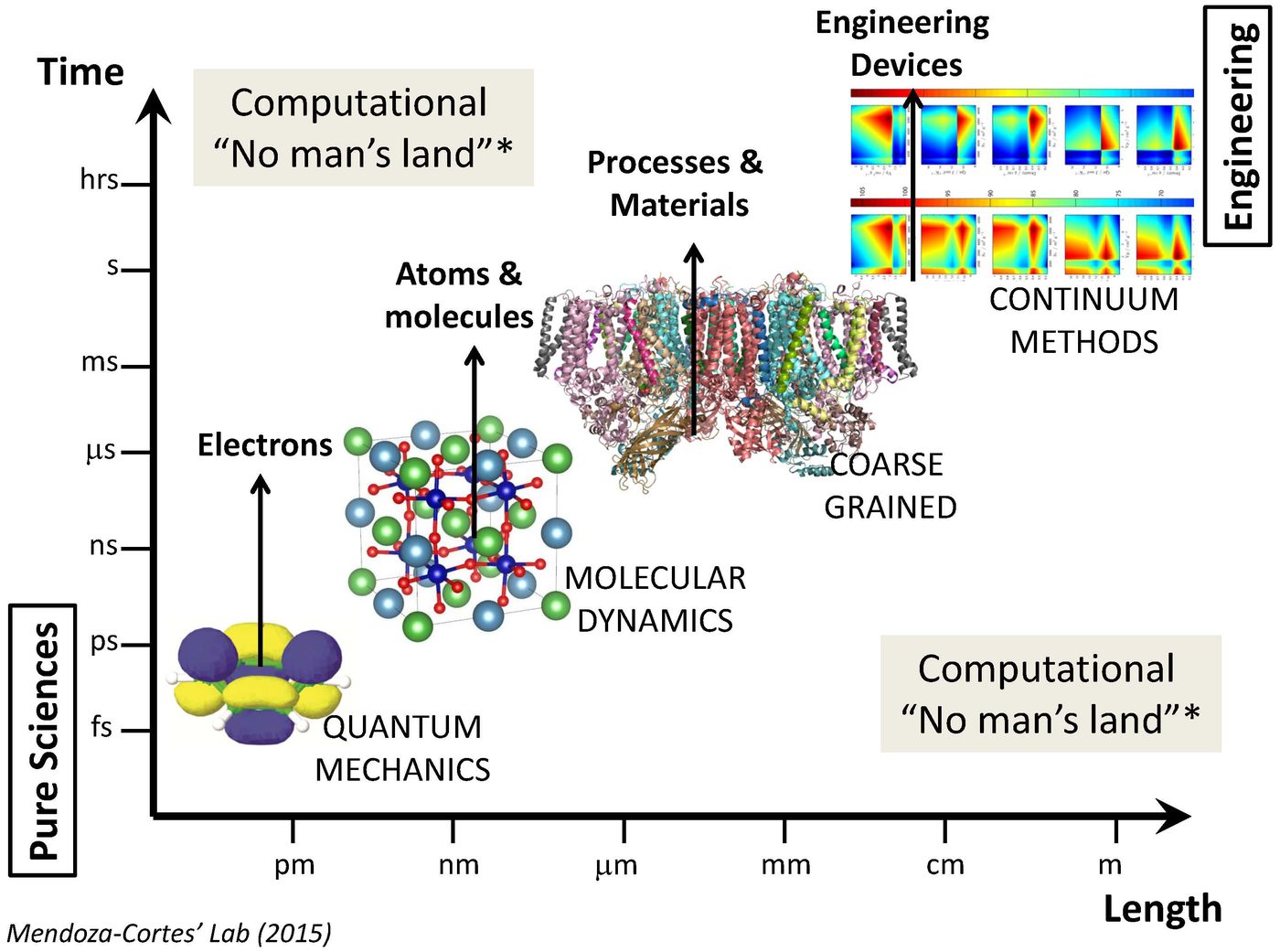
- Quantum mechanics. Density-functional theory (hybrid, dispersion-corrected and spin–orbit), wavefunction methods (MP2, coupled cluster) and four-component relativistic methods for molecules and periodic solids.
- Atomistic and multiscale simulation. Molecular dynamics, first-principles and reactive force fields, coarse-grained models, grand canonical Monte Carlo and continuum models.
- Machine learning and AI. Interatomic potentials trained on energies, forces and Hessians; classification experiments to choose molecular descriptors; reproducible pipelines and AI agents working inside audited workflows.
- Mathematics and quantum computing. Order theory, combinatorics and tropical algebra to understand learning machines; quantum algorithms for physics and chemistry.
- High-throughput workflows. Automated pipelines on MSU's high-performance computing center, the GPU-enabled MSU Data Machine and national facilities.
- Partnership with experiment. Most projects are designed together with experimental groups, from synthesis and electrochemistry to scanning-probe and terahertz spectroscopy.
This research has been funded by different internal and external grants. For more information, see Funding.