
José L. Mendoza-Cortés
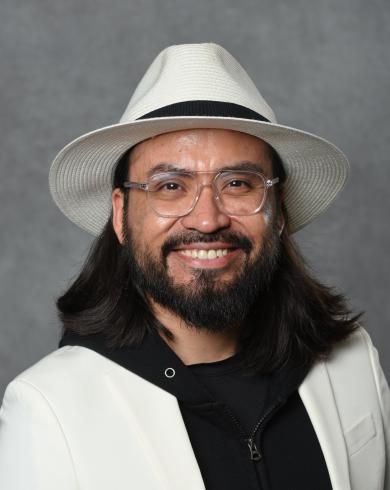
José L. Mendoza-Cortés is a theoretical and computational condensed-matter physicist, materials scientist and chemist at Michigan State University. He develops methods to solve the Schrödinger and Dirac equations and machine-learning models, studies their mathematical properties, and uses them with experimental partners to design materials for energy storage, catalysis, and 2D and quantum technologies. He received his Ph.D. from Caltech and was a postdoctoral fellow at UC Berkeley and Lawrence Berkeley National Laboratory.
Biography
José Mendoza-Cortés grew up in Mexico, where he earned top honors in the national knowledge olympiad for primary schools and, in high school, competed in the national olympiads in chemistry, informatics, mathematics and physics, representing Mexico at the 2002 International Chemistry Olympiad. He studied chemistry at Tecnológico de Monterrey (B.Sc. 2008) and spent the last two years of his degree as an exchange student at UCLA, completing graduate coursework and joining the group of Omar Yaghi.
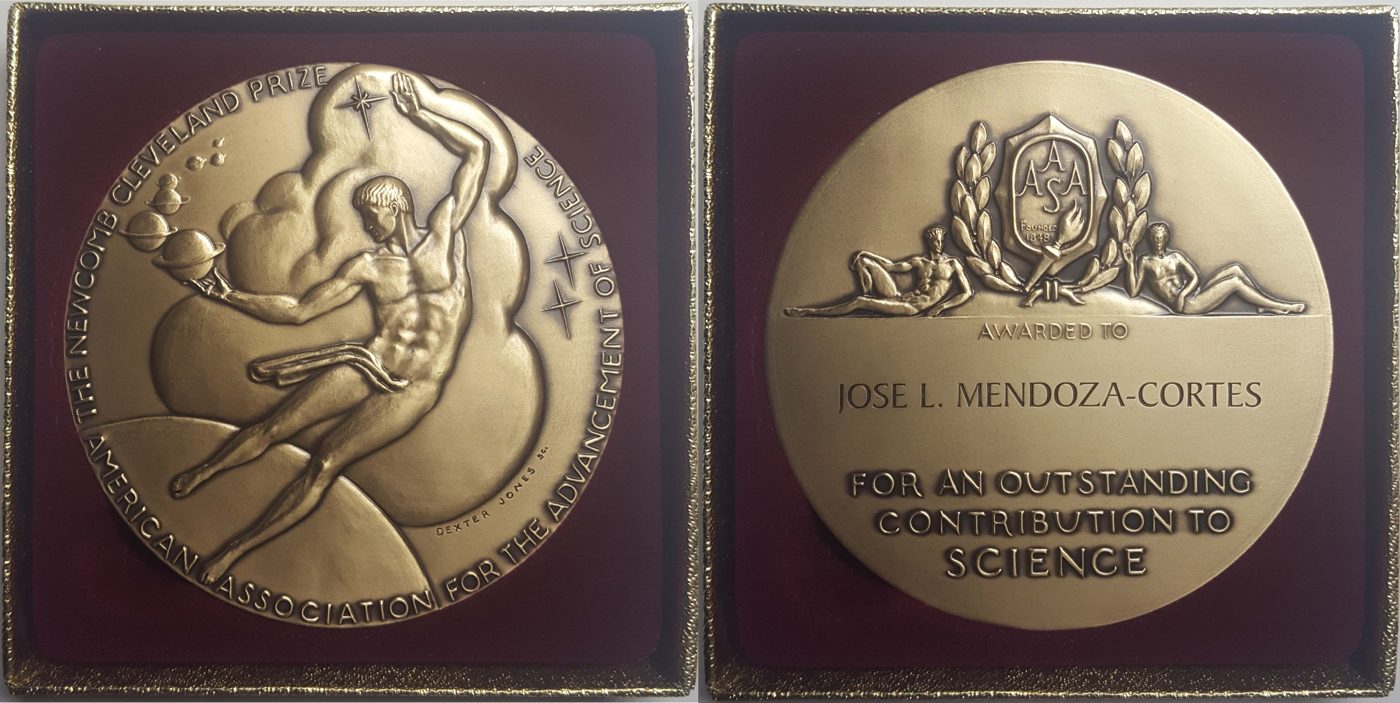
As an undergraduate he co-authored the first three-dimensional covalent organic frameworks (Science, 2007), building the computational models used to identify their structures; the paper received the AAAS Newcomb Cleveland Prize. He also catalogued the secondary building units of metal-organic frameworks (Chemical Society Reviews, 2009), a standard reference for designing the materials recognized by the 2025 Nobel Prize in Chemistry; Omar Yaghi's Nobel lecture lists him among the group's former visiting students.
He earned his M.Sc. (2010) and Ph.D. (2012) at Caltech with William A. Goddard III, with a thesis on the design of molecules and materials for clean energy, catalysis and molecular machines. He then helped start the theory and simulation effort of the Joint Center for Artificial Photosynthesis at Caltech and was a postdoctoral fellow with Martin Head-Gordon at UC Berkeley and Lawrence Berkeley National Laboratory.
In 2015 he became an assistant professor of chemical and biomedical engineering at the FAMU–FSU College of Engineering, with affiliations in scientific computing and materials science (and, from 2018, physics) at Florida State University and as a scientist at the National High Magnetic Field Laboratory. He created FSU's first courses on machine learning and quantum computing. He joined Michigan State University in 2020, where he leads the Mendoza Lab.
His research has been featured by Forbes, CNBC, public radio, MRS Bulletin, C&EN, Laser Focus World, the U.S. Department of Energy and MSUToday, and he has given 70 invited talks, including keynote lectures. He is a proponent of renaissance science: solving problems by combining fields regardless of where their traditional boundaries lie. Through his advisors, his academic ancestors include Marie Curie and Ralph Fowler, the doctoral advisor of Paul Dirac (academic tree), and a 2023 mathematics paper gave him an Erdős number of 5.
Appointments
| Years | Position | Institution |
|---|---|---|
| 2020–present | Assistant Professor, Chemical Engineering and Materials Science | Michigan State University |
| 2023–present | Affiliated faculty, Physics and Astronomy | Michigan State University |
| 2015–2020 | Assistant Professor, Chemical and Biomedical Engineering | FAMU–FSU College of Engineering (Florida A&M University and Florida State University) |
| 2015–2020 | Scientist, Condensed Matter Science | National High Magnetic Field Laboratory |
| 2015–2020 | Affiliated faculty, Scientific Computing and Materials Science and Engineering | Florida State University |
| 2018–2023 | Affiliated faculty, Physics | Florida State University |
Education and training
| Year | Degree or position | Institution |
|---|---|---|
| 2014 | Postdoctoral fellow, theoretical chemistry (with M. Head-Gordon) | UC Berkeley and Lawrence Berkeley National Laboratory |
| 2012–2013 | Staff scientist and postdoctoral scholar | Caltech and the Joint Center for Artificial Photosynthesis |
| 2012 | Ph.D., Materials Science and Applied Physics (advisor: W. A. Goddard III) | California Institute of Technology |
| 2010 | M.Sc., Materials Science and Applied Physics | California Institute of Technology |
| 2008 | B.Sc., Chemistry | Tecnológico de Monterrey (ITESM), with two years at UCLA |
Honors and awards
- 2026 Keynote speaker, ACS Spring 2026, symposium This Would Change Everything
- 2025 Royal Society of Chemistry Emerging Investigator (PCCP 2025 Emerging Investigators)
- 2025 Advanced Materials Rising Stars
- 2025 Nominated by MSU for the Blavatnik National Awards for Young Scientists
- 2024 Telly Award for the documentary on the lab produced by MSU ICER
- 2023 Speaker, Blue/Green Seminar (University of Michigan and MSU)
- 2020–2023 Scialog Fellow, Negative Emissions Science, four consecutive years
- 2018 Royal Society of Chemistry Emerging Investigator
- 2018 Carl Storm Fellowship, Gordon Research Conferences
- 2017 Office of Naval Research Summer Faculty Fellowship
- 2016 Council on Research and Creativity Assistant Professor Award, Florida State University
- 2010 Graduate Student Travel Award, Caltech
- 2009 Roberto Rocca Graduate Fellowship (15 fellows per year worldwide)
- 2009 International Center for Materials Research fellowship, UC Santa Barbara (declined)
- 2007 AAAS Newcomb Cleveland Prize, best paper in Science
- 2007 Glenn T. Seaborg Symposium, UCLA
- 2006 Most Promising Young Scientist Award, Ministry of Education, Mexico (one per year)
- 2005 Snyder Research Fellowship, University of Illinois at Urbana-Champaign
- 2002 International Chemistry Olympiad, Groningen, the Netherlands
- 2002 Mathematics Olympiad, silver medal
- 2001 Chemistry Olympiad, gold medal; Physics, Mathematics and Informatics Olympiad, gold medal
- 1997 National olympiad for primary schools, gold medal
Professional service
- Panelist, DOE Basic Energy Sciences Roundtable on Foundational Science for Carbon-Neutral Hydrogen Technologies (2021).
- Proposal reviewer for NSF (panels in 2016, 2024 and 2025), DOE (including Energy Frontier Research Centers), NIH, the ACS Petroleum Research Fund and the Austrian Science Fund.
- Referee for JACS, J. Chem. Theory Comput., J. Phys. Chem. Lett., npj Computational Materials, Advanced Materials, Nano Letters, Chemical Reviews, Angewandte Chemie and many other journals.
- Co-organizer of a symposium at the ECS meeting in Chicago (2025); one of about 30 organizers at large of the 2021 APS March Meeting; chair of the Dynamic Dirac Quantum Matter (2019) and Advances in Dirac and Weyl Materials (2017) workshops.
- Member of the American Physical Society Committee on Minorities (2018–2022), during which the APS Bridge Program became part of the Inclusive Graduate Education Network.
- MSU: College of Engineering Computing Services Advisory Committee (2022–2028); Community Engagement, Innovation and Entrepreneurship Task Force (2024–2025); 1855 Professorship search committee (2023); CHEMS semiconductor faculty search (2024–2025, both positions filled) and Marketing Committee (2023–present); 12 doctoral committees at MSU and 19 at FSU.
- Member of APS, MRS, ACS, AIChE and SHPE.
Academic family tree
Academic genealogy through doctoral and postdoctoral advisors. Students who graduate from the group join both lines.
Through the Ph.D.
- José L. Mendoza-Cortés, Ph.D. 2012, Caltech
- William A. Goddard III, Ph.D. 1964, Caltech
- Pol Duwez, D.Sc. 1933, Université Libre de Bruxelles
- Émile Henriot, D.Sc. 1912, Sorbonne
- Marie Curie
Through the postdoc
- José L. Mendoza-Cortés, postdoc 2014, UC Berkeley
- Martin Head-Gordon, Ph.D. 1989, Carnegie Mellon
- John Pople, Ph.D. 1951, Cambridge
- John Lennard-Jones, D.Sc. 1924, Cambridge
- Ralph H. Fowler, who advised Paul Dirac (Ph.D. 1926)
A few more things
- Omar Yaghi's 2025 Nobel Prize lecture in chemistry lists him among the group's former visiting students (slide 49).
- A 2023 paper in mathematics gave him an Erdős number of 5, so anyone who publishes with the group has an Erdős number of at most 6.
- As one of the best students in Mexico's national academic olympiad for sixth graders, he met the president of the country.
- His photo appeared on the back cover of the textbooks of a public high-school system, because he took part in every science olympiad available at the time (chemistry, physics, informatics and mathematics).
- His family branch is connected to the Spanish conquistador Hernán Cortés and to Antonio de Mendoza, the first viceroy of New Spain.
- Scientific heroes: Marie Curie, Paul Dirac and Grigori Perelman.
- Languages: Spanish (native), English (fluent), basic Mandarin and French.