 The Donald Morelli Research Group
Thermoelectric Materials
The potential for a material to be a good thermoelectric is generally determined by measuring the thermoelectric dimensionless figure of merit also known as the zT. This value is generally near 1 for a good thermoelectric material. The goal of thermoelectrics research is to increase this value in bulk materials in order to increase the efficiency of a multitude of processes.
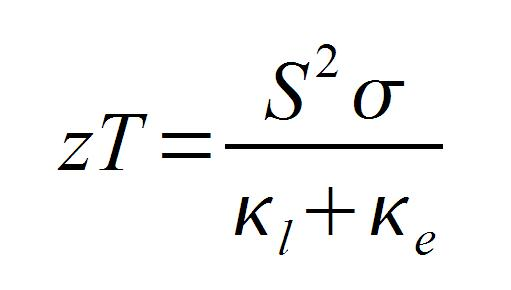
S: Seebeck coefficient (μV/K)
σ: electrical conductivity (μΩcm)
κl: lattice thermal conductivity (W/cmK)
κe: electronic thermal conductivity (W/cmK)
Increasing zT
Reducing Thermal Conductivity
One of the primary methods for increasing the zT is to reduce the thermal conductivity. The thermal conductivity of a material is made up of two components, the lattice component and the electronic component. The electronic component of the thermal conductivity comes from the heat that is transfered through the material via the charge carriers and is directly related to the electrical conductivity (σ in the numerator). Therfore, reducing κe is not beneficial to the zT. The lattice component of the thermal conductivity is a result of heat transfer via lattice vibrations, also known as phonons. κl is independent of the numerator and thus reducing this value can contribute to an increase in the final zT value.
 |
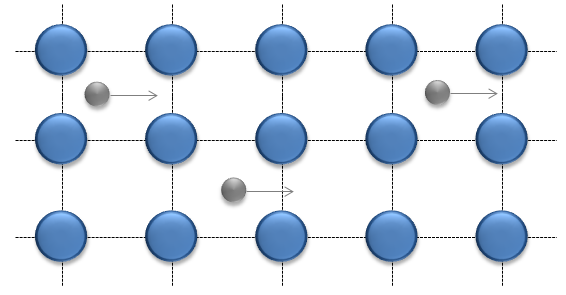 |
| Phonons are vibrations that move through the lattice carrying heat (κl). These vibrations happen in the longitudinal and transverse directions. | Electrons also move through the lattice carrying heat. Scattering these electrons can reduce the κe; however scattering electrons reduces electrical conductivity and is detrimental to the zT value. |
There are several "tried and true" methods for reducing the lattice thermal conductivity of a material. Each of these methods involves scattering the phonons as they move through the lattice at different length scales. The three methods discussed below scatter phonons in three different scales: angstroms, nanometers, and microns.
- Angstroms: Substitution and doping methods involve replacing a fraction of one of the original elements in the host material with an isoelectronic atom (substitution) or an atom with ±1 electron (n or p-type doping). This "impurity" atom is randomly dispersed throughout the unit cells of the material and has a different size and mass than the atoms in the host matrix. Therefore, the phonons traveling through the lattice experience a defect and are scattered on the atomic or angstrom length scale.
- Nanometers: Phonons are scattered on the nanometer length scale by using nanoinclusions. These inclusions are nano-scale particles incorporated into the material during synthesis or sintering which may be made of the same compound or a unique material. The nano-inclusions cause the phonons traveling through the material at the nanometer scale to experience a defect and scatter, reducing the thermal conductivity.
- Microns: Grain boundary engineering is used to scatter the long wavelength phonons in the range of several microns. This is done by powder processing and adjusting the sintering parameters in order to reduce the final grain size of the material. As phonons encounter a grain boundary they are scattered, thus increasing the number of grains can reduce the lattice thermal conductivity on the micron length scale.
Each of these methods may be incorporated into a material individually or in combination. Depending on the intrinsic thermal conductivity of the material, the different methods may have different effectiveness in enhancing the overall zT value.
Increasing Power Factor
The numerator of the above zT equation is often referred to as the power factor. By increasing this value the zT of a material can be enhanced. The primary method for increasing the power factor is doping.
Doping is done by replacing one of the host atoms with an element with ± one electron (compared to the host element). In doing this, the carrier concentration of the compound can be tailored to the optimal level. Doping concentrations are usually rather low (<15%) and often reach a solubility limit where the compound cannot be formed homogeneously with large concentrations of the dopant atom. The Seebeck coefficient and electrical conductivity are both dependant on the carrier concentration and carrier mobility. Thus the ability to tailor the carrier concentration via atomic doping is critical to optimizing the power factor.
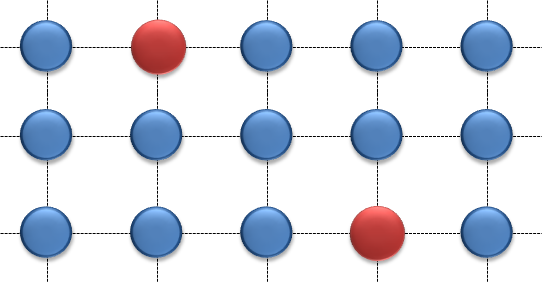
or one less electron (red), changing the carrier concentration of the material.