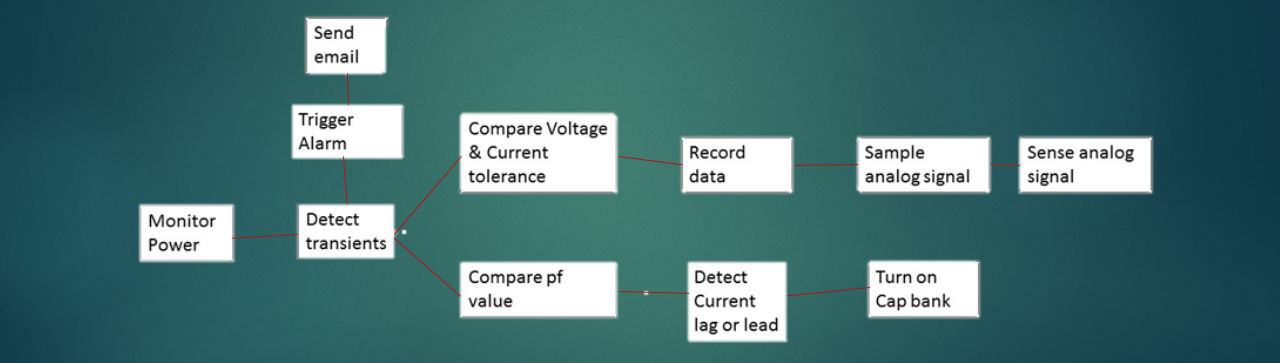
Prototype
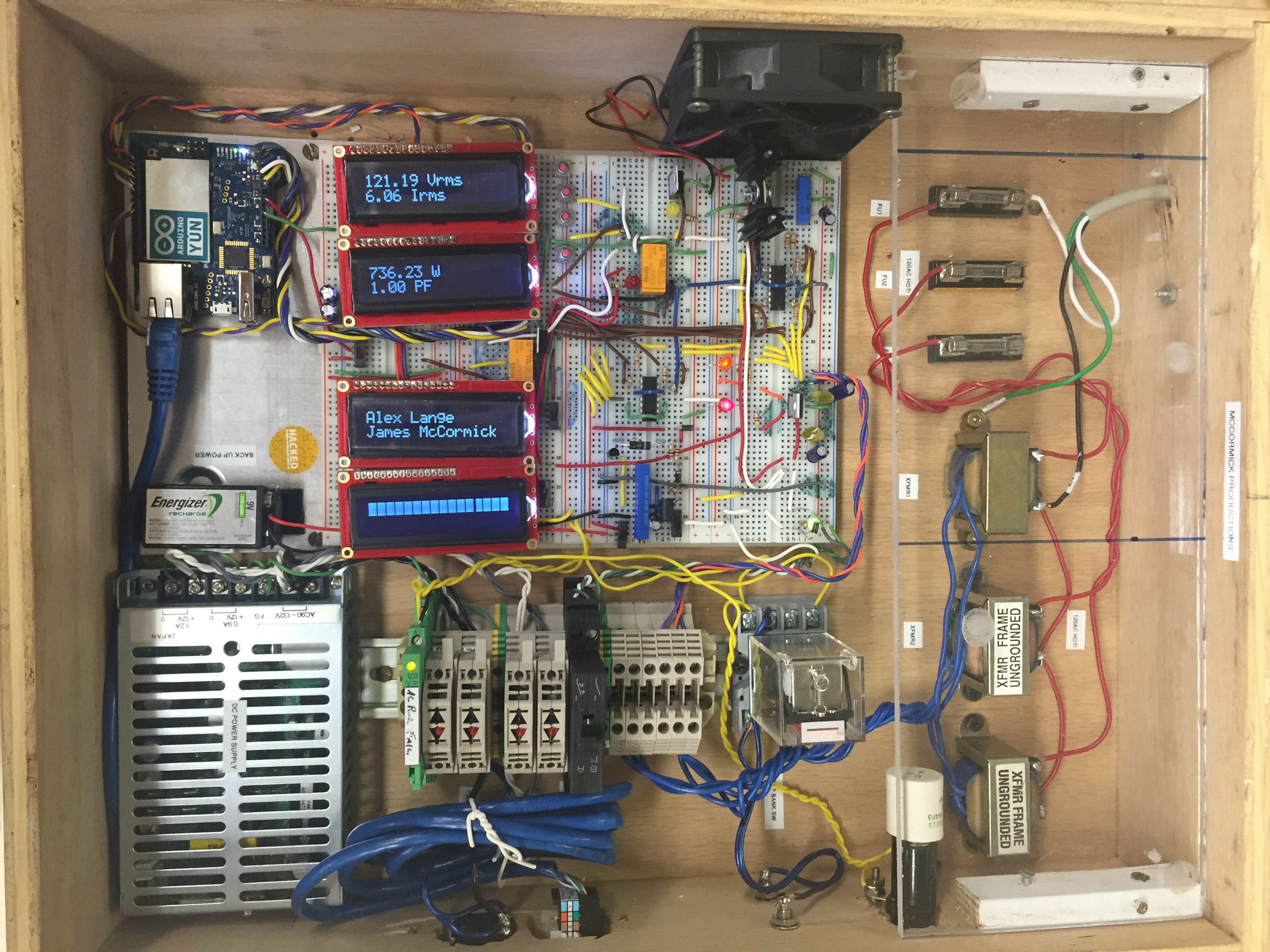
Hardware:
-Microcontroller
-Signal conversion circuit
-Under voltage switch over circuit
-Battery charger circuit
-Input voltage/power circuit
-Current clamps
-Voltage transformers
-LCD displays
-Enclosure
Microcontroller: Arduino YÚN
-General Methodology
Timer
Functions continually check time and compare it to their task period
Benefits: not using a lot of processing power for less important tasks (updating LCDs)
-Limitations
Limited I/O on microcontroller
-Overcoming Limitations
Using I2C communication for LCDs
Add module to LCD to give them different addresses
Cuts down the number of I/O required for the four LCDs from 9 to 2
-Microcontroller
-Signal conversion circuit
-Under voltage switch over circuit
-Battery charger circuit
-Input voltage/power circuit
-Current clamps
-Voltage transformers
-LCD displays
-Enclosure
Microcontroller: Arduino YÚN
-General Methodology
Timer
Functions continually check time and compare it to their task period
Benefits: not using a lot of processing power for less important tasks (updating LCDs)
-Limitations
Limited I/O on microcontroller
-Overcoming Limitations
Using I2C communication for LCDs
Add module to LCD to give them different addresses
Cuts down the number of I/O required for the four LCDs from 9 to 2