

Composition-Processing-Microstructure-Property Relationships of Fe And Al Modified Ti-Cr Alloys
Beta-Titanium (Ti) alloys have applications in several industries (e.g. aerospace, automotive, and biomedical) where material performance requirements vary widely. Low-cost beta-Ti alloys, containing lower-cost alloying elements, are currently being investigated to help expand Ti alloy applications into industries where cost is prohibitive. Because the BCC beta phase is a metastable phase, it can undergo transformations to other metastable and stable phases which allow the microstructure and mechanical properties of beta-Ti alloys to be tailored to different applications. To control the microstructure of beta-Ti alloys, it is critical to understand the influence of individual alloying elements as well as the influence of processing conditions on the phase transformation in these alloys.
To investigate the composition-processing-microstructure-property relationships of beta-Ti alloys, a low-cost Ti-Cr alloy system was chosen and modified using Fe and Al additions. Four alloy combinations were used to target the beta-to-omega and beta-to-alpha phase transformations: Ti-11Cr, Ti-11Cr-0.85Fe, Ti-11Cr-5.3Al, and Ti-11Cr-0.85Fe-5.3Al (all in at%). These alloys were subjected to 400C heat treatments for times between 0 and 24hrs and the phase transformations and mechanical properties of the alloys were investigated using multi-scale, multi-modal techniques. Scanning and transmission electron microscopy, high-temperature x-ray diffraction, and atom probe tomography techniques were used to determine the phase transformations and the diffusion of alloying elements occurring during the heat treatments.
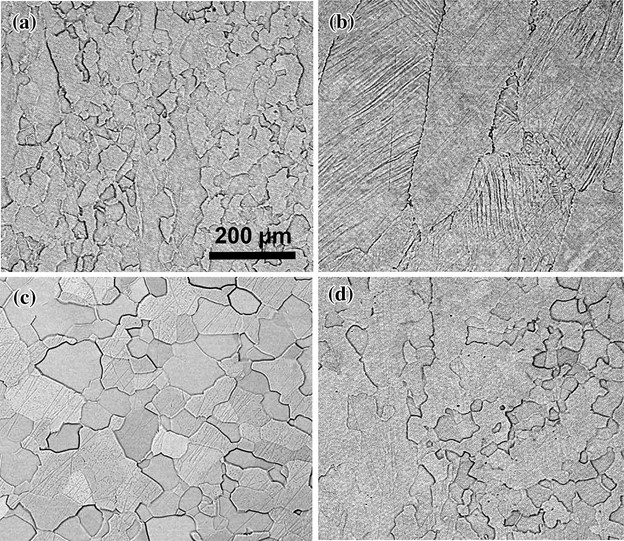
Back-scattered electron (BSE) images and energy-dispersive x-ray spectroscopy (EDS) measurements were taken using a FEI Quanta 3D field emission gun (FEG) dual beam focused ion beam/scanning electron microscope (FIB/SEM). Figure 1 shows representative BSE images of all the alloys. While Figure 1b has plate- or needle-shaped lamella in the microstructure, these features are an artifact of the etching process. Adding Fe or Al resulted in increased grain size in all three orientations. The addition of Fe approximately doubled the average grain size. The addition of Al nearly tripled the average grain size; thus, Al had a more pronounced effect on enhancing the grain size. However, when Al was added to the TCF alloy, the average grain size only increased by 20%. As such, there appears to be a reduced effect of Al on grain growth when combined with Fe addition. Overall, by adding both 3 wt.% Al and 1 wt.% Fe to Ti-12Cr (wt.%), a greater than doubling of the average grain size resulted.
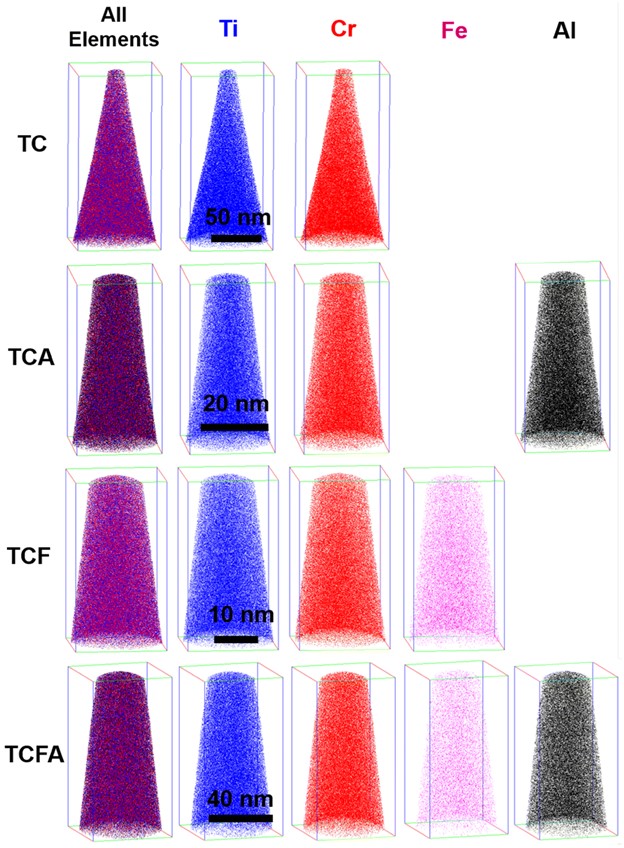
Needle specimens for atom probe tomography (APT) were prepared from the polished bulk metallographic samples by the focused ion beam (FIB)-based lift-out and annular milling method. To check this nanoscale compositional homogeneity of all four alloys, APT analysis was conducted. The ion maps in Figure 2 indicate that the element distribution in all four alloys was relatively uniform.
Hardness testing, tensile testing, and resonance ultrasound spectroscopy have been used to investigate the mechanical properties of the alloys. Overall, a complete understanding of the composition-processing-microstructure-property relationships is being developed which can help further improvement of low-cost beta-Ti alloys.
Publications from this project:
J. Ballor, M. Ikeda, E.J. Kautz, C.J. Boehlert, A. Devaraj, “Composition dependent microstructure-property relationships of Fe and Al modified Ti-12Cr(wt%)”, Journal of Materials, Vol. 71 no. 7 (2019) 2321-2330. https://doi.org/10.1007/s11837-019-03467-y
J. Ballor, E. Kauth, B. Gwalani, C.J. Boehlert, and A. Devaraj, “Influence of Composition and Structure on Measured H Concentration in beta-Ti Alloys via Atom Probe Tomography”, Microscopy and Microanalysis (2019). https://doi.org/10.1017/S1431927619013448

