

Composition-Processing-Microstructure-Property Relationships of the Zinc-Magnesium System for Absorbable Biomedical Implant Applications
The search for absorbable metal systems, showing a good combination of mechanical properties, uniform corrosion behavior, and biocompatibility, remains to be an open challenge. Magnesium (Mg) and zinc (Zn) have been identified as the most suitable elements to explore the next generation of biodegradable medical implant devices. However, none of the current Zn-Mg alloys is yet able to simultaneously meet those three benchmarks: adequate mechanical performance (i.e. tensile strength > 300 MPa, elongation-to-failure ( ) > 20%) for structural support, biocompatibility to prevent an inflammatory response, and a corrosion rate matching that of the healing tissue.
It is well established in the field of physical metallurgy that the refinement of grain size increases the yield strength of polycrystalline materials. This has led to a continuing tendency for designing metallic materials with fine microstructures that generally exhibit superior strength, hardness, and wear resistance. In addition to high strength, adequate and toughness are also required for engineering materials to prevent catastrophic failure during service. However, strength and tend to be mutually exclusive properties, and there is usually a trade-off between both, which complicates the development of advanced materials for structural and functional applications.
Unlike conventional metal forming processes, i.e. rolling, forging, or extrusion, severe plastic deformation (SPD) techniques have shown potential to achieve a high strength while maintaining a good . In particular, Boehlert’s research group is focused on high-pressure torsion (HPT), as it is considered the most effective SPD technique in terms of grain refinement, and has been used for synthesizing new metal systems that can promote additional strengthening mechanisms. In collaboration with Professor Megumi Kawasaki of Oregon State University, Zn-Mg hybrid disks have been HPT-processed under 6 GPa applied pressure at room temperature (RT) under different conditions (1, 5, 15, and 30 turns) to evaluate their performance as potential absorbable biomedical candidates, see Figure 1.
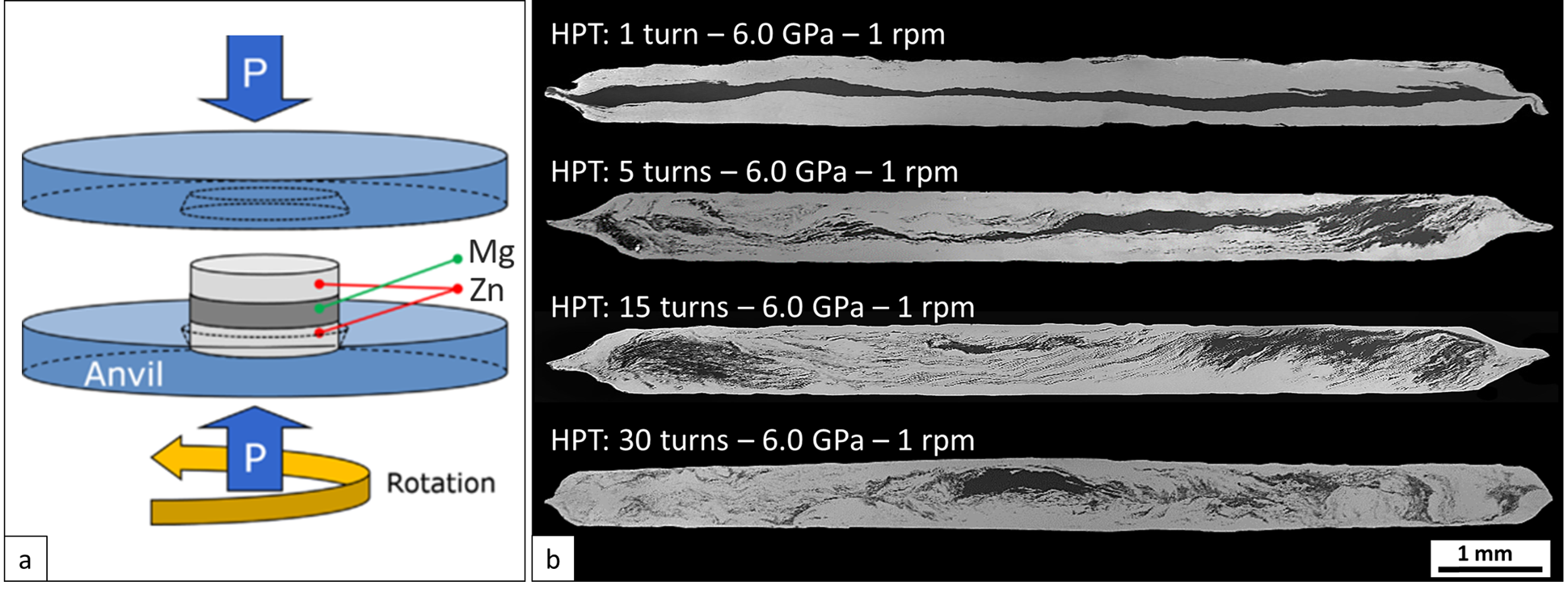
Microstructural characterization via SEM revealed the development of a sub-micron multilayered structure embedded in a Zn-rich matrix with an average grain size of ~ 600 nm at the disk periphery after 30 turns. The central regions of the disks consisted of relatively larger Mg-rich and Zn-rich phases after 1 and 5 turns. At least 15 turns were needed to achieve a relatively homogenous microstructure. A general tendency for decreasing the grain size and the scale of the multilayered structure was observed with increasing radial distance and number of HPT turns.
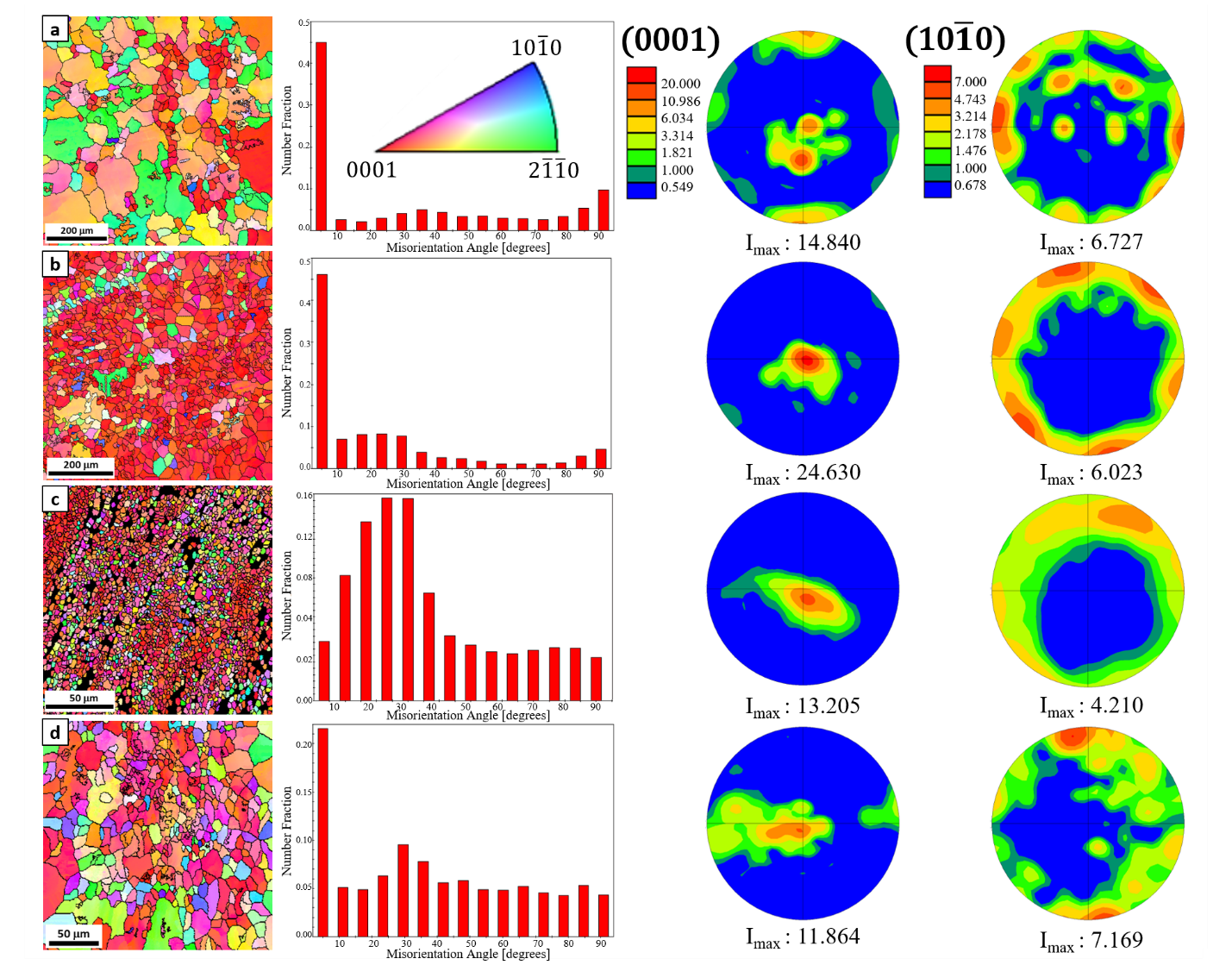
Electron backscattered diffraction (EBSD) analysis showed that the grain size refinement of the Zn-rich phase, from 1 to 15 turns, was accompanied by a significant increase in the volume fraction of high-angle boundaries (HABs), see Figure 2. A strong basal texture developed after 5 turns, however, the maximum intensity value of the corresponding (0001) pole figure decreased gradually from 5 to 30 turns, suggesting the occurrence of DRX during HPT.
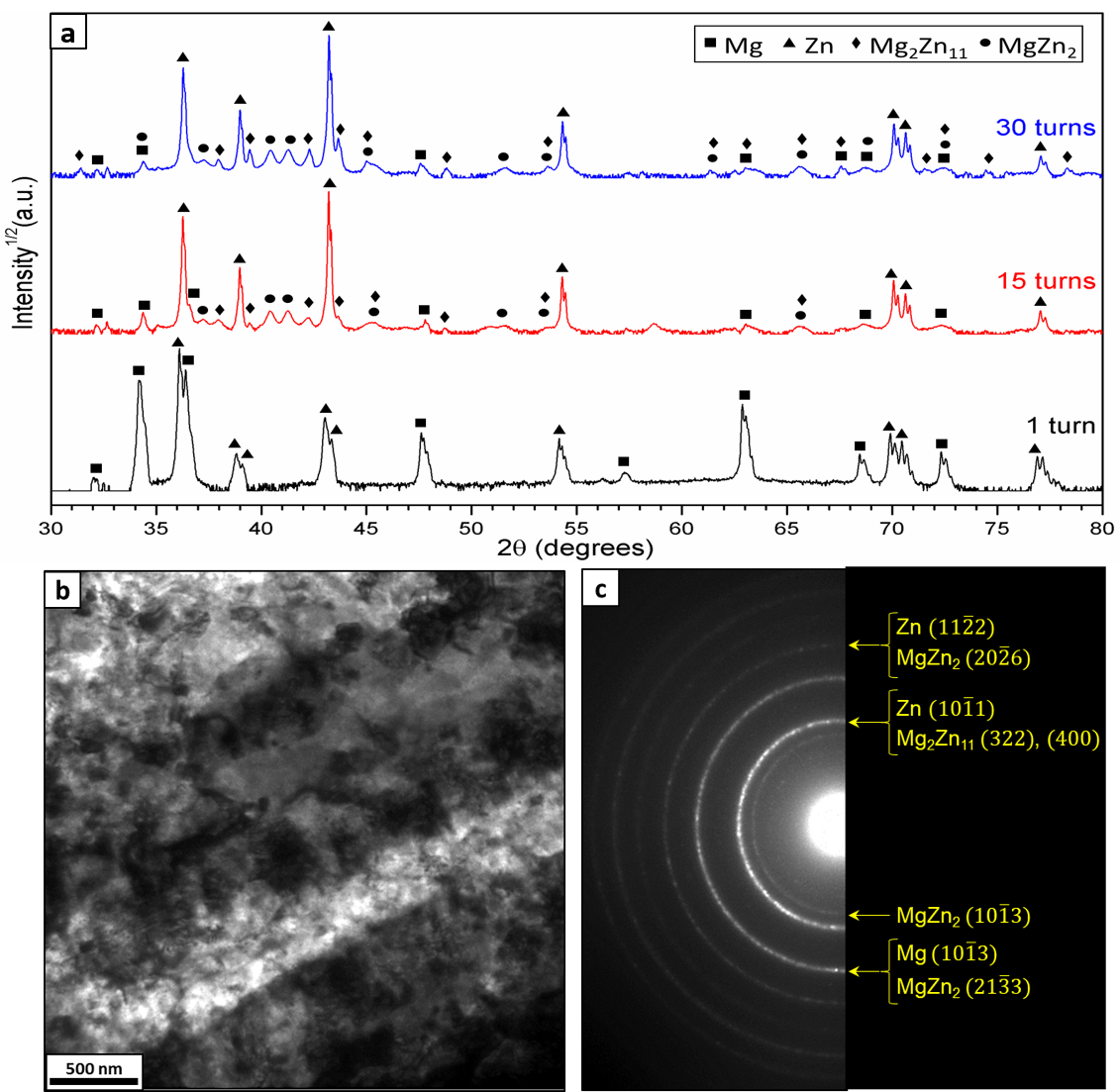
X-ray diffraction along with transmission electron microscopy (TEM) demonstrated that HPT was able to in induce the nucleation of the intermetallic compounds, Mg2Zn11 and MgZn2, identified close to the disk edges after 15 and 30 turns, see Figure 3. The volume fraction of these intermetallics increased consistently with the number of turns, as determined from Rietveld refinement. Similarly, an exceptional increase of the hardness values was recorded with the increasing number of turns, with values over 250 HV after 30 turns at the disk periphery. These values are among the highest hardness values ever reported for the Zn-Mg alloy system, and it is due to the contribution of several strengthening mechanisms: Hall-Petch effect and hard intermetallic compounds.
Overall, these results have demonstrated that HPT exhibits potential for the development of Zn-Mg hybrid systems (at RT) with ultrafine-grained metal-matrix structures having enhanced hardness that may open a window towards the research of a new generation of medical device applications.
Publications from this project:
D. Hernández-Escobar, R.R. Unocic, M. Kawasaki, and C.J. Boehlert, “High-Pressure Torsion Processing of Zn-3Mg Alloy and its Hybrid Counterpart: A Comparative Study”, Journal of Alloys and Compounds, Vol. 831 (2020) 154891. https://doi.org/10.1016/j.jallcom.2020.154891
D. Hernández-Escobar, J. Marcus, J-K Han, R.R. Unocic, M. Kawasaki, and C.J. Boehlert, “Effect of post-deformation annealing on the microstructure and micro-mechanical behavior of Zn-Mg hybrids processed by High-Pressure Torsion” Materials Science and Engineering A, vol. 771 (2020) 138578. https://doi.org/10.1016/j.msea.2019.138578
D. Hernandez-Escobar, Z.U. Raman, H. Yilmazer, M. Kawasaki, and C.J. Boehlert, “Microstructural evolution and intermetallic formation in Zn-Mg hybrids processed by High-Pressure Torsion”, Philosophical Magazine, Vol. 99, Issue 5 (2019) pp. 557-584. https://doi.org/10.1080/14786435.2018.1546962

