ECE 480 Team 5:
Interactive Radar Demonstration
Project Details
Goal
Our goal was to develop an interactive radar
demonstration that will engage children and hopefully spark an interest in
radar technology and its related fields. We believe that an interactive,
game-like display with colorful, stimulating graphics will attract their
attention and prompt them to wonder how the box across the room knows where
they are. If our design is successful, our product will expose children to the
fascinating idea of action at a distance and, hopefully, encourage them to
pursue an education in science or engineering.
Project
In order to attract the attention of
children, we developed an interactive Pong emulation. Starting with the MIT
Lincoln Labs radar kit, we proposed using a multi-platform processing chain to
process the radar signal, extract range and velocity data, and use this data to
control the position of the player’s paddle on the screen. To accomplish
our goal, we selected the Arduino MEGA 2560 R3 processor and the 4D Labs PICASO
uVga card. The Arduino handles signal processing, including noise cancellation
and frequency peak detection, and the PICASO generates the game graphics as dictated
by the output of the Arduino.
Many long hours of testing the project
revealed some problems, including a very small window of range detection. To
compensate for these issues, we designed a filtering and biasing circuit to
condition the input signal to the Arduino. After this circuit was implemented,
the project performed better overall, but the range limitation still remained.
We were unable to identify for sure the cause of this issue, but we suspect
there may be reflection issues in the RF stage of the project.
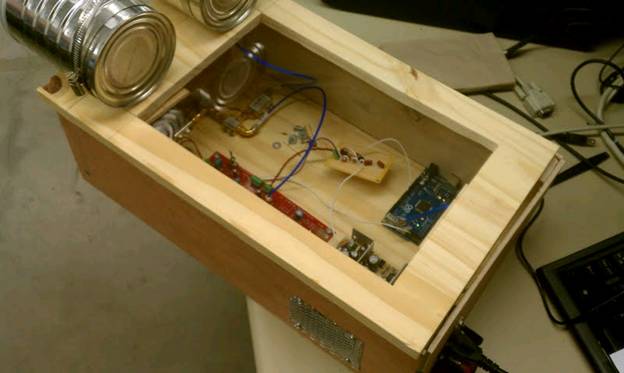
As testing concluded, we constructed a
wooden box to house the project. The box increases the convenience of our
design, and allows the entire product to be placed on a movable cart for
portability. The box can be seen below in a testing environment.
Unfortunately, as mentioned before, our
team was unable to remedy the problem of poor range detection. We hope that
future teams will be able to expand and improve upon our design for a more
interactive and exciting demonstration.