|
MSU students and faculty have installed different types of computer labs in 4 schools near Mto wa Mbu, Tanzania over the last 4 years. All of these schools have wireless access to the internet via a solar powered remote satellite uplink. To conserve energy and thus decrease system cost and increase lifespan, it is desirable for the system to power itself down when no schools are using the Internet.
Each school that accesses the network needs to be able to ask the solar system to turn on from a remote location. The team is to use some sort of GSM (cellular) transmitter/receiver at each remote school to “call” the solar-powered Internet access system at the base school and ask for access (i.e., the power to that system must be turned on). Thus, when the system is off, the only power drain will be that necessary to keep the GSM receiver available to receive the call and turn on the power. If the GSM transceiver is mounted adjacent to the satellite router and solar power system, it will require an external antenna, as the router/battery/inverter system is entirely contained in a steel box.
Further, the satellite system should monitor itself, especially battery state of charge, and prohibit turn on when conditions warrant it. Since GSM capabilities will already be built in, the system should be able to “text” our local solar technicians in case of certain fault conditions. This will dramatically reduce downtime, because it is common for dirt storms to cake the solar panels, or a mouse to chew through a wire. In addition, in the “base” school with the Internet antenna and in one or two other schools where the computer systems served are also solar powered, the monitoring system should also report on the state of the solar system’s battery charge and, when charging, the charging rate, logging these data and reporting major deviations to the local solar tech.
|
|
 |
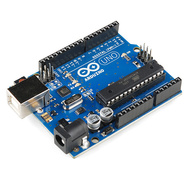 |
Arduino Uno Multicontroller (Revision 3)
The Arduino Uno is a microcontroller board based on the ATmega328 (datasheet). It has 14 digital input/output pins (of which 6 can be used as PWM outputs), 6 analog inputs, a 16 MHz crystal oscillator, a USB connection, a power jack, an ICSP header, and a reset button. It contains everything needed to support the microcontroller; simply connect it to a computer with a USB cable or power it with a AC-to-DC adapter or battery to get started.
|
|
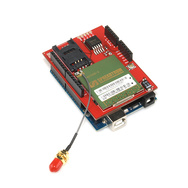 |
Cellular Shield with SM5100B
The Cellular Shield for Arduino includes all the parts needed to interface your Arduino with an SM5100B cellular module. This allows you to easily add SMS, GSM/GPRS, and TCP/IP functionalities to your Arduino-based project. All you need to add cellular functionality to your Arduino project is a SIM card (pre-paid or straight from your phone) and an antenna and you can start sending Serial.print statements to make calls, send texts and serve web pages!
|
|
|
|
 |
 |
Wednesday, April 25th
Finished connections and soldering for connections between voltage monitoring system. Tested system on arduino. |
|
|
Friday, April 20th
Tested GSM functionality between devices. Tested ethernet monitoring system. Added connections between devices and tested accurate measuring of digital pin between modules. |
|
|
Thursday, April 12th
Finished design of all prototypes. Tested functionality of each module independently.
|
|
Friday, March 16th
Finalized parts list. All parts ordered.
|
|
Wednesday, March 7th
Final approval for project objectives from sponsor.
|
|
|
 |
Dow Chemical
|
 |
|
Study Abroad
|
 |
|
|