 |
Experimental
Solid Mechanics Laboratory
------------------------------------------
College of
Engineering
|
|
Mechanics of Energy Storage
Materials
In spite of decades of research, the capacity of the state-of-the-art
Li-ion batteries (which, for example, directly effects the range of an
electric car) did not improve to meet the future energy storage demands
. Replacing the existing electrodes with high performance materials
such as Si and Ge (as anodes) can improve the capacity of lithium-ion
batteries by 35%, which is a remarkable increase. However,
these
high performance materials exhibit poor cyclic performance (i.e., rapid
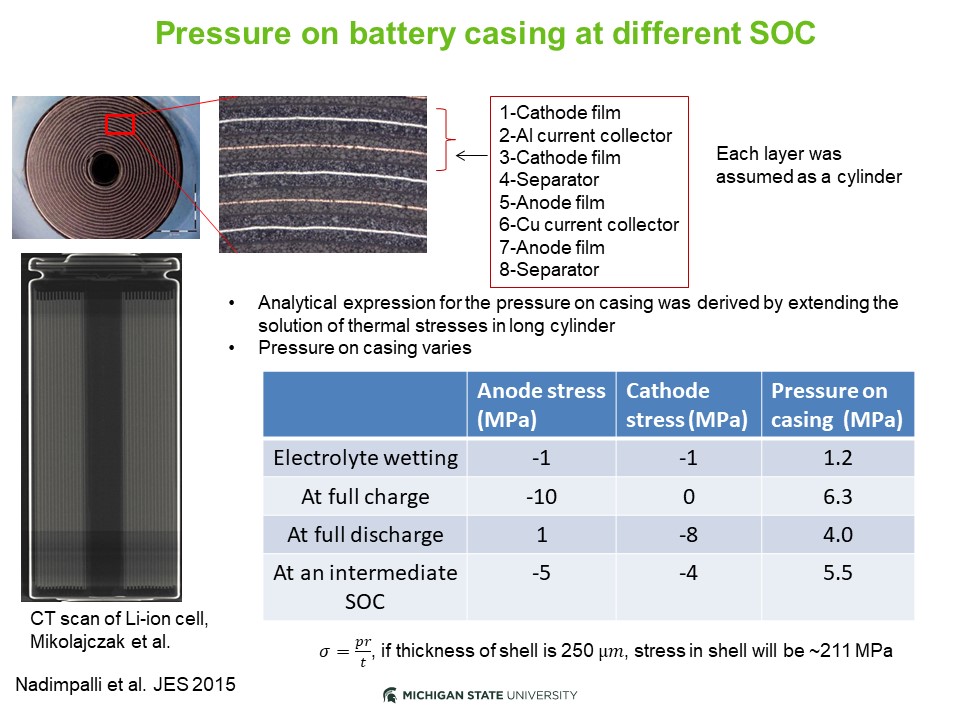
degradation) due to stresses generated in these materials during
charge/discharge (or lithiation/delithiation) reactions. The mechanical
stresses not only cause fracture of electrodes but also contribute to
chemical degradation (i.e., SEI layer), transport properties of
electrodes, and kinetics of chemical reactions. The
stresses play a key role in the performance of cathode materials as
well. Hence, it is essential to understand the mechanical behavior of
electrodes and how this effects the transport and kinetic properties.
Motivated by such
practical problems,
we have been developing in situ experimental techniques and multi-scale
theoretical models to provide a better understanding of the
chemo-mechanics of battery electrodes at various length and time
scales. Please visit the publicatios list for
full list of topics we have been working on.

-
Time-dependent deformation behavior of
polyvinylidene fluoride binder: Implications on the mechanics of
composite electrodes,Vol 332, 118-128, 2016,
Journal of Power Sources. (Co-authors: A.
Santimetaneedol, R. Tripuraneni, and S.A. Chester)
-
On plastic deformation and fracture in Si
films during electrochemical lithiation/delithiation cycling,
Vol.160,
A1885-A1893, 2013, Journal of The Electrochemical Society. (Co-authors:
Vijay
Sethuraman and Pradeep R. Guduru)
-
Measurement and modeling of the mechanical
and electrochemical response
of amorphous Si thin film electrodes during cyclic lithiation,
In Press, 2013,
Journal of the Mechanics and Physics of Solids. (Co-authors: Giovanna
Bucci, Vijay Sethuraman, Allan F. Bower, Pradeep R.
Guduru)
-
Quantifying the capacity loss due to
Solid-Electrolyte-Interphase
layer formation in Li-ion batteries, Vol.215, 145-151, 2012,
Journal of Power
Sources. (Co-authors: Vijay A
Sethuraman, Swapnil Dhalavi, Brett Lucht, Michael Chon, Vivek Shenoy,
Pradeep
R Guduru)
-
Stress evolution in
composite silicon
electrodes during
lithiation/delithiatoin”, Vol. 160, 4, A739-A746, 2013,
Journal of The
Electrochemical Society. (Co-authors: Vijay
Sethuraman, A. Nguyen, M.J.
Chon, H.Wang,
D.P.Abraham, A.F. Bower, V.B. Shenoy, P.R. Guduru)
|
|
Fracture
Behavior of 3D Printed Thermoplastics
The
global additive manufacturing market for both rapid prototypes and
functional end-use parts is expected to grow at a compound annual
growth rate of 20%. Such a rapid market growth is realized due to the
advantages such as design flexibility, customized geometries and low
volume production, short design-to-manufacture cycle times, and reduced
assembly time. These advantages make 3D printing as the new
manufacturing paradigm. A recent sustainability perspective reveals
that 3D printing has the potential to reduce costs by US$170-593
billion, the total primary energy supply by
2.54–9.30 EJ and
CO2 emissions by 130.5–525.5 Mt by 2025.
Additive
manufacturing has been successfully adapted in several industries
including medical, aerospace, automotive, machinery, and architecture
industries. Due to the vast and promising applications of FDM printed
parts, their mechanical performance has been the focus of many studies.
However, the fracture properties of the 3D printed thermoplastics has
not been studied before. Here we developed fracture mechanics-based
methods to evaluate the fracture behaivor of 3D printed thermoplastics.
This work is a collaborative effort between our group and Prof. Ameli's
group at University of Washinton Tri-Cities.

-
Fracture
resistance measurement of fused deposition modeling 3D printed
polymers, Vol.60, 94-101, 2017, Polymer
Testing. (Co-authors:Nahal
Aliheidari, Rajasekhar Tripuraneni,
and Amir Ameli)
-
Intelayer
adhesion and fracture resistance of polymers printed through melt
extrusion additive manufacturing process, Vol. 156, 351-361,
2018, Materials & Design. (Co-authors: N Aliheidari, J Christ,
R Tripuraneni, and A Ameli)
|
|
Microelectronic
Packaging and Solderjoint Fracture
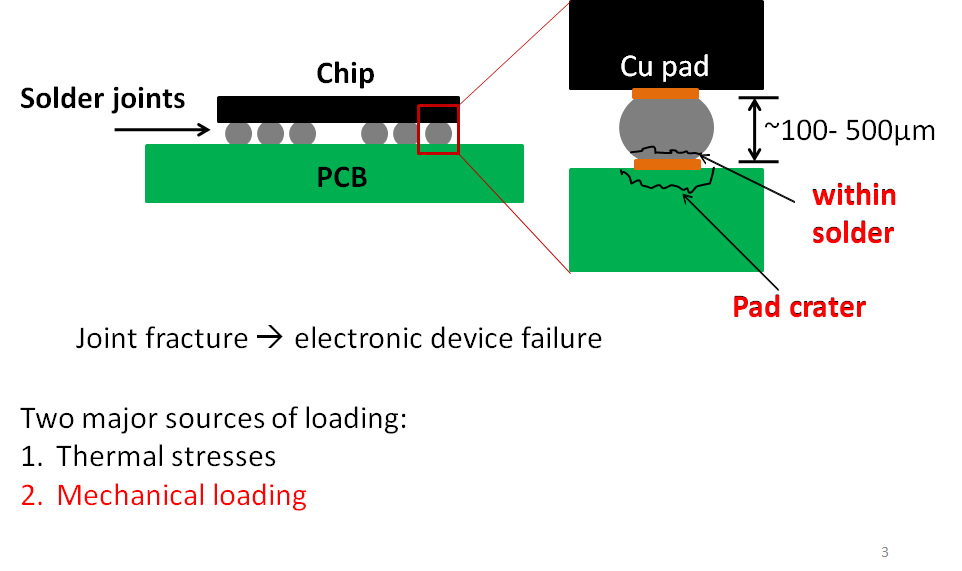
Microelectronic packages experience various thermal and mechanical
loading conditions during their assembly, testing and service
phases. Although most research has focused on solder joint failure due
to thermal fatigue, the mechanical strength of solder joints is also an
important performance parameter in many devices. This is especially
true in higher density array packages, larger printed circuit boards,
and electronic devices for aerospace and automotive applications, where
mechanical loads can be a significant cause of failure during service
and assembly. One of the main causes of device failure is the
fracture of solder joints in these packages. However, the
fundamental fracture behaviro of lead-free solder joints is not
understood thoroughly. We have developed experimental
techniques
to characterize the fracture behavior of lead-free solder joints.
- Effect of temperature on the fracture behavior of Cu/SAC305/Cu solder joints, Vol.199, 730-738, 2018, Engineering Fracture Mechanics. (Co-authors: PB Thompson and R. Johnson)
-
R-curve behavior of Cu-Sn3.0Ag0.5Cu solder
joints:Eeffect of
mode ratio and microstructure, Vol. 527, 724-734, 2010,
Material Science and
Engineering A. (Co-author: Jan K. Spelt)
-
Fracture load prediction of lead free solder
joints, Vol. 77,
3446-3461, 2010, Engineering Fracture Mechanics.(Co-author: Jan K.
Spelt)
-
Mixed-mode fracture load prediction of lead free
solder joints,
Vol. 78, 317-333, 2011, Engineering Fracture Mechanics.(Co-author: Jan
K. Spelt)
-
Effect of geometry on the fracture behaviour
of lead-free solder
joints, Vol.78, 1169-1181, 2011, Engineering Fracture
Mechanics.(Co-author: Jan K. Spelt)
-
Prediction of pad cratering fracture at the
copper pad-printed
circuit board interface, Vol. 52, 1454-1463, 2012,
Microelectronics
Reliability.(Co-author: Jan K. Spelt)
|
Contact
Information:
|
Prof.
Siva Nadimpalli
Department
of Mechanical Engineering
428 S. Shaw Lane,
East
Lansing, MI, 48824
Office:
517 432 2976, Lab: 517 432 3535
Email: sivan@msu.edu |
|