
NanoPATh Group
Nanoelectronics, Plasmas, & Accelerator Technology
Research

Our group is broadly interested in theoretical and computational research in nanoelectronics, electromagnetic fields and waves, plasmas, and accelerator technology. We identify the practical problems and explore the underlying physics for the development of novel nanoscale devices, emerging plasma and vacuum nanoelectronics, compact radiation sources (radio frequency - microwave - millimeter wave - THz - x-ray), and compact accelerators.
Here are the current research areas we are working on:
-
Electron emission models: Electron sources are important to applications such as microwave generation, space-vehicle neutralization, X-ray generation, e-beam lithography, and electron microscopy. We have been modeling the highly nonlinear electron emission from a metal surface illuminated by a laser. The very short electron bunches produced would enable many exciting technological developments, such as four-dimensional (4D) time-resolved electron microscopy.
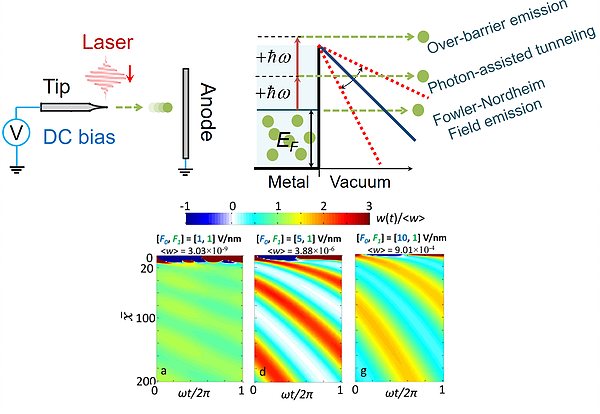
Time-dependent current for laser induced electron emission
-
Electrical contacts & nanoscale charge transport: Contact resistance is the resistance to current flow, due to surface conditions and other causes (e.g. current flow constriction), when contacts (usually of dissimilar materials) are touching one another in a device. Contact resistance is one of the major limiting factors to devices made of exceptional materials, such as carbon nanotubes (CNTs), graphene, diamond, as well as emerging two-dimensional semiconductors such as atomically thin black phosphorus. We have been exploring the scalings of contact resistance and of nanoscale charge transport across interfaces, aiming to optimizing charge transport in various devices.
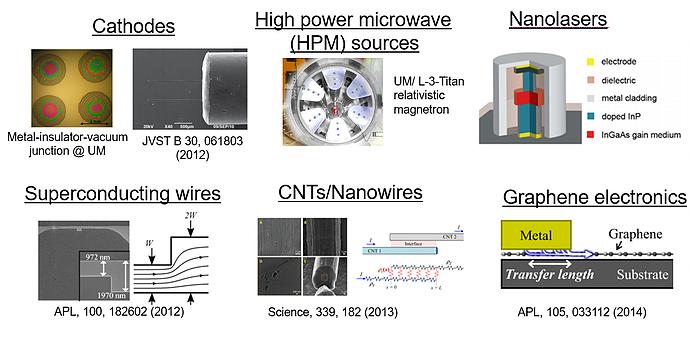
Electrical contacts in various devices
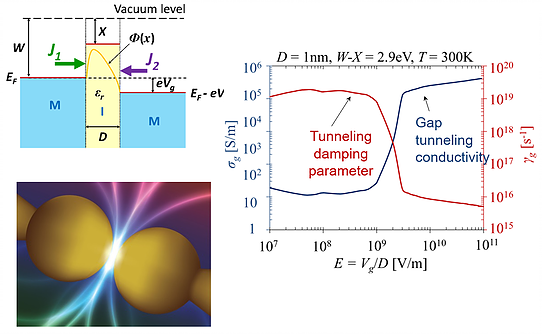
Electron tunneling in nanoscale MIM junctions
-
Electron beam interaction with novel structures: When electrons propagate close to the surface of metallic periodic grating, electromagnetic radiation can be emitted by the so called Smith-Purcell (SP) effect. SP effect is one particularly promising choice for developing compact Near-infrared - THz - millimeter radiation sources, which have significant potential applications in high-resolution imaging, noninvasive sensing, high-data rate communications and material analysis. We have been developing various strategies to enhance coherent SP radiation, which is important to the development of high brightness compact light sources.
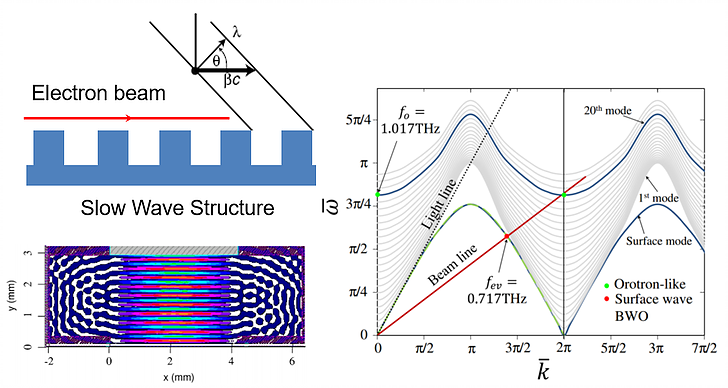
THz coherent radiation from SP effect

Novel Plasma and Vacuum Electronic Devices