

|
The Future of the American Garage: Sustainability and Adaptive Reuse Students: Cynthia Liao, Tasnima Naoshin Mentors: Eva Kassens-Noor, George Berghorn, Linda Nubani, Mark Wilson Abstract: As an emerging technology, autonomous vehicles will have transformative impacts on our society. This study assumes a post-AV transition scenario where personal vehicles are fully autonomous and on-demand functioning as a mass mobility system, such that individuals do not need to own a car. Currently, the American suburban landscape is dominated by single- family homes with attached garages. Under the assumed scenario, the typical garage in these homes will become obsolete, creating a prime market for adaptive reuse of the space. In this study, we look at accessory dwelling units (ADUs) as a potential conversion option and examine the impacts of ADU planning, construction, and usage. We approach our analysis from the perspective of environmental, social, and economic sustainability. Addressing the environmental aspect, we consider local and national sustainability standards for exterior and interior construction materials, focusing on supply chain and chemical emissions, and evaluate energy consumption and regulations. Addressing the social and economic aspects, we consider the implications of ADU construction on phenomena such as urban sprawl, affordable housing, and business opportunities. To explore location-based impacts, we also conduct a paired-comparison analysis using the attached garage space of two single-family houses, one located in suburban Atlanta, Georgia and the other located in the suburbs of the San Francisco Bay Area, California. These locations were chosen to encompass the various types of suburbs in the US and the socioeconomic pressures present in each region. The results of our analysis can then be generalized to suburban areas with similar characteristics. 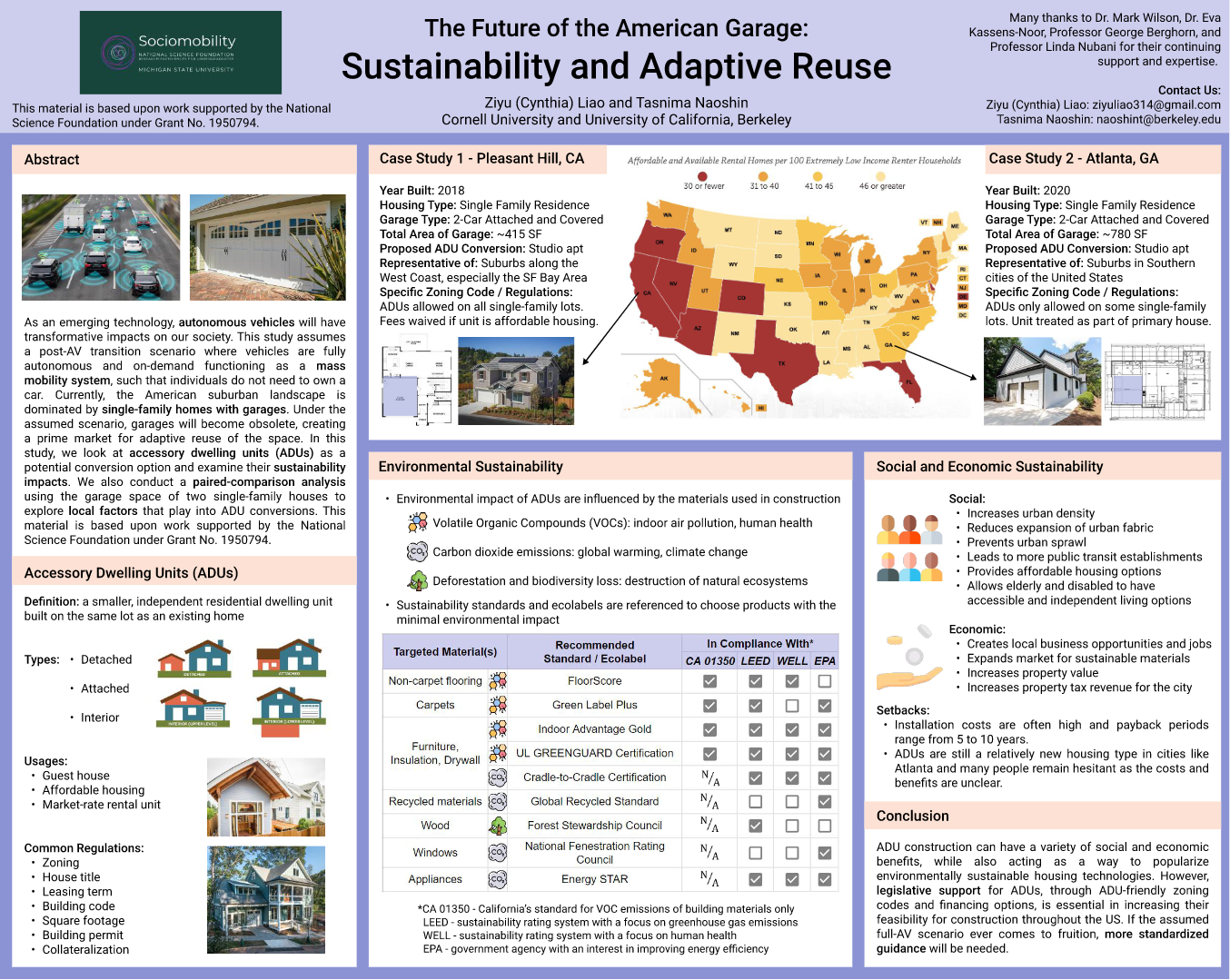  |
|
User-Centered Needs Assessment of First-Mile Last-Mile for Aging Populations Students: Chizaram Ugboh, Jessica Ullom-Minnich, Laura Nagle, Michael Hernandez Lamberty Mentors: Chu-Hsiang Chang, Elizabeth Mays, Elizabeth Pollack, Justin Scott, Michele Grimm, Tamara Bush Abstract: Emerging technology has brought the deployment of autonomous vehicles (AVs) closer to reality than ever before. AVs could be integrated into a First-Mile Last-Mile (FMLM) transportation system as the link between public transit and the start or end of a trip. In an empathetic design process, it is important to identify diverse populations' user needs as design criteria. Aging populations may benefit the most from AVs in a FMLM system due to AV's increased safety features and lower reliance on user driving skills. This project evaluates the needs of aging populations regarding FMLM challenges and AVs. This research investigates the user needs of two target populations in a FMLM system. Those in the current elderly group (66+) already experience the mobility challenges of age. The future-elderly group (56-65) make up those likely to need the system by the time fully-autonomous vehicles are available, but who do not currently experience mobility challenges. We have developed an initial user needs list based on existing literature. We will improve these user needs by performing 30 minute, telephone or zoom interviews with members of the general population and the two target populations. The interview data will be transcribed and examined through qualitative analysis methods, and we will use interview data to update and finalize the user needs of each target population. These results aim to compile a comprehensive user needs list of an AV that can address the challenges of those who currently may have and those who will eventually have FMLM challenges. 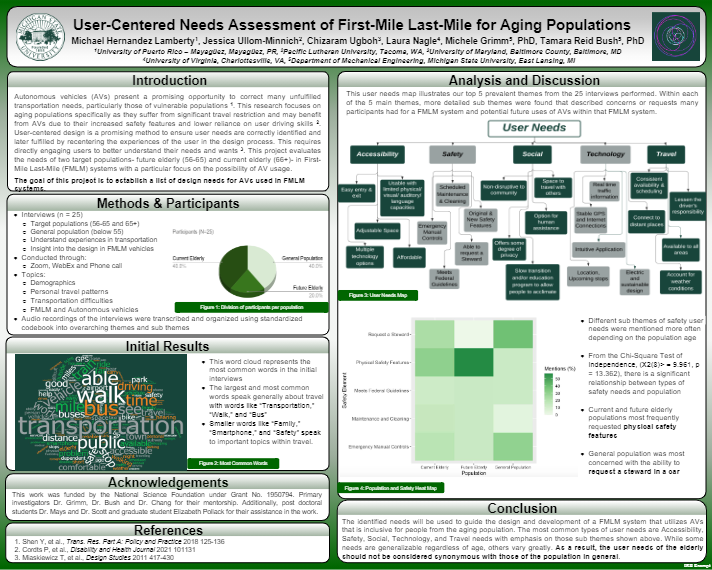  |
|
Evaluating the Environmental Impact of Electric Autonomous Vehicles through an Analysis of Travel Patterns Students: Adeline Hauck, Cassie Starr, Natalie Kelly Mentors: Annick Anctil, Mehrnaz Ghamami, Sharlissa Moore Abstract: The introduction of autonomous vehicles (AVs) will affect driver transportation patterns and Vehicle Miles Traveled (VMT). An anticipated rise in AV travel demand, thereby increasing VMT, will reduce vehicle lifetime and increase energy consumption and greenhouse gas (GHG) emissions. Given the potential for AV usage in the future and its undetermined environmental effects, this research aims to identify adoption and use factors contributing to society level VMT and the resulting implications for a life cycle assessment (LCA) of autonomous vehicles. Previous environmental assessments have not considered changes in travel patterns or effects of human behavior in analyzing the environmental impact of AV introduction. This research relies on (1) an initial survey gathering participants' current travel behavior and willingness to adopt AVs, followed by (2) the utilization of a traffic simulation 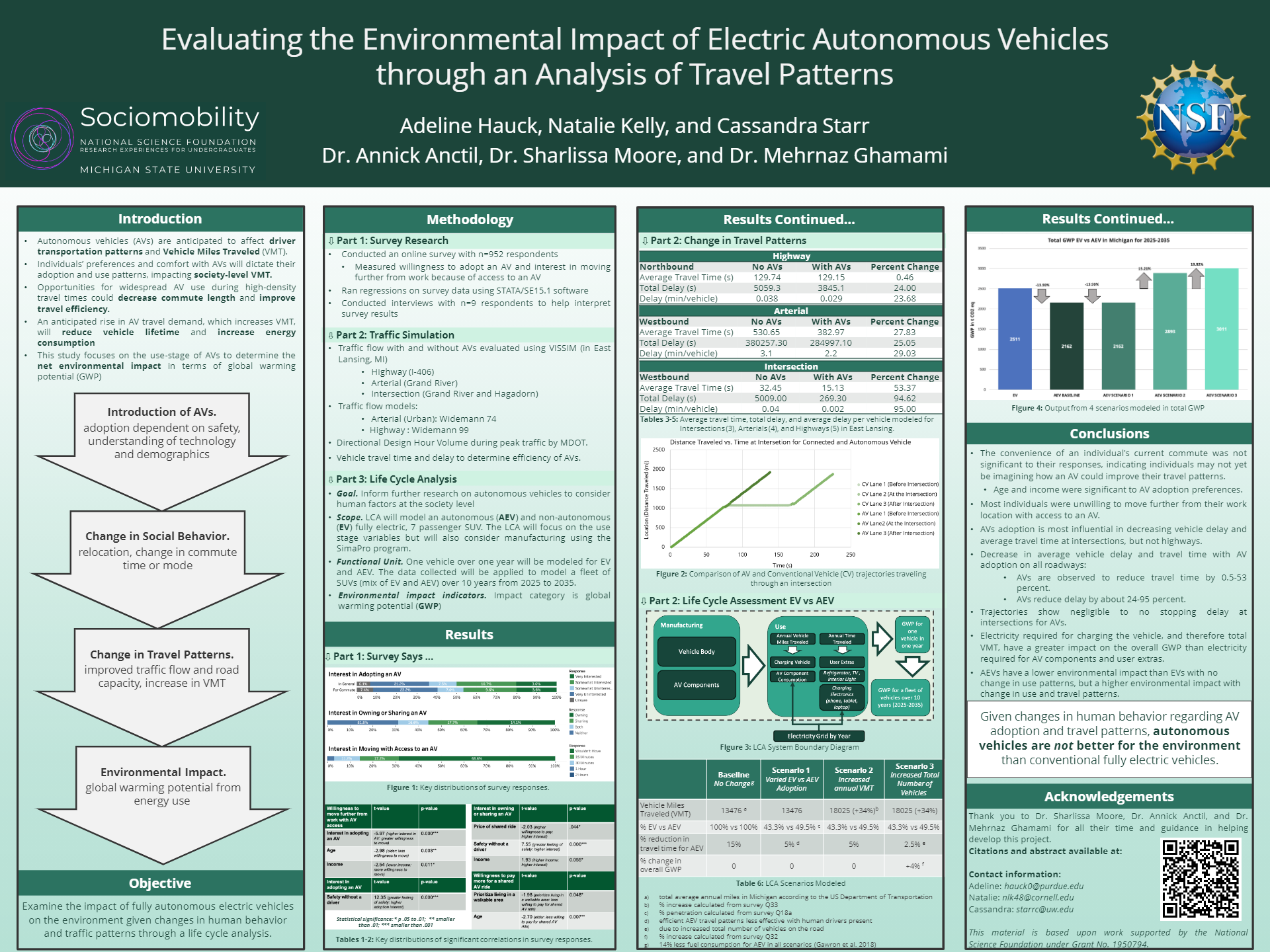  |
|
The Future of Crash Prevention: Assessing the Potential of Automated Emergency Braking in Passenger Vehicles Students: Katelyn Rousch, Nrushad Joshi, Cleveland Yancovitz Mentors: Eva Kassens-Noor, Peter Savolainen, Josh Siegel Abstract: In 2019, the United States experienced 6,756,000 crashes, resulting in 2,740,000 injuries and 36,096 deaths. Research suggests around 94% of crashes are caused by human behaviors such as recognition errors, decision errors, and overcompensation. In recent years, vehicle manufacturers have made improvements in advanced driver assistance systems (ADAS) such as the automatic emergency brake (AEB), which demonstrates promise for mitigating crashes by providing a superhuman reaction time to slow or stopped objects ahead of the vehicle. However, there are currently no models bridging these experimental data with naturalistic, real-world data. This study cross-examines experimental AEB test data, naturalistic driving data, and self-reported survey data to gain a clearer picture of how ADAS technology may mitigate crashes. Current test data shows that AEB is 75.2% effective at preventing crashes in controlled conditions. Naturalistic driving data used in this study shows that around 70.9% of crashes occur within the ideal weather and lighting conditions. Of these crashes, around 54% of these are rear-end striking, meaning that the vehicle operator was unable to decelerate in time to avoid hitting the vehicle in front of them. These statistics provide context as to the potential crash savings that could be realized by AEB systems. However, survey data indicates a potential disconnect as 20.6% of respondents were very comfortable and 37.6% who are somewhat comfortable with AEB technology. Collectively, these numbers will be used to simulate a long-term projection on the number crashes AEB could prevent. 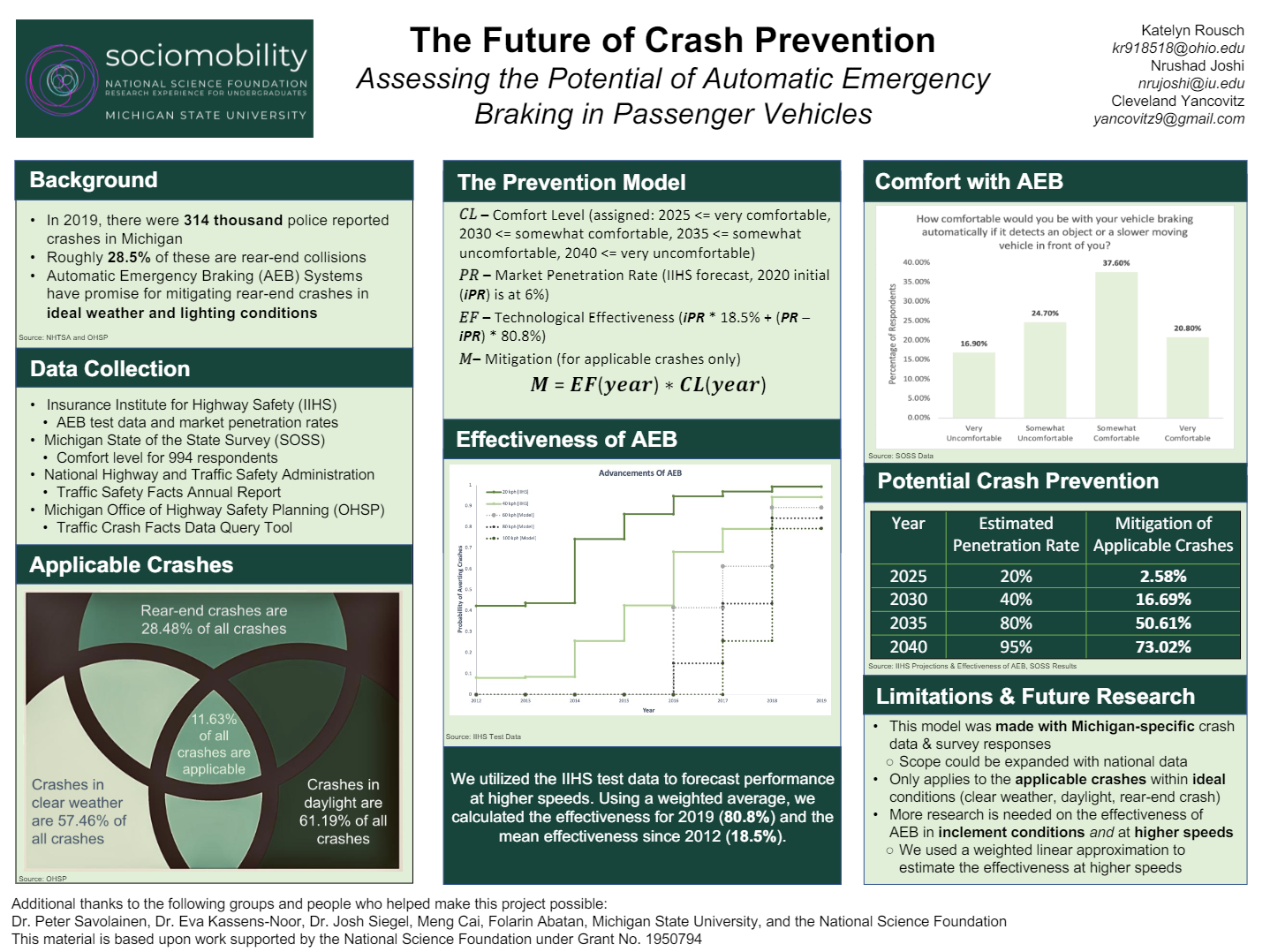  |
This material is based upon work supported by the National Science Foundation under Grant Number 1950794. Any opinions, findings, and conclusions or recommendations expressed in this material are those of the author(s) and do not necessarily reflect the views of the National Science Foundation.

