Loading...
Surgical Site Infections (SSI) occur at the location where the surgery was performed and can be a result of unsanitary surgical settings and practices. These infections can lead to extended hospitalization, treatment, and even death. In a study conducted by the Center for Disease Control (CDC) in the United States from 2006-2008, there were over 16,000 surgical site infections which equated to an overall rate of 1.9% of all operative procedures. However, the prevalence of these infections drastically increases when compared with underdeveloped countries. Surgical operations in these countries are often conducted in unhygienic settings which are conducive to the growth of bacteria and disease. Without a sterile surgical environment, the patient is put at higher risk of infection which could lead to a significantly longer recovery time or death.
The goal of this project is to develop a surgical tool which would be continuously suffused with an anti-microbial solution, administered through a series of micro-channels . The solution will diffuse throughout the tool effectively creating a coating across the surface. This will prevent the growth of bacteria on the tool itself, which comes in direct contact with the patient. This is critical to the safety of the patient and will greatly minimize the chances of infection to occur. The tool is to be suffused with the solution for the duration of the surgery. This means that even while the tool is not in use, the surface will still be disinfected despite any bacteria present in the surgical environment. The tool developed will be of great assistance to surgeons performing in unsanitary environments.
An air compressor powered by a battery will inflate a pressure infusion bag encasing an IV bag containing the antimicrobial. The increase in pressure will cause the flow-rate to increase. The antimicrobial will then be transported to the surgical tool through tubing and flow through micro-channels to deliver the desired fluid to the surface of the tool. The system will be controlled by a phone application which will communicate to the microcontroller via Bluetooth connection. The microcontrolelr will receive feedback from a pressure sensor and use these values to maintain the proper pressure for complete suffusion.
The design of the self-suffusing tool is composed of four main parts. A power supply section, the feedback sensor, the pressure infusion bag, and the tool itself. Each section plays an integral role in the success of the tool and is described below.
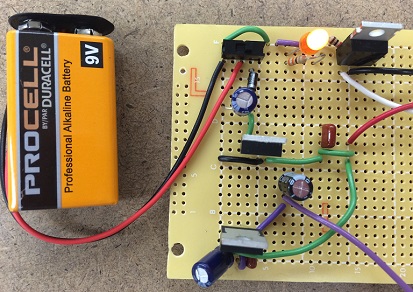
The design implements two power regulators, the LM2940 and LM3940. The LM2940 converts the 9 volt battery voltage to provide a five volt output while the LM3940 creates a 3.3 volt output from a 5 volt input. The 3.3 volt regulator provides the power to the microcontroller and the pressure sensor. Due to the size of current microcontrollers, the power requirements have dropped from the traditional 5 volts to a lower 3.3 volts to prevent damage to the components. While this decrease in size is welcomed, careful consideration must be taken to ensure the 3.3 volt components are not fed any higher voltage than what they require. The 5 volt regulator provides the motor with the power it requires to provide the pressure bag with sufficient air pressure for operation.
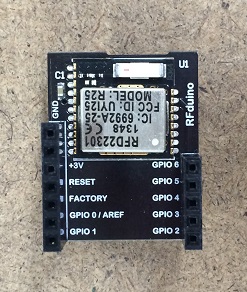
The RFD22102 RFDuino Dip is a low energy BLE RF module with built-in ARM Cortex M0 Microcontroller for rapid development and prototyping projects. It is a very small board, about the size of a fingertip, and is completely compatible with the Arduino interface.The RFduino can be programmed using the Arduino IDE This microcontroller was chosen specifically for its low energy usage and its Bluetooth capabilities. It is also small in size and will allow for a compact system.
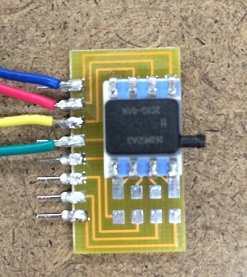
The Honeywell Board-Mount Sensor SMT is a digital pressure sensor that is utilized in the system to monitor the pressure of of the fluid entering the tool. An integral part to the system, the sensor feeds back to the microcontroller, allowing the system to adjust the pressure to the desired quantity.
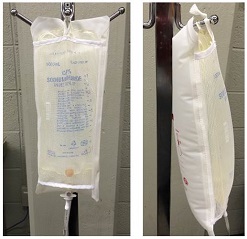
The design calls for a way to control the flow rate of the antimicrobial into the tool. To do this a pressure infusion bag was implemented. The pressure infusion bag encases the bag of antimicrobials, increasing the pressure of the fluid when inflated. This increase in pressure causes the flow rate of the fluid into the tool to increase as well. Therefore the flow rate can be controlled by the inflation and deflation of the pressure bag. The pressure bag is inflated by an air compressor. Both parts are extremely in-expensive, keeping the cost of the system low.
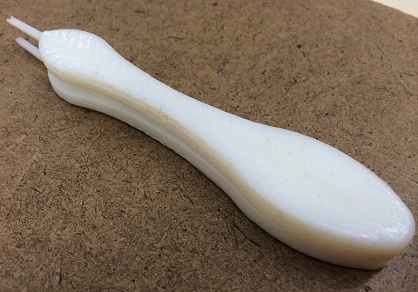
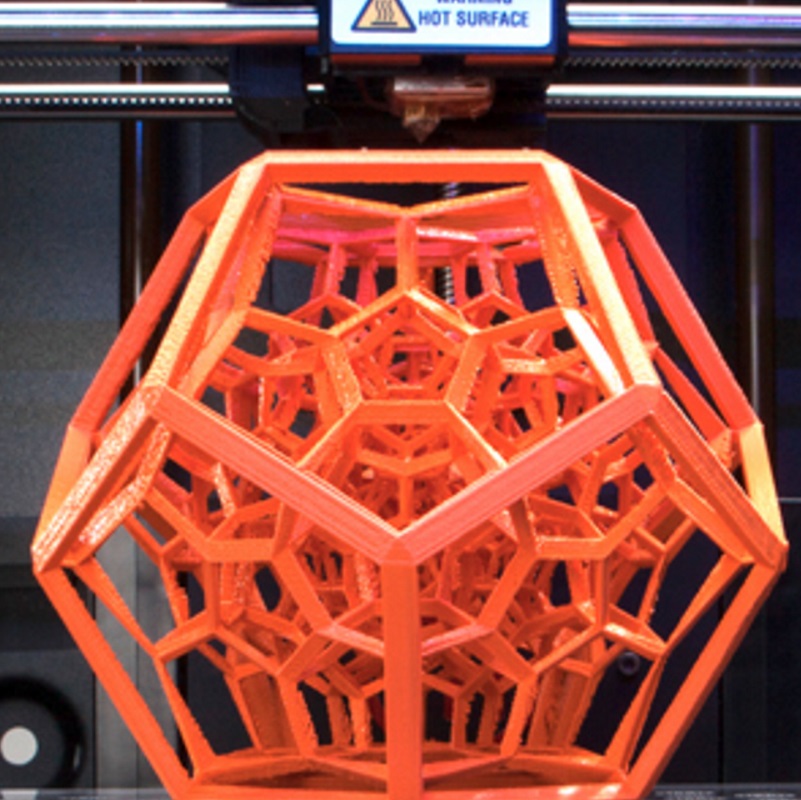
The surgical tool created was the Adson thumb forceps, which are capable of continuously suffusing antimicrobials, increasing the cleanliness of the surface of the tool. This will be implemented through creating microchannels within the tool to transport the antimicrobial. Once the device is designed, it can be created through the use of an advanced 3D printer. The construction of the tool was achieved with the 2013 version of SolidWorks. After obtaining an authentic pair of Adson thumb forceps, the dimensions were copied and modified to be able to insert a microchannel system within the tool.
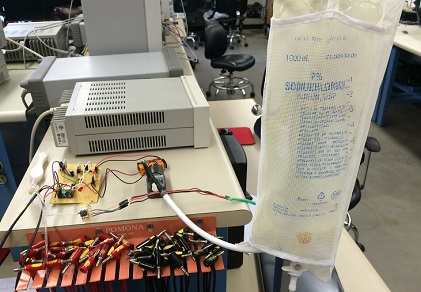

Design Team 1 successfully created self-suffusing Adson Thumb Forceps. The system utilizes a series of microchannels to deliver the antimicrobial to the surface of the tool. It can be controlled via a smartphone application communicating through Bluetooth with the system. It receives feedback provided by the pressure sensor to ensure the correct amount of fluid is being delivered to the tool.
Design Team 1 is a professional design group full of bright, young minds. Composed of five members, Design Team 1 strives to revolutionize the field this life-changing project.

Adam is from Grand Rapids, Michigan. He is graduating with a degree in Electrical Engineering in May 2015. He is pending approval for a position as a Nuclear Propulsion Engineer for the United States Navy.

Jose, from Sturgis, Michigan is expected to graduate with a Bachelor's of Science in Electrical Engineering in December of 2015. Jose will be returning to Bosch for an internship and is looking forward to getting more experience in the field.
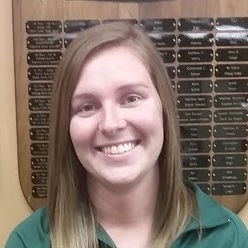
Kasey is from Carleton, Michigan and will be graduating with a Bachelor's of Science in Electrical Engineering in May 2015. She is very excited to have accepted a position with Eaton as a Power Systems Engineer at their New Jersey location.
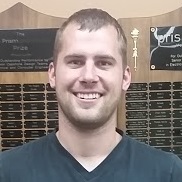
Parker is from Bridgman, Michigan. He is graduating with a degree in Electrical Engineering in May 2015. He is currently exploring career options and is extremely excited to apply his strengths in the future.
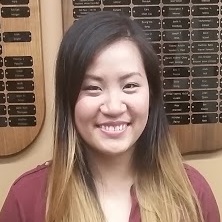
Originally from Holt, Michigan, Stephanie plans on graduating with a Bachelor's of Science in Electrical Engineering in May 2015. She has accepted a position with Jackson National Life Insurance as a Software Developer I and looks forward to starting her new position upon completion of her degree.
The technical documents of the project are all listed below. From the Proposal to the Final Report, read about the project from the very beginning.
Design Team 1 would like to extend their gratitude to all those who helped them succeed this semester.
Thank you to Dr. Udpa for all his knowledge and leadership. We truly appreciate all the time spent meeting with the group to discuss specifications, various design ideas and progression of the project.
Thank you Dr. Wen Li for her guidance and advice. Your positive attitude translated to the group members allowing us to successfully collaborate and remain focused as a team.
Thank you to Dr. Timothy Grotjohn and Dr. Lalita Udpa for their instruction and mentorship throughout the semester. We really enjoyed our time participating in the course.
Thank you to all the guest speakers for their intelligence and direction. The knowledge shared will help us navigate through life and be utilized throughout our careers.
Thank you to Dr. Helene Pazak and the staff at the MSU College of Veterinary Medicine. Your assistance and feedback proved a valuable tool and allowed the team to create a low cost self-suffusing surgical tool system.
Thank you to Roxanne Peacock and the MSU ECE shop for your continued assistance throughout the semester. We would not have been able to accomplish our goal with out your help.